
March 29, 2026 by Ingrid Fadelli, Phys.org
Collected at: https://phys.org/news/2026-03-universal-scheme-quantum-state.html
Quantum technologies, devices that can process, store, or detect information leveraging quantum mechanical effects, could outperform classical devices in some tasks or scenarios. Despite their potential, verifying that these devices work correctly and truly realize desired quantum states can be challenging, particularly when they cannot be fully examined or inspected.
One approach to verify quantum states or measurements is known as self-testing. This is a technique that allows quantum scientists to confirm the properties of a quantum system solely by analyzing its outputs, instead of examining how it operates internally.
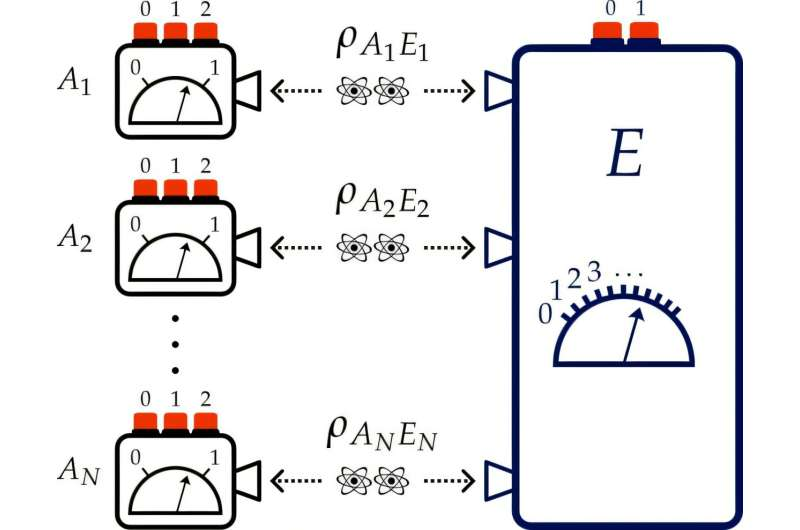
Researchers at Université libre de Bruxelles (ULB), the University of Gdansk, and the Polish Academy of Sciences recently introduced a new universal scheme that could be used to self-test any quantum state or measurement. Their protocol, introduced in a paper published in Nature Physics, works by placing a device within a simple star-shaped quantum network and assessing the correlations between measurements obtained from different outputs that share entangled quantum states, to determine whether they are aligned with theoretical predictions.
“Suppose that, in the future, we have built a quantum computer,” said Dr. Shubhayan Sarkar, a postdoc at the University of Gdansk. “Just like supercomputers today, they will only be remotely accessible to everyone. How would you know that the results provided by that computer are genuinely quantum in the sense that quantum phenomena were used to produce them?”
Credit: Nature Physics (2026). DOI: 10.1038/s41567-026-03181-y
A further goal within the field of quantum engineering is to determine whether a quantum computer or another quantum device solves a task correctly. One way to check this would be to ask this device specific questions and then ensure that its underlying hardware is exploiting quantum particles based on the system’s answers.
“Such a type of certification, where minimal physical assumptions are made about quantum devices, is known as device-independent certification,” said Dr. Sarkar. “Since any quantum device is based on quantum states, measurements, and operations, certifying a device requires certifying these elements in a device-independent way. It’s worth mentioning that any device-independent certification is based on quantum nonlocality, whose experimental tests were awarded a Nobel Prize in 2022.”
A new tool to test quantum devices
A few years ago, when Dr. Sarkar was completing his Ph.D. at the Centre for Theoretical Physics at the Polish Academy of Sciences, he had already started studying self-testing quantum verification schemes. His doctoral thesis focused on the identification of suitable schemes to verify specific quantum states or measurements.
“It was always an interesting problem to me whether every quantum state can be certified in this way or not,” said Dr. Sarkar. “Indirectly, this would allow making any quantum protocol device-independent, thus making them more secure and based on minimal assumptions of the underlying setup. At the time of me joining my Ph.D., the problem with any bipartite state was already resolved. However, beyond this case, little was known. The problem seems to be unsolvable using the previously known ways in the standard scenarios.”
After completing his Ph.D., Dr. Sarkar started exploring quantum networks in which multiple independent sources are involved, in collaboration with Prof. Remigiusz Augusiak. The two researchers soon discovered that it is possible to certify various composite measurements in these networks. This realization paved the way for the development of their scheme.
“Consider a large network like a star, with a single node inside and all the other external nodes connected to it, like a server connected to various other systems,” Prof. Augusiak, assistant director at the Centre for Theoretical Physics at the Polish Academy of Sciences.
“The server can perform joint operations on the signals received from all links while external systems act only on their own links. Using a family of Bell inequalities, we first certify the external systems and their links to the server. This, along with some additional conditions, allows one to certify the server’s joint operation. But, of course, both phases are done together in a single experiment.”
Contributing to the advancement of quantum technologies
The primary advantage of the team’s protocol is its generality. Notably, the star-shaped network it relies on was already experimentally implemented with a limited number of external systems, which validates the feasibility of the scheme, at least for small-scale networks. In the future, the scheme could also be tested on larger networks that include a greater number of entangled systems.
“We resolved a fundamental problem in quantum theory by proving that for every quantum state and measurement, there exists a unique set of correlations that allow us to identify it device-independently, that is, without placing any trust in the devices used,” said Prof. Augusiak.
“From an application perspective, we provided a way to certify any quantum preparation device as well as a measurement device, which will be useful to certify any quantum device. At the same time, we solve an open problem as to whether a mixed state can be certified device-independently, which is not possible in the standard Bell scenario.”
In the future, the approach proposed by Dr. Sarkar, Prof. Augusiak and their colleagues could be used to convert any quantum information protocol into an equivalent device-independent scheme, in which observers would no longer need to trust devices to validate quantum states. These device-independent schemes could help to boost the reliability and security of quantum technologies, allowing users to verify that devices behave in accordance with quantum mechanical laws without having to trust their underlying hardware or internal design.
“The current scheme is of a proof-of-principle type and still requires a lot of research to make it optimal and usable for practical purposes,” added Dr. Sarkar. “So, the first aim would be to make it more practical, for instance, by lowering the number of Bell tests to be made as well as by improving its robustness to noise and imperfections. On the other hand, adapting quantum information protocols to the star network will also be appealing, as this would readily make them device-independent using our result.”
Publication details
Shubhayan Sarkar et al, A universal scheme to self-test any quantum state or measurement, Nature Physics (2026). DOI: 10.1038/s41567-026-03181-y.
Journal information: Nature Physics
Leave a Reply