
By University of Pittsburgh March 26, 2026
Collected at: https://scitechdaily.com/new-discovery-challenges-80-year-old-theory-about-turbulence/
Turbulent flows, long thought to follow fixed rules of energy transfer, may be more flexible than previously believed.
Anyone who has watched waves crash along a shoreline has seen turbulence in action. Beneath the surface, water rarely moves in a straight line. Instead, it twists into spinning structures called eddies that form, break apart, and cascade into smaller swirls until their energy fades. This process gives turbulent flows their chaotic appearance, but it has long been thought to follow strict physical rules.
That assumption is now being questioned.
Researchers at the University of Pittsburgh, working with collaborators in Italy, have found that the direction of energy flow in turbulence is not always fixed. Under certain conditions, it can be altered, opening the door to actively controlling how fluids mix and move. Their study, published in Science Advances, introduces a new way to think about one of physics’ most studied phenomena.
Challenging a long-held assumption
“Since 1941, with Andrey Kolmogorov’s research, energy flux has been predicted. In 3D flows like in bodies of water, energy moves from larger to smaller scales. For 2D flows, which occur in thin layers of water, that flux is reversed, from smaller to larger,” said Fang, assistant professor in the Department of Civil and Environmental Engineering at Pitt’s Swanson School of Engineering.
“To understand this abstract concept at different scales,” Fang added, “I recast the energy flux process into a mechanical process based on Navier-Stokes equations. And since this is a mechanical process, I could try to reverse it by changing the geometry between displacement and force.”
To explore this idea, Fang built a mathematical framework based on tensors, which describe how forces and motion interact in a system. His analysis showed that the alignment of these tensors determines how energy moves. By changing that alignment, it becomes possible to redirect the flow of energy.
“We showed that we could produce turbulent flows that either exhibit forward or inverse energy flux,” Fang said. “Our framework extends to the 3D scale as well.”
From Theory to Experiment
Earlier work by Fang demonstrated how microscopic swimmers can influence strong ocean currents. In this study, he focused on how background flows interact with external forces, including groups of tiny swimmers. When these forces are properly arranged, they can shift how energy moves through the system.
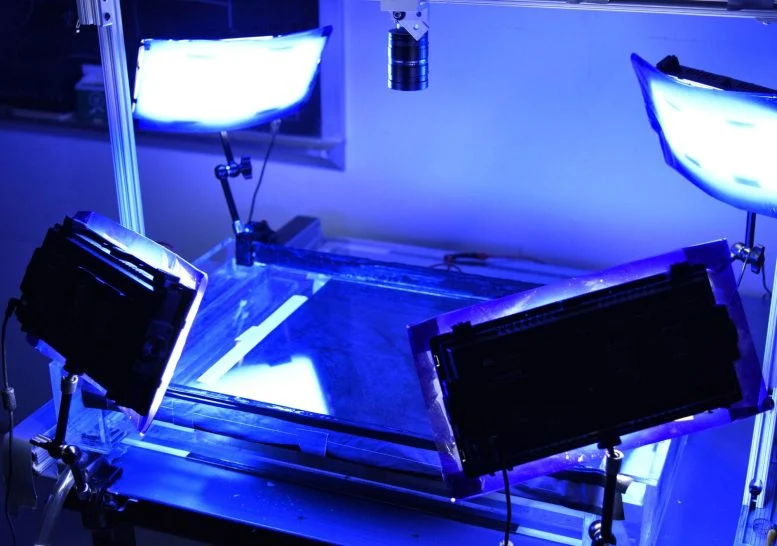
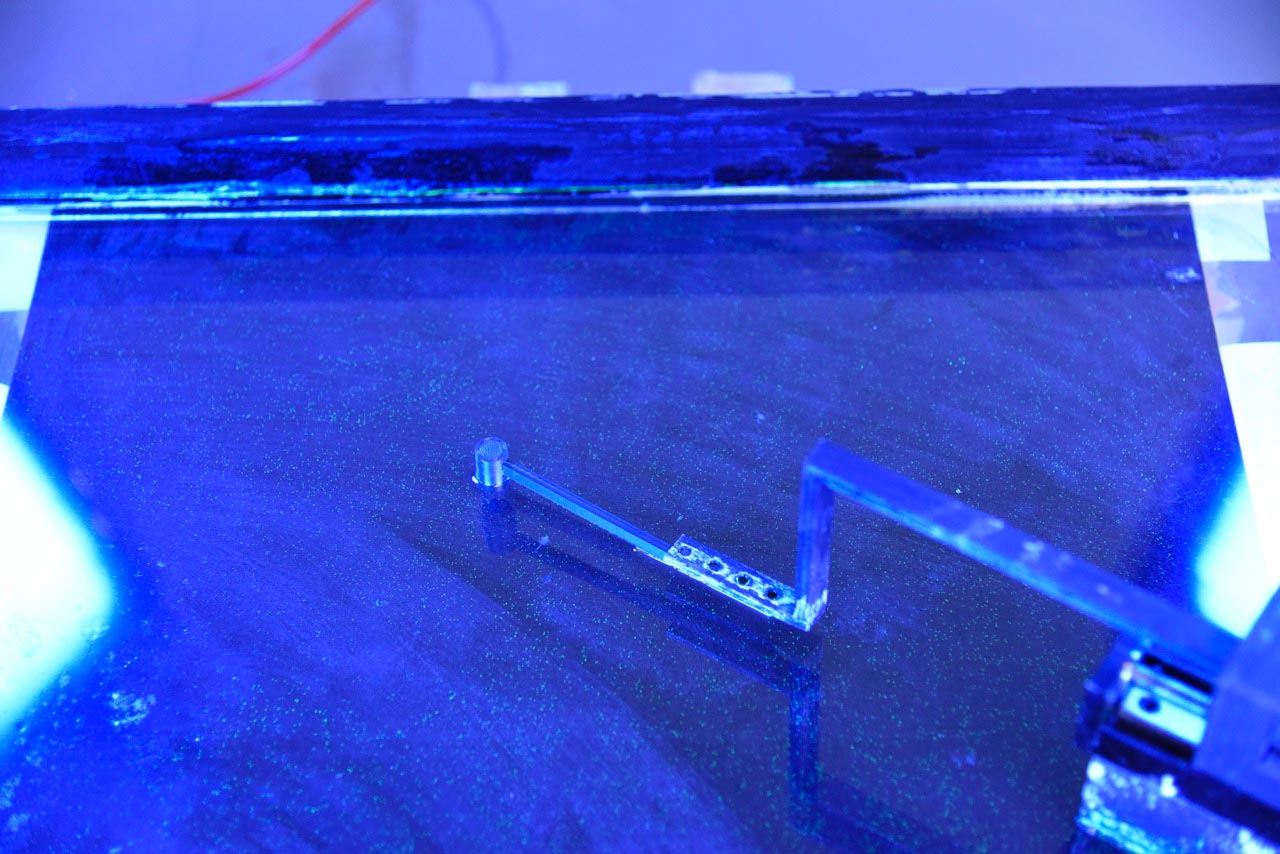
To test their model, Fang and Si used a thin-layer, electromagnetically driven setup. In a shallow tank, they applied a horizontal magnetic field to create a two-dimensional flow. A rod array was introduced to disturb the flow, and tracer particles in a thin electrolyte layer made the motion visible.
These experiments confirmed that adjusting the system’s geometry can change the direction of energy transfer.
Harnessing energy flux
“Through this theoretical framework, we found that we can use small physical boundaries up to ten meters (about 33 feet) to perturb ocean transport barriers that spans kilometers,” said Fang. “It is possible to change the direction of the energy flux, which can improve how wastewater or other contaminants along a coastline are dispersed.”
The approach could also be useful in medicine. “In microfluidic flows of less than one millimeter (about 0.04 inches), where the viscosity of a liquid makes mixing difficult because there is little to no turbulence,” added Fang, “we could align the forces and displacement to generate weak ‘low Reynolds number turbulence,’ which could speed up mixing of agents.”
Beyond these applications, the findings may help improve climate models by offering a better understanding of how energy moves through oceans and the atmosphere.
“While it’s hypothetical at this point, the research could improve climate modeling,” said Fang. “As climate change alters wind patterns and ocean flows, wind stress and currents could change the direction of energy flux. Understanding the forces that create this change can lead to more accurate models.”
Reference: “Manipulating the direction of turbulent energy flux via tensor geometry in a two-dimensional flow” by Xinyu Si, Filippo De Lillo, Guido Boffetta and Lei Fang, 25 July 2025, Science Advances.
DOI: 10.1126/sciadv.adv0956
Funding: US National Science Foundation
Leave a Reply