
March 26, 2026 by Sejong University
Collected at: https://techxplore.com/news/2026-03-artificial-pain-closer-memristor-links.html
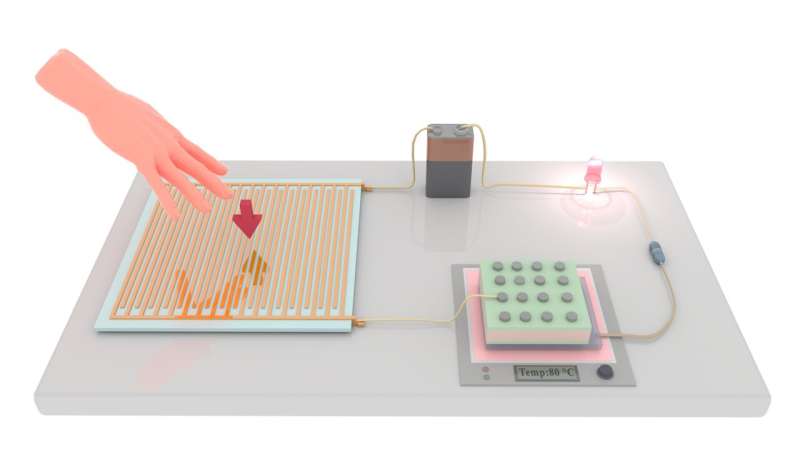
An international research team has reported an artificial nociceptor system that captures the temperature-dependent threshold modulation of biological nociceptors. Published in Advanced Functional Materials under the title “Temperature-Modulated Threshold Response in a Volatile Memristor: Toward a Biomimetic Polymodal Nociceptive System,” the study was led by Professor Hee-Dong Kim of Sejong University and conducted jointly by researchers in Sejong University and at the University of Tokyo, Japan.
Expanding the paradigm of artificial nociceptive systems
Achieving a complete hardware-level emulation of a biological mechanism remains an ideal goal in the field of biomimetics. In particular, areas that require immediate response to external environments, such as pain perception systems, demand careful design in terms of both operational stability and sensing modal spectrum. Conventional artificial nociceptors have been limited in the range of stimuli they can accommodate, which constrains their applicability in real-world settings.
To overcome these limitations, the research team introduced a memristor device in which temperature dependence is coupled with resistive switching, thereby capturing the interactions among different stimuli modalities.
Core innovation: Temperature-dependent threshold modulation
In biological nociceptors, the threshold for responding to mechanical stimuli shifts with temperature. For instance, under inflammatory conditions or in the presence of heat, the same mechanical stimulus can trigger a stronger response.
The researchers showed that the quantified temperature dependence of the memristor can capture this threshold variability of biological nociceptors within a single device, allowing more integrated and lifelike stimulus-response behavior.
With only a minimal circuit configuration, the team successfully demonstrated key nociceptive mechanisms at the system level, including threshold-triggered responses, recovery, and hyperalgesia, together with temperature-dependent threshold modulation.
A foundation for future technologies
The findings could provide a technological foundation for a broad range of future applications, including electronic skin capable of autonomously detecting danger, intelligent humanoid robots, and wearable devices. Professor Hee-Dong Kim said, “Building on this work, we hope to bridge the gap between biological theory and practical biomimetic implementation across a variety of fields, paving the way for technologies with real-world applications.”
Publication details
Chanmin Hwang et al, Temperature‐Modulated Threshold Response in a Volatile Memristor: Toward a Biomimetic Polymodal Nociceptive System, Advanced Functional Materials (2026). DOI: 10.1002/adfm.202528652
Journal information: Advanced Functional Materials
Leave a Reply