
March 26, 2026 by Krystal Kasal, Phys.org
Collected at: https://phys.org/news/2026-03-earth-magnetic-field-previously-undetected.html
High-energy particles called galactic cosmic rays (GCRs) bombard unprotected objects in space, often causing damage. Earth, however, is protected by its magnetic field, which creates a protective shell around the planet that can deflect dangerous charged particles, like GCRs.
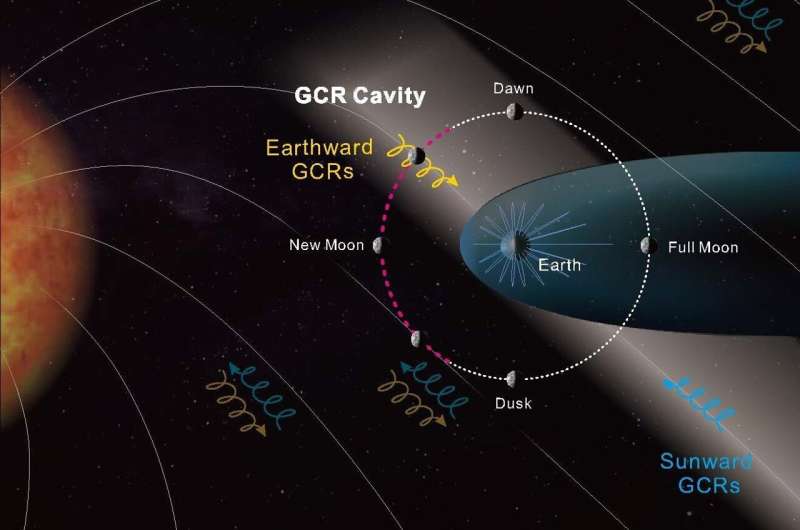
The moon is known to pass through the tail-like part of Earth’s magnetosphere, but a new study, published in Science Advances, suggests the moon might experience additional protection at another point in its orbit. Although this pocket of protection exists when the moon is outside of the magnetosphere, researchers believe the effects are still due to Earth’s magnetic field.
An anomalous dip in particle counts
When the research team analyzed data taken from the Lunar Lander Neutron and Dosimetry (LND), onboard China’s Chang’E-4 lander, they were surprised to find that the LND experienced a 20% dip in GCR particles hitting detectors while the lander was on the moon’s far side. This occurred at a specific time during the lunar “morning” and only for about 2 days each lunar cycle. Since the LND took data over 31 cycles, the team could see that this was not just a one-off occurrence. This was unexpected because it was previously assumed that GCRs are evenly distributed in the space between Earth and the moon, outside Earth’s magnetosphere.
GCRs consist of different types of charged particles with varying energies. Most (about 85%) are protons, while about 12% are helium atoms, and only around 1% are heavier nuclei. The data showed that the reduction in particle count was most pronounced for lower-energy protons. Higher energy particle counts were also reduced, but to a lesser degree.
Unexpected protection
Magnetic fields don’t simply stop existing at a certain point. Instead, their influence just decreases more and more with distance away from the source. The magnetosphere is the region where Earth’s magnetic field prevails over the solar wind magnetic field. So, although the moon was outside of Earth’s magnetosphere during these points of lower particle counts, its magnetic field was still exerting some degree of magnetic force—enough to influence the GCR particles.
The team says that the particles were deflected due to the gyroradii of the particles, which is the radius of the circular motion they follow in the presence of a uniform magnetic field. This is also dependent on the mass of the particle, its velocity, and its charge.
“The size of Earth’s magnetosphere on the dayside extends about 6 to 10 Earth radii, which is comparable to the gyroradii of lower-energy protons. Therefore, the lower-energy particles are easily affected by Earth’s magnetic field because of their smaller gyroradii compared to the higher-energy particles,” the study authors write.
To further validate these findings, the team conducted particle simulations to model the effect of Earth’s magnetic field on GCR propagation. These simulations, along with previous additional spacecraft data confirmed the observed reduction in GCRs at these locations.
Safer lunar missions
Although the full spatial extent of the cavity is not precisely determined yet, the team believes these findings are valuable for future space missions. Knowing where areas of reduced radiation are can help to keep astronauts and equipment safer on future missions, since GCR particles are seriously detrimental to human health and can damage equipment.
“This finding provides a potential strategy for mission planning, especially for manned lunar missions and extravehicular activities, as operations could be timed to coincide with these lower radiation periods to reduce exposure risk. Future studies with extended datasets could further clarify the spatial extent and behavior of this cavity, offering deeper insights into potential radiation protection strategies, not only for the Earth-Moon system but potentially for missions near other magnetized bodies within the solar system,” the study authors write.
Publication details
Wensai Shang et al, A galactic cosmic ray cavity in Earth-Moon space, Science Advances (2026). DOI: 10.1126/sciadv.adv1908
Journal information: Science Advances
Leave a Reply