

March 25, 2026 by Patricia DeLacey, University of Michigan College of Engineering
Collected at: https://techxplore.com/news/2026-03-memristor-fully-analog-hardware-based.html
As AI processing demands reach the limits of current CMOS technology, neuromorphic computing—hardware and software that mimic the human brain’s structure—can help process information faster and more efficiently. A new memristor made from 2D layers of bismuth selenide (Bi2Se3) combines long-term data retention and analog tuning to enhance AI energy efficiency and processing speed.
The University of Michigan Engineering study ispublished in ACS Nano.
The Bi2Se3 memristor demonstrated three technical requirements that no practical memristors had combined up until this point: long-term data retention, analog-style memory states and the ability to operate regulator-free in circuit. In a demonstration, the memristor successfully controlled a balance lever as part of a fully analog, all-hardware reservoir computing network.
“Our work provides a new pathway for making key components for building hardware-based neural networks. The presented memristors can truly work in a way that AI circuit designers will love,” said Xiaogan Liang, a professor of mechanical engineering at U-M and corresponding author of the study.
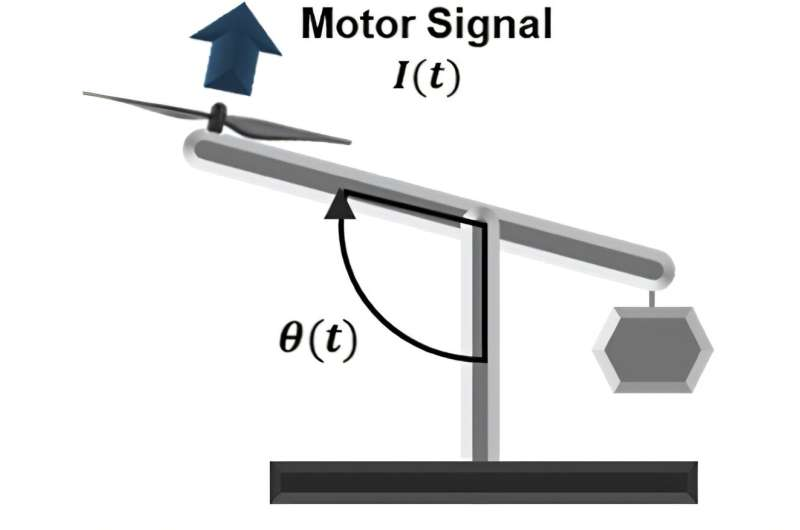
The Bi2Se3 memristor controlled a balance lever in a fully analog, all-hardware reservoir computing network. By bypassing the need for analog-to-digital conversion, the memristor used just 7 microwatts of power while dynamically adjusting propeller speed to maintain a 90-degree angle. Credit: Ki et al., 2026.
Fabricating a scalable memristor crossbar array
Memristors, devices that adjust electrical resistance based on past current or voltage, enable in-memory computing, an essential component of neuromorphic computing. The ability to store and process information in the same device eliminates the bottleneck in conventional computing where data must constantly shuttle between separate memory and processing units.
The memristor properties needed for hardware-based neural networks are typically at odds with one another. The devices with long-term data retention through non-volatile memory require an external current-regulating device to prevent abrupt switching. On the other hand, those with analog-style memory states, meaning continuous tuning rather than binary switching, suffer from poor data retention.
To overcome these challenges, the research team fabricated crossbar arrays of vertically arranged Bi2Se3 memristors on a silicon substrate. Through photolithography, the team first layered 500-nanometer-wide gold (Au) bottom electrodes on top of a 300-nanometer-thick silicon dioxide base. Bi2Se3 flakes made up of a few stacked 2D layers were then grown directly on the gold electrodes through physical vapor deposition. The gold both serves as an electrode and helps control nucleation and grain size of Bi2Se3, ensuring site-specific growth.
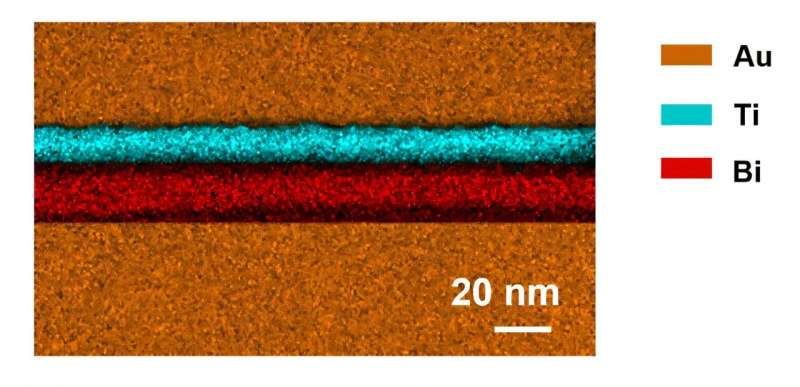
Close examination of the new memristor revealed that gold filaments extend from the bottom electrode into the Bi2Se3 layer and retract without bridging to the top titanium electrode. This enables continuous analog tuning that mimics the way synaptic connections in the human brain strengthen or weaken. Credit: Ki et al., 2026.
To complete the vertical stack, titanium (Ti) and additional gold layers were deposited perpendicular to the bottom electrode to make a lattice with a Au/Bi2Se3/Ti sandwich at the points of intersection.
This gold-assisted vapor deposition process is compatible with existing semiconductor manufacturing approaches, demonstrating scalability.
Gold filaments enable precise analog tuning
When testing device performance, the Bi2Se3 memristors demonstrated strong analog conductance tuning of 10–40%, stable retention with less than 1% loss over 10,000 seconds. The device operated without external current regulators.
An elemental analysis and simulations revealed that tiny finger-like gold filaments extend upwards from the bottom electrode into the Bi2Se3 layer when voltage is applied. These conductive filaments grow and contract without bridging the gap to the top electrode, allowing smooth analog tuning of the device conductance. The lattice structure formed by the crossbar array facilitates in-memory computing by hosting dynamic growth and retraction of gold filaments, which continuously modulates the device resistance.
Fully analog, all-hardware balancing control
To test the device, the researchers incorporated Bi2Se3 memristors into a fully analog all-hardware reservoir computing network that controlled a balance lever. The balance lever resembles a seesaw with a motor and propeller and, at one end, a dangling weight on the other end and a sensor that tells the system if the lever is tilted. The goal is to dynamically control the propeller to achieve a 90-degree angle.
The Bi2Se3 memristors replaced the software that typically serves as the readout layer that determines actionable output. Their memristor succeeded in calculating how much to spin the propeller to achieve a perfect 90 degree angle. The memristor avoided the need for analog-to-digital conversion, achieving ultra low power consumption of about 7 μW, or 7 millionths of a watt. For scale, a household LED light uses about 8 to 12 watts.
If scaled up, this new memristor could enable neuromorphic computing devices, which would significantly improve AI hardware energy efficiency, processing speed and simplicity for circuit design.
Publication details
Seung Jun Ki et al, Analog-Tunable Nonvolatile Regulator-Free Memristors for Neuromorphic Controlling, ACS Nano (2026). DOI: 10.1021/acsnano.5c16447
Journal information: ACS Nano
Leave a Reply