
March 20, 2026 by Ingrid Fadelli, Phys.org
Collected at: https://phys.org/news/2026-03-entanglement-quantum-scheme.html
Over the past decades, quantum scientists have introduced various technologies that operate leveraging quantum mechanical effects, including quantum sensors, computers and memory devices. Most of these technologies leverage entanglement, a quantum phenomenon via which two or more particles become intrinsically linked and share a unified quantum state, irrespective of the distance between them.
Despite their potential, many quantum technologies developed to date are prone to errors when deployed experimentally, as they are highly sensitive to noise due to interactions with their surrounding environment. This significantly limits their reliability and precision, preventing their widespread use.
Researchers at University of Strasbourg and Macquarie University have devised a new quantum sensing scheme that could enable the collection of precise quantum measurements even in the presence of environmental noise.
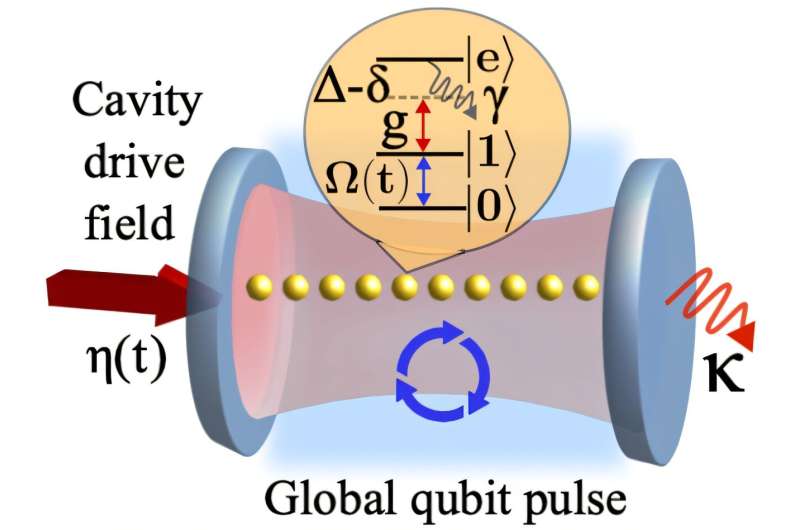
Their proposed protocol, outlined in a paper published in Physical Review Letters, relies on the entanglement of many atoms that behave as spins, which are trapped inside a light-trapping tool known as an optical cavity.
“Our recent work was inspired by an earlier collaboration where we sought to answer the question: Can one perform high fidelity and deterministic, non-local entangling gates on qubits without directly driving the spins?” Vineesha Srivastava, Gavin K Brennen, and Guido Pupillo, first author and co-senior authors of the paper, told Phys.org.
“We found in the affirmative: by driving tailored pulses on a cavity mode that is linearly coupled to the spins, a variety of multiqubit entangling gates can be engineered with optimal fidelity given the available spin-cavity cooperativity.”
Srivastava, Brennen, Pupillo and their colleague Sven Jandura set out to explore the possibility of realizing quantum sensing via the mechanism they uncovered while conducting their earlier research. This ultimately inspired the construction of their general protocol for the processing of information in symmetric states, which could be used to realize precise quantum sensing.
Quantum sensing by controlling spins in a cavity
The researchers first designed a protocol that would allow them to reliably create a class of collective quantum states known as symmetric Dicke states, which can emerge when atoms interact with light inside an optical cavity.
Subsequently, they showed that a simple and robust version of this protocol could be applied specifically to quantum sensing, the precise measurement of physical quantities (e.g., time, magnetic fields, etc.) via quantum mechanical effects.
“By using knowledge of the typical noise sources inherent in systems such as the one we considered, it is possible to obtain short sequences of operations that generate enough entanglement to approach Heisenberg limited precision measurement of static fields on the spins,” explained Srivastava.
“We were able to clearly prove that with entangled states of up to 100 spins, which is experimentally achievable and provides substantial improvement over unentangled probes.”
Notably, the scheme introduced by this research team could be applied to any experimental setup in which spins are linearly coupled to a common bosonic mode (i.e., a quantized vibration, field or wave that behaves like a type of particle known as a boson). For example, their protocol could be realized leveraging trapped ions, atoms in optical or microwave cavities and superconducting qubits in stripline resonators.
“Driving the cavity strongly to produce multi-qubit quantum gates should be simpler experimentally than previous schemes driving individual qubits, and it allows to generate large scale entanglement on timescales of just a few tens of nanoseconds with neutral atoms, which is faster than can be done with other methods,” said Pupillo.
“The detailed knowledge of noise channels in these systems allows precise optimization of parameters at a level not possible before in realistic experimental situations.”
Towards the experimental realization of the team’s scheme
The new quantum sensing protocol proposed by Srivastava, Jandura, Brennen, and Pupillo could soon be realized experimentally. In the future, it could pave the way for the development of more precise and reliable atomic clocks, quantum sensors, magnetometers and other advanced measurement tools.
“There has been tremendous progress on the control and measurement of ensembles of single quantum systems, for applications in magnetometry, gravimetry, and electric field sensing, and indeed several companies now sell off-the-shelf quantum sensors,” said Brennen.
“For the most part, these sensors are non-entangled or only ‘lightly entangled,’ meaning they don’t exploit the full advantage that quantum mechanics provides over classical systems in measurement precision. Our work shows that entanglement enhanced sensing is not as demanding as many in the field may have supposed, and that Heisenberg limited sensing is achievable using short control sequences with only global spin rotations and external driving of the mode.”
The researchers are currently exploring possible collaborations with groups of experimental physicists at different institutes worldwide. Their hope is to soon concretely demonstrate the potential of their proposed quantum sensing scheme using different experimental platforms.
“Promising platforms to realize our idea include neutral atoms coupled to a Fabry–Perot cavity as pioneered, for example, by the Gerhard Rempe, Jakob Reichel and Mikhail Lukin groups, and trapped-ion strings where spin states are coupled to collective motional modes, as demonstrated by the Blatt and Monroe groups, for example,” added Srivastava.
“These groups have the tools and expertise that could make an experimental realization feasible. Our immediate focus is on translating the theory into experimentally testable protocols and identifying clear, measurable signatures in these systems.”
Publication details
Vineesha Srivastava et al, Entanglement-Enhanced Quantum Sensing via Optimal Global Control with Neutral Atoms in a Cavity, Physical Review Letters (2026). DOI: 10.1103/k3bb-yfdv. On arXiv: DOI: 10.48550/arxiv.2409.12932
Journal information: Physical Review Letters , arXiv
Leave a Reply