

March 18, 2026 by Ingrid Fadelli, Phys.org
Collected at: https://phys.org/news/2026-03-microwave-quantum-network-resilience-disturbances.html
Quantum communication systems are emerging solutions to transmit information between devices in a network leveraging quantum mechanical phenomena, such as entanglement. Entanglement is a quantum effect that entails a link between two or more particles that share a unified state even at a distance, so that measuring one instantly affects the other.
Like most quantum systems, quantum communication networks are typically highly sensitive to changes and disturbances in the environment, also referred to as noise. Random changes in temperature, as well as random energy caused by heat (i.e., thermal noise), can disrupt the connections in a quantum network, making the reliable transfer of quantum states challenging.
Researchers in Shenzhen, China have demonstrated a quantum network that relies on microwave photons, low-energy light particles and a superconducting transmission line. Their paper, published in Nature Electronics, introduces a promising approach to reduce thermal noise in this network, enabling the reliable transmission of quantum states between distant devices.
“Modern high-performance computers achieve their power by connecting many processors together in clusters,” Youpeng Zhong, co-senior author of the paper, told Phys.org.
“A similar idea is emerging in quantum computing: linking multiple quantum processors into a network could make it easier to build large and powerful quantum machines. Superconducting quantum circuits are currently one of the most promising platforms for quantum computing, but building networks between them presents a unique challenge.”
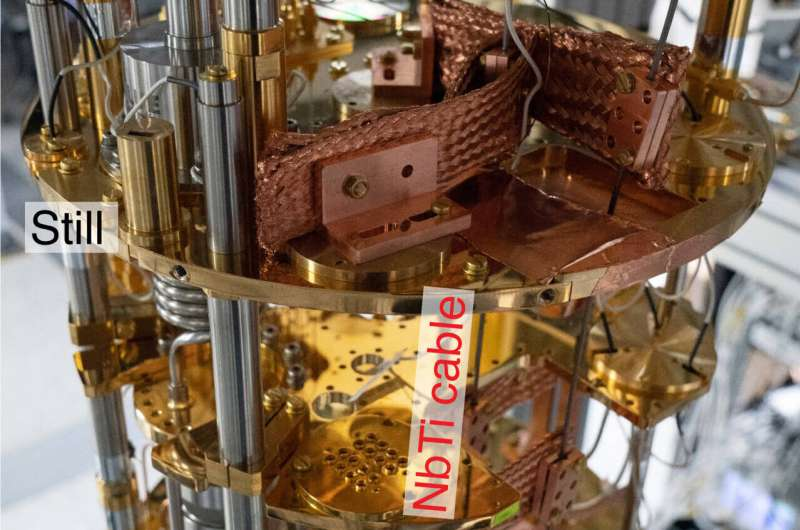
The experimental setup used to demonstrate a thermal-noise-resilient microwave quantum link between superconducting quantum processors. Credit: Jiawei Qiu.
In quantum communication systems, superconducting quantum circuits carry quantum information using microwave photons. As these light particles hold little energy, they are known to be highly susceptible to thermal noise.
“Processors and the communication channels based on superconductors therefore need to usually operate at temperatures close to absolute zero,” said Zhong. “This requirement makes large-scale superconducting quantum networks costly and technically demanding. Our work was motivated by the question: can microwave quantum signals be made resilient enough to travel through a much warmer environment?”
A promising superconductor-based microwave quantum network
The primary objective of the study by Zhong and his colleagues was to show that microwave quantum signals can also be reliably transmitted across a high-temperature transmission line, while preserving quantum coherence in the system. Quantum coherence is the property that ultimately allows entangled particles to retain their quantum behavior, without being disturbed by environmental noise.
“The approach we introduced combines a few relatively simple ideas,” explained Zhong.
“First, we found that superconducting transmission lines can maintain low loss even when they pass through warmer temperature stages. A useful analogy is a high-quality water pipe: it not only prevents the water inside from leaking out, but also prevents contamination from leaking in.
“Once we knew the channel itself could remain clean, the next challenge was removing the thermal noise already present inside a warm channel.”
To remove the thermal noise already present in their quantum network, the researchers coupled the transmission line carrying microwave photons (i.e., the channel) to an object that can absorb heat, also known as a cold sink.
Via a process known as radiative cooling, unwanted heated photons naturally flow into the cold object, which serves as a reservoir. This cleans the communication line from thermal noise.
Unfortunately, the radiative cooling process would also remove the quantum signals that were meant to be transmitted. To prevent this from happening, Zhong and his colleagues used tunable couplers, devices that control the strength of connections between different parts of a circuit, essentially acting as valves.
“We first open the valve to empty the channel of thermal noise, then close it and quickly transmit the quantum signal before the channel is ‘contaminated’ by thermal noise,” said Zhong.
“Our scheme is intuitive and avoids adding components that could introduce loss. Using this method, we were able to raise the channel temperature up to 4 K while still transmitting quantum states and generating entanglement between remote superconducting qubits.”
Possible applications and future research directions
Quantum communication systems based on superconducting circuits typically only work if the entire system permanently remains at extremely low temperatures. The approach introduced by this research team, on the other hand, allows a microwave quantum communication system based on superconductors to operate at much higher temperatures.
“This could greatly reduce the complexity and cost of building large superconducting quantum networks,” said Zhong.
“In our initial tests, we were able to generate remote entanglement with a fidelity of 93.6% at a channel temperature of 1 K. This performance is comparable to state-of-the-art demonstrations carried out entirely at millikelvin temperatures, and importantly, it exceeds the interface threshold required for distributed quantum error correction.
“Reaching temperatures as high as 4 K is particularly appealing because this helium temperature regime can be achieved with high cooling power and low cost.”
In the future, this recent study could open new possibilities for the development of microwave-to-optical transducers, devices that convert microwave photons into optical photons and are necessary to transmit quantum information over long distances, leveraging optical fibers.
The team hopes that their efforts will pave the way for the realization of new promising quantum communication networks that enable the fast transfer of information between distant devices.
“Our group has been focused on distributed quantum computing, with the goal of building practical superconducting quantum networks,” said Zhong. “This work demonstrates that thermal microwave links are feasible, but as a first prototype there is still room for improvement.”
The experimental setup that Zhong and his colleagues used in their initial demonstration does not reliably protect the quantum network from thermal noise in a quantum chip itself. As chip-level thermal noise is a key source of errors, the researchers would soon also like to boost the resilience of quantum processors against this noise.
“Looking forward, we hope to build larger distributed quantum systems—not only networks connecting superconducting processors to each other, but also hybrid systems linking superconducting circuits with other quantum platforms,” added Zhong. “We believe such hybrid architectures could unlock capabilities that are difficult to achieve with any single technology alone.”
Publication details
Jiawei Qiu et al, A thermal-noise-resilient microwave quantum network up to 4 K, Nature Electronics (2026). DOI: 10.1038/s41928-026-01581-9.
Journal information: Nature Electronics
Leave a Reply