
March 17, 2026 by University of Surrey
Collected at: https://techxplore.com/news/2026-03-grid-emissions-solar-roof.html
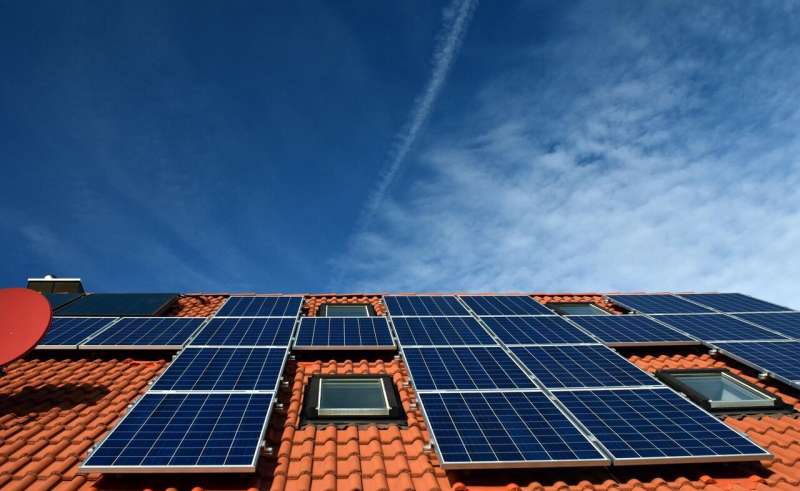
Off-grid buildings in warm climates could cut their carbon emissions by more than half and reduce energy costs to just $0.15 per kilowatt-hour through a combination of rooftop solar panel shading and thin layers of heat-absorbing material in the roof, according to new research from the University of Surrey. The research team tested 30 different roof configurations for a standalone building and they found that where you place phase change material (PCM) in a roof would matter more than how much you use—a finding that could change the cost-benefit analysis of making remote buildings more sustainable.
PCMs absorb and release heat as they melt and solidify, helping to regulate indoor temperatures. The research team discovered that placing a single thin layer of PCM (just over one centimeter) on both sides of the roof insulation, combined with the natural shading cast by rooftop solar panels, delivered annual energy savings of 8.75% and reduced CO₂ emissions by 41% to 54% compared to a standard unenhanced roof.
Counterintuitively, the study also found that placing PCM on the outer side of the roof alone actually increased energy demand in most cases. The material absorbed daytime solar heat and released it at times when it was not useful, raising rather than lowering cooling requirements.
The study has been published in Renewable Energy.
“In some countries, solar energy is abundant but millions of rural households still depend on diesel generators. This study shows that simple, low-cost roof modifications—a thin layer of heat-absorbing material in the right position, combined with the natural shading from solar panels—can halve carbon emissions and bring energy costs down to affordable levels. You don’t need expensive, complex interventions to make a real difference. That matters enormously for communities with limited resources and no access to the grid,” said Mahmoud Shafiee, Professor in Energy Resilience; Head of Energy Research Cluster; University REF Lead for Engineering.
Researchers used industry-standard simulation tools (DesignBuilder integrated with EnergyPlus) to model how the building would perform, then optimized the power supply system—a mix of solar panels, a fuel generator, and battery storage—using energy planning software (HOMER Pro). The building was designed to an internationally recognized standard for energy testing (ANSI/ASHRAE Standard 140-2017).
Among the most cost-effective configurations, rooftop PV shading contributed roughly 55% of the total energy improvement, with PCM accounting for the remaining 45%.
Publication details
Morteza Asghari et al, Energy, economic, and environmental assessment of a standalone hybrid renewable system for sustainable buildings with phase change materials and rooftop PV shading, Renewable Energy (2026). DOI: 10.1016/j.renene.2026.125436
Journal information: Renewable Energy
Leave a Reply