
Tanya Weaver 17/03/2026
Collected at: https://eandt.theiet.org/2026/03/17/ps45m-ai-supercomputer-set-accelerate-uk-fusion-energy-research
A new AI supercomputer will enable the UK Atomic Energy Authority (UKAEA) to tackle key fusion energy challenges such as plasma turbulence, materials development and tritium fuel breeding.
Due to start operations in June, ‘Sunrise’ will be based UKAEA’s Culham Campus in Oxfordshire, with £45m in funding from the Department for Energy Security and Net Zero (DESNZ).
Fusion is a potential source of almost limitless clean energy , seen as vital for energy security and the climate crisis. However, fusion is as difficult to realise in practice as it is hard to harness.
Researchers will test and iterate designs virtually, avoiding the cost, risk and time required for physical testing. With its 6.76 exaflops of AI-accelerated modelling, Sunrise will enable the creation of high-fidelity simulations and digital twins.
Rob Akers, UKAEA’s director for computing programmes, said: “UKAEA is taking lessons from the Apollo programme: we learn fastest when we can test, iterate and improve safely in the virtual world before we commit to our real-world mission.”
Sunrise is the result of a close collaboration between UKAEA, DESNZ, the Department for Science, Innovation and Technology, AMD, Dell Technologies, Intel, the University of Cambridge and data technology firm WEKA.

Tue 17 Mar 2026United Kingdom Atomic Energy Authority
It features advanced AMD CPUs and GPUs, purpose-built on the Dell PowerEdge server platform, to deliver massive AI and high-performance computing within an efficient 1.4MW power envelope.
Thomas Zacharia, senior vice-president of strategy and development, public sector at AMD, said: “With Sunrise, the UK will have a powerful new capability to rapidly and accurately simulate plasma behaviour and fusion conditions, helping researchers advance the development of stable, efficient and economically viable fusion energy.”
Lord Vallance, minister for science, innovation, research and nuclear, said: “We can be proud that Britain will lead the way on research, innovation and skills for a future of limitless fusion energy.”
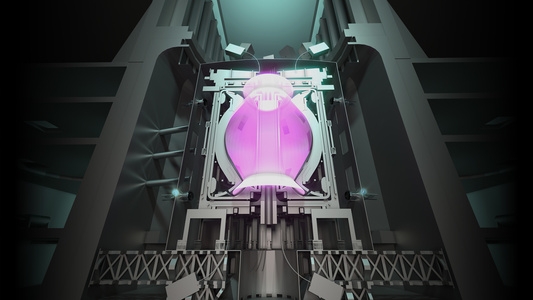
Sunrise will be used to address real-world challenges from a wide range of UK fusion programmes, including the LIBRTI (lithium breeding tritium innovation) programme, which is developing tritium fuel-cycle technologies for self-sufficiency in future fusion operations, and the Spherical Tokamak for Energy Production (STEP) Fusion, the UK’s first prototype fusion energy power plant currently under development by the UKAEA at a site in north Nottinghamshire . The aim is for the plant to be operational by 2040.
Leave a Reply