
March 17, 2026 by Sam Jarman, Phys.org
Collected at: https://phys.org/news/2026-03-discrete-crystal-usable-sensor-weak.html
The bizarre properties of discrete time crystals could be harnessed to detect extremely subtle oscillations of magnetic fields, physicists in the US and Germany have revealed. Publishing their results in Nature Physics, a team led by Ashok Ajoy at the University of California, Berkeley, show for the first time that these exotic materials could have practical uses far beyond their current status as an impractical curiosity.
Discrete time crystals (DTCs) are an exotic phase of matter which break entirely from the rules which apply to classical materials. Whereas an ordinary crystal is made up of atomic or molecular patterns that repeat at regular intervals in space, DTCs have structures that constantly oscillate in repeating cycles when driven by an external protocol, without ever reaching thermal equilibrium.
“Since their initial experimental demonstrations in 2017, there has been enormous excitement surrounding these states,” explains co-author Paul Schindler at the Max Planck Institute of Complex Systems. “Yet a persistent question has remained unanswered: can this exotic order be harnessed for practical applications?”
Harnessing an exotic phase
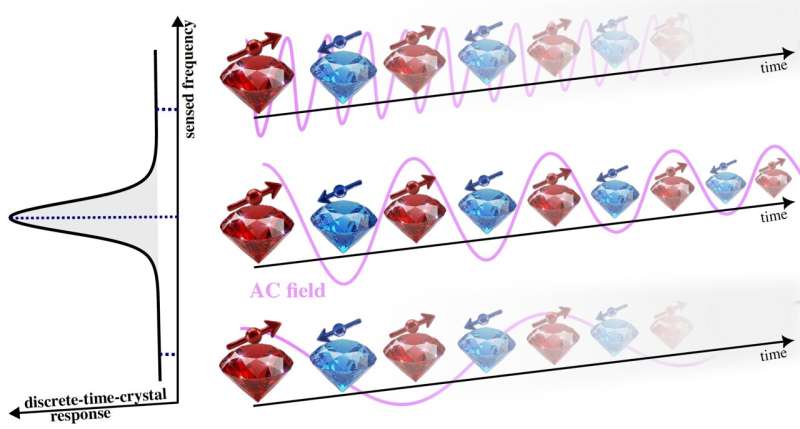
In their study, Ajoy, Schindler and their colleagues explored how a DTC’s oscillations could be employed to create a working quantum sensor. In their investigation, they first considered how a DTC would respond to a magnetic field which oscillates at its own natural frequency.
In classical physics, such a force would drive an oscillating system to resonate—amplifying its vibrations, while retaining its natural frequency. In contrast, a resonating DTC will adjust to twice the frequency of the driving force, dramatically extending its lifetime in turn. Like a regular crystal, however, this can only happen within an extremely narrow window of driving frequencies.
“We turned this into a sensing principle: the time crystal essentially ‘lights up’ only when the signal frequency matches its resonance, giving us a narrow-band detector,” Schindler says. “Importantly, unlike traditional approaches, the precision is set by the time-crystal’s lifetime rather than by interactions between the sensor spins.”
Inherited robustness
To demonstrate this principle, the researchers used a DTC to detect an extremely weakly oscillating magnetic field, coupled to the nuclear spins of carbon atoms in diamond.
By adjusting the driving protocol used to generate the crystal, they could fine-tune the window of frequencies at which this resonance occurred. This enabled their sensor to detect oscillations at an extremely high resolution, across frequencies ranging from 0.5 to 50 kHz. This range is notoriously difficult to capture with other types of quantum sensor (based on systems like atomic vapors of electron spins), which are far better suited to either very low or very high frequencies.
“Crucially, it inherits the robustness of time-crystalline order, making it resilient against experimental imperfections such as pulse errors and sample inhomogeneities,” Schindler explains. “What’s more, our sensor leverages many-body interactions rather than attempting to circumvent interactions between the spins.”
For now, physicists continue to regard DTCs as an intriguing yet ultimately impractical phenomenon. But for the first time, the results of Ajoy’s team clearly demonstrate their potential for meaningful applications—perhaps paving the way for their use in cutting-edge experiments.
“The sensing principle we demonstrate is platform-independent and should be directly applicable to a variety of quantum sensing platforms, like superconducting circuits, trapped ions, and cold atoms,” Schindler predicts. “This discovery opens up a new class of non-equilibrium-based robust quantum sensors.”
Publication details
Leo Joon Il Moon et al, Sensing with discrete time crystals, Nature Physics (2026). DOI: 10.1038/s41567-025-03163-6
Journal information: Nature Physics
Leave a Reply