
By Kavli Institute for the Physics and Mathematics of the Universe March 12, 2026
Collected at: https://scitechdaily.com/a-subtle-twist-in-the-universes-oldest-light-may-be-larger-than-we-thought/
Researchers created a technique to reduce uncertainty in cosmic birefringence measurements, resolving a key phase ambiguity and improving future studies of fundamental physics.
A research team examining the uncertainties linked to cosmic birefringence has introduced a technique that improves the reliability of observational measurements. Their findings were reported in a study published in Physical Review Letters.
The study is the first to quantitatively examine the uncertainty associated with the birefringence angle. This measurement is an important observational parameter that could offer insight into unknown physical theories that break the universe’s left-right symmetry, as well as deepen scientific understanding of dark matter and dark energy.
The cosmic microwave background, which is the faint afterglow left over from the Big Bang, preserves valuable information about the earliest stages of the universe. Recent observations have suggested the presence of a small rotation in the polarization of this ancient light, a phenomenon known as cosmic birefringence. Scientists suspect that this rotation may be linked to unknown elementary particles called axions.
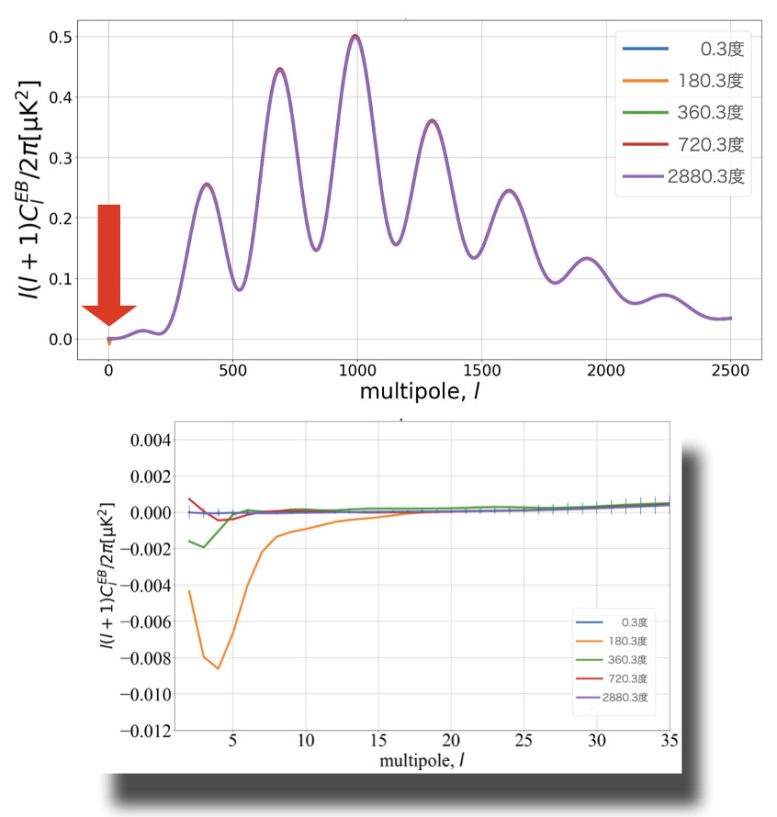
Precisely determining the rotation angle of cosmic birefringence (the birefringence angle) is essential for identifying the physical processes responsible for the effect. Researchers investigate this rotation by measuring the strength of a signal known as the CMB EB correlation. Earlier studies estimated this rotation to be about 0.3 degrees.
New Analysis Suggests a Larger Birefringence Angle
A team led by University of Tokyo Graduate School of Science PhD candidate Fumihiro Naokawa, working with Kavli Institute for the Physics and Mathematics of the Universe (Kavli IPMU, WPI) Project Associate Professor Toshiya Namikawa, carried out a detailed analysis of the uncertainties involved in cosmic birefringence measurements. Their results suggest that the rotation angle could be larger than the previously reported value of roughly 0.3 degrees.
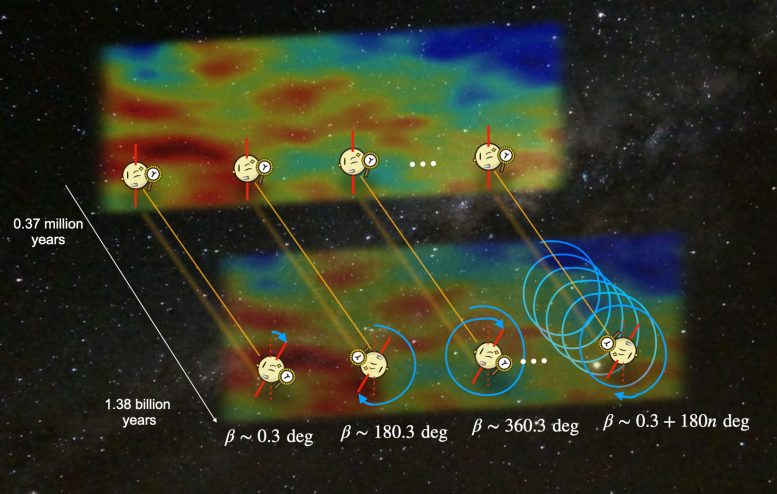
“Can you tell what day it is just by looking at a clock? No, you cannot. To determine the date from the clock hands, you need to know how many times the hands have rotated since a specific reference date and time. In scientific terms, a situation like this clock’s hands—where observing only the current state does not reveal how many rotations occurred in the past—is described as having 360-degree phase ambiguity.
“Like a clock, the CMB we can observe is only in its current state. Therefore, rotation angles such as 0.3 degrees, 180.3 degrees, and 360.3 degrees should be indistinguishable. This means the birefringence angle has a phase ambiguity of 180 degrees,” said Naokawa.
Resolving the 180-Degree Phase Ambiguity
The researchers developed a strategy to overcome this ambiguity after discovering that the shape of the EB correlation signal contains information about how many times the polarization direction has rotated. By carefully analyzing the detailed structure of the EB correlation signal, scientists can determine the correct rotation and remove the ambiguity.
This method for reducing uncertainty could play an important role in future cosmic birefringence studies that rely on highly precise data. It may also help researchers test theoretical models using observations from upcoming projects such as the Simons Observatory and LiteBIRD.
The team also discovered that when phase uncertainty is included in the analysis, cosmic birefringence influences another cosmic microwave background signal known as the EE correlation. The EE correlation is an important measurement used to determine the universe’s “optical depth,” a parameter that helps scientists study cosmic reionization. Because of this newly recognized effect, previously reported estimates of optical depth may need to be revised.
Telescope Error Mitigation and Future Observations
In a separate study also published in Physical Review Letters, Naokawa investigated methods for correcting errors introduced by telescopes when observing cosmic birefringence.
He identified a new way to verify the phenomenon by using certain celestial objects, including radio galaxies powered by supermassive black holes. This approach could help future studies better confirm cosmic birefringence and may ultimately contribute to uncovering the nature of dark energy.
References:
“Phase Ambiguity of Cosmic Birefringence” by Fumihiro Naokawa, Toshiya Namikawa, Kai Murai, Ippei Obata and Kohei Kamada, 27 January 2026, Physical Review Letters.
DOI: 10.1103/6z1m-r1j5
“Universal Profile for Cosmic Birefringence Tomography with Radio Galaxies” by Fumihiro Naokawa, 27 January 2026, Physical Review Letters.
DOI: 10.1103/srfg-9fdy
Leave a Reply