
March 2, 2026 by University of Illinois at Urbana-Champaign
Collected at: https://phys.org/news/2026-03-agrivoltaics-yields-profits-crop-deployed.html
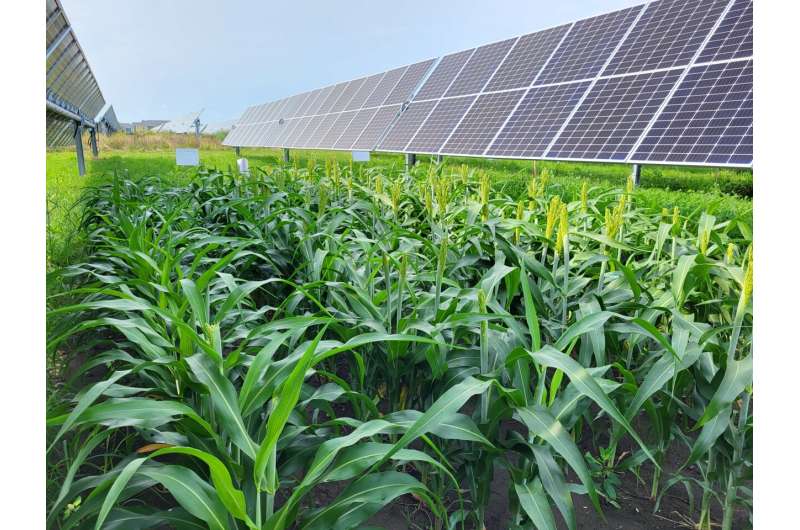
In a world where increasing demands for food security and energy strain existing resources, scientists are looking for new ways to maximize both. One potential option, agrivoltaics, integrates solar photovoltaics with crops. A study examines the agricultural and economic trade-offs that come with installing solar arrays on working farms across the Midwest. The research is published in the journal Proceedings of the National Academy of Sciences.
The study found that agrivoltaics can increase or reduce yields and profits, depending on the crop and where such agrivoltaic systems are deployed.
Led by scientists at the University of Illinois Urbana-Champaign, the team first developed a process-driven model to quantify the impacts of agrivoltaics on energy, water, and plant-soil dynamics. The model was first validated and published in the Journal of Advances in Modeling Earth Systems.
The team integrated an economic model to estimate annual net profits per acre from crop production and energy generation for agrivoltaics, conventional agriculture, and stand-alone solar energy systems. The researchers ran 15-year simulations involving different climate conditions and agrivoltaic systems across the Midwest. In the agrivoltaic simulations, solar arrays covered 33% of each site.
These analyses revealed that average aridity or humidity was a key driver of crop yields and the economic viability of agrivoltaic systems.
“In the humid eastern Midwest, solar shading reduced photosynthesis, reduced maize yields by 24% and soybean yields by 16%, lowering farmers’ profits,” said study first author Mengqi Jia, a research scientist in the Agroecosystem Sustainability Center in the Institute for Sustainability, Energy and Environment at the U. of I. “In contrast, in the semi-arid Midwest, shading alleviated water stress, moderating maize yield losses and increasing soybean yields by 6%.”
Jia led the study with crop sciences professor Bin Peng; natural resources and environmental sciences professor Kaiyu Guan, the founding director of the ASC; and iSEE director Madhu Khanna, a professor of agricultural and consumer economics at the U. of I.
“Our integrated modeling framework is a new and powerful tool to investigate the food-energy-economic nexus,” Peng said. “We identified ‘win-win’ opportunities where soybean-based agrivoltaics in the semi-arid region produce economic benefits for both farmers and solar developers, highlighting the necessity for region-specific designs tailored to local climate conditions.”
“Our in-depth research provides a scientific basis to support land-use planning and offer policymakers, land managers, and investors practical guidance for expanding agrivoltaics in locally appropriate and environmentally resilient ways,” Guan said.
“While agrivoltaics can produce benefits for soybean farmers, especially in semi-arid regions, the high installation costs of increasing the height of solar panels limits their economic competitiveness relative to stand-alone solar for developers across most of the Midwest,” Khanna said. “Utility-scale solar developers would therefore need policy or market incentives in order to adopt agrivoltaics with row crops.”
The economic viability of agrivoltaics in the Midwest also depends on several market factors, including commodity crop prices, land-lease prices, and overall weather patterns, the researchers said.
Publication details
Jia, Mengqi et al, Climate-driven divergence in biophysical and economic impacts of agrivoltaics, Proceedings of the National Academy of Sciences (2026). DOI: 10.1073/pnas.2514380123. doi.org/10.1073/pnas.2514380123
Mengqi Jia et al, Assessing the Impact of Agrivoltaics on Water, Energy, and Carbon Cycles Using the Community Land Model Version 5, Journal of Advances in Modeling Earth Systems (2026). DOI: 10.1029/2025ms005092
Journal information: Proceedings of the National Academy of Sciences
Leave a Reply