
March 12, 2026 by University of Tsukuba
Collected at: https://phys.org/news/2026-03-bioinspired-event-camera-tracks-full.html
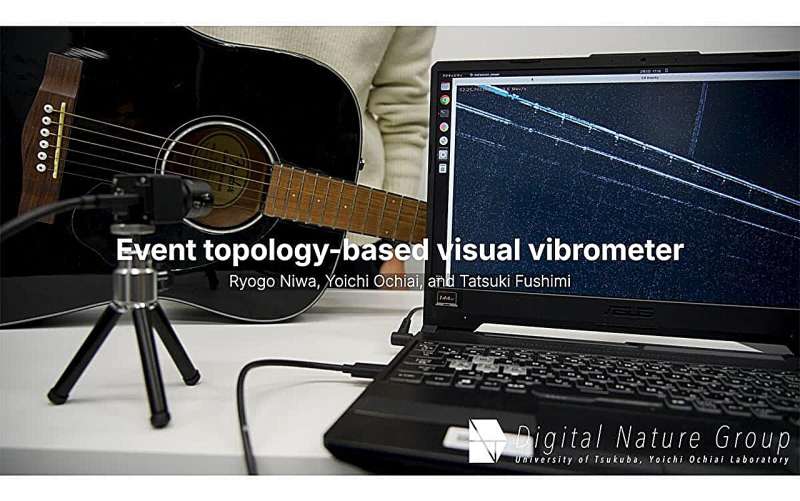
Researchers at University of Tsukuba have developed a noncontact vibration measurement method using an event camera, a sensing technology inspired by biological vision. By applying geometric analysis to event-stream data, the team succeeded in reconstructing vibrations—an achievement that had posed substantial challenges using an event camera.
The method is more accessible and cost-effective than standard optical vibrometry techniques based on lasers. The researchers also demonstrate that multiple sound sources can be separated and simultaneously recorded using a single camera. The study is published in the journal Applied Physics Letters.
Noncontact vibration measurement is essential for ensuring the safety and reliability of structures such as buildings, bridges, aircraft, and railway systems.
Laser-based systems such as laser Doppler violometers provide accurate results but require expensive equipment and elaborate setup procedures. Camera-based vibration measurement has gained attention as a more affordable alternative. However, conventional cameras generate images by integrating light over a finite exposure time.
To capture high-speed vibrations, the exposure time must be shortened, which reduces the amount of detectable light. Accordingly, the illumination must be significantly increased, enforcing a trade-off in spatial resolution when attempting high-speed imaging
To address these limitations of laser- and frame-based systems, the present study utilizes an event camera for vibration measurements. An event camera is a sensor inspired by the efficient adaptive processing of brightness changes in the biological vision of insects such as dragonflies.
By independently recording brightness changes at each pixel, event cameras can capture high-speed motion in the absence of intense lighting.
Previous approaches using event cameras have estimated vibration frequencies but have struggled to accurately recover the amplitude and phase information. Incorporating topological data analysis, a mathematical framework that identifies geometric patterns in complex data, the present researchers directly reconstructed the full vibration trajectory from event-stream data.
By adapting the Mapper algorithm, the team precisely estimated the amplitude, phase, and frequency of the vibrations from the passive event-camera input alone. The method also enables the concurrent isolation and recording of multiple sound sources with a single camera.
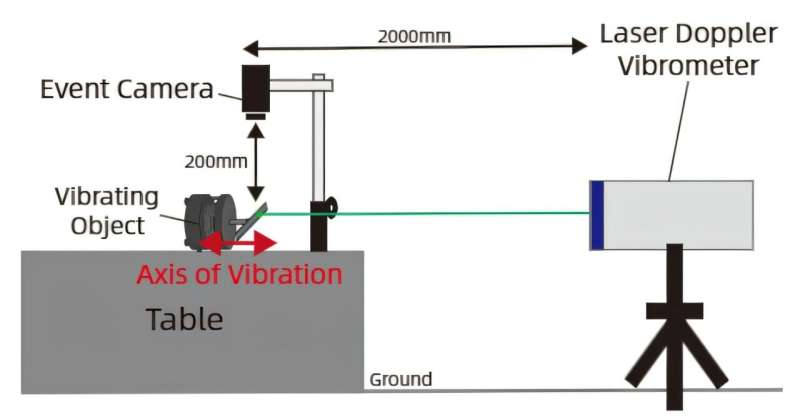
Schematic of the experimental setup. Credit: Applied Physics Letters (2026). DOI: 10.1063/5.0311647
Publication details
Ryogo Niwa et al, Event topology-based visual vibrometer, Applied Physics Letters (2026). DOI: 10.1063/5.0311647. On arXiv: DOI: 10.48550/arxiv.2510.17092
Journal information: Applied Physics Letters , arXiv
Leave a Reply