
March 11, 2026 by Ingrid Fadelli, Phys.org
Collected at: https://phys.org/news/2026-03-scalable-quantum-batteries-faster-classical.html
Over the past decades, energy engineers have developed increasingly advanced battery technologies that can store more energy, charge faster and maintain their performance for longer. In recent years, some researchers have also started exploring the potential of quantum batteries, devices that can store energy leveraging quantum mechanical effects.
To store energy, quantum batteries rely on qubits, quantum systems that can exist in two energy states simultaneously, leveraging a property known as superposition. While in principle these batteries could perform better than classical batteries, the realization of battery prototypes that exhibit this predicted quantum advantage has proved challenging.
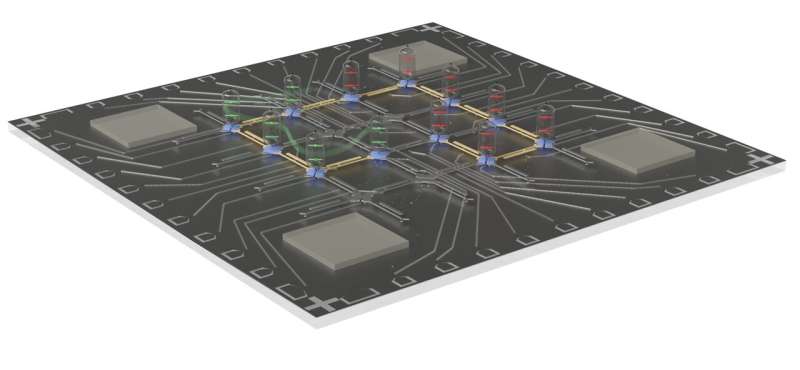
Researchers at the Southern University and Technology in China (Sustech) and the Superior Council for Scientific Research (CSIC) in Spain recently realized a quantum energy storage device that was found to outperform a classical equivalent when operating under realistic conditions.
This notable achievement, reported in a paper published in Physical Review Letters, could open new avenues for the experimental realization of quantum batteries that could be deployed in real-world settings.
“This paper came from the complementarity of the efforts by our research teams, the theory group at CSIC (Spain) and the experimental one at Sustech (China), in investigating the experimental feasibility of quantum batteries,” Alan C. Santos, co-senior author of the paper, told Phys.org.
“This investigation was initially proposed by Profs. Dian Tan and Chang-Kang Hu, who promoted the question: How can we build a quantum battery in superconducting devices? This question also disturbed me a lot, as many works demonstrated the power of quantum charging using theoretical models that are very hard to reproduce in the laboratory.”
The quest to demonstrate a quantum battery advantage
Building on their respective earlier works, Santos at CSIC and his collaborators at Sustech set out to show that quantum batteries could charge faster than their classical counterparts. Their plan was to demonstrate this quantum charging advantage in a real device and under conditions resembling those in which quantum batteries would be operating should they be deployed outside the lab.
“Our paper came about from the need to address the under-explored aspect of energy storage in quantum technologies,” explained Dian Tan, co-senior author of the paper.
“As we highlight in the opening sentence of our paper, ‘While significant progress has been made in areas like quantum computation, communication, and sensing, energy storage solutions for quantum systems have not been fully developed. As quantum devices become more complex, there is a growing demand for efficient and scalable energy storage mechanisms, which led to the exploration of quantum batteries as a potential solution.'”
Theoretical studies have been predicting that quantum batteries could outperform classical ones when placed under the same energetic constraints for some time now. Yet clear experimental evidence of their quantum advantage remains scarce, and the researchers have been working to fill this gap in the literature.
“The ability to enhance energy storage will be critical for the future of quantum computing, quantum communication, and quantum sensing technologies,” said Tan.
“Moreover, the study of quantum batteries offers significant insight into how quantum resources like entanglement, coherence, and many-body dynamics can be leveraged in energetic processes. This connection between quantum thermodynamics and energy storage opens exciting new possibilities for powering future quantum devices, and it’s an area of research that has both practical and theoretical importance.”
The main goal of this recent study was to introduce a viable and scalable approach to realize batteries that exhibit a quantum charging advantage. The battery design they proposed is based on superconducting qubits, a type of qubit that has proved promising for the development of various quantum technologies.
“Unlike most previous theoretical studies of quantum batteries, which have focused on models with global or all-to-all interactions—known to enable strong collective charging advantages—our work focuses on systems with more experimentally feasible, local interactions,” said Tan.
“Since global interactions are difficult to fully control in real-world quantum systems, achieving a quantum charging advantage in such systems has been challenging. Our approach aimed to overcome these experimental limitations and demonstrate the quantum charging advantage in a more scalable, controllable quantum system.”
Solid-state quantum batteries that outperform classical ones
To compare their quantum battery with a classical equivalent, the researchers assumed that the latter is also a quantum system, but one that does not exhibit any collective dynamics. This is because it is collective dynamics that create entanglement, the link between distant particles (in this case, qubits) that allows them to share a single unified state.
“In our experiments, we turn on interactions in the quantum charging,” said Santos. “The key point here is that we imposed an energetic constraint. Both batteries should expend the same energy during the charging process, or the energy cost of the quantum charging cannot be higher than the classical counterpart.”
If, under these conditions, a quantum battery performs better than its classical counterpart, charging faster and more efficiently, it exhibits a quantum advantage. The superconductor-based battery developed by Santos, Tan and their colleagues was found to exhibit this advantage, both in theoretical calculations and in experiments.
“The crucial role of the superconducting device is its high flexibility to create some kinds of interactions between the superconducting artificial atoms that cannot be easily done in other platforms,” said Santos. “Due to the unconventional kind of atom-atom interaction predicted by the theory, to achieve the quantum charging advantage, superconducting devices were the most promising experimental setup.”
As part of their study, the researchers compared their quantum battery with a classical battery also based on a superconducting qubits processor. While the units (i.e., qubits) in the quantum battery interacted with each other, those in the classical one were isolated and did not interact.
“We also made sure that both batteries used the same amount of energy during the charging process, so the quantum battery didn’t consume more energy than the classical one,” explained Tan. “Under these energy constraints, we show the quantum battery performed better in terms of charging power, thanks to the interactions between its units.”
Santos, Tan and their colleagues are among the first who have successfully realized a quantum battery that clearly exhibits an advantage over a classical one with a comparable design. The newly developed battery could soon inspire other similar battery designs.
“There are several theoretical proposals in the literature of quantum batteries showing good advantages, but the requirements of the models are not experimentally feasible, or at least, not with the current technology,” said Santos.
“This is easy to understand, as all these proposals focused on the maximum performance of a quantum battery. Our strategy was a bit different: given the current technical scenario, how can we reach quantum charging advantage?”
Towards the practical application of quantum batteries
While the researchers’ findings are promising, the practical applications of quantum batteries have yet to be clearly delineated. Extensive further research will be needed before these alternative battery designs can make their way into real-world settings.
A key advantage of the battery design introduced by Santos, Tan and their colleagues is that it is scalable. In fact, simply increasing the number of battery cells could enable the realization of more powerful devices that can store more energy.
“Most previous studies of quantum batteries have focused on models with global or all-to-all interactions, which are known to enable strong collective charging advantages,” said Tan.
“However, such global interactions are extremely challenging to implement in scalable solid-state platforms, including superconducting qubit systems, where interactions are typically local or nearest-neighbor and must be carefully engineered.
“In our paper, we address this gap by proposing and experimentally implementing a new Hamiltonian architecture that is compatible with nearest-neighbor couplings and standard microwave control techniques.”
A multi-cell quantum battery based on the team’s design should thus not only be scalable in principle, but could also be easy to realize using a superconducting quantum processor. The researchers have already demonstrated the potential of this multi-cell design in their experiments.
“To our knowledge, our experiment represents one of the largest and most hardware-compatible multi-cell quantum battery implementations realized to date in a fully controllable superconducting platform,” said Tan.
“This establishes an important step toward scalable quantum energy storage and highlights the relevance of our approach for future quantum technologies.”
In the future, the team’s quantum battery could be integrated with other components and used to power quantum computers or other quantum technologies. For instance, it could be used to store energy produced by quantum heat engines, devices that convert heat into useful work leveraging the laws of quantum mechanics.
“Any quantum platform that requires controlled energy injection—such as superconducting quantum processors, quantum sensors, or quantum simulators—could benefit from a quantum battery,” explained Tan.
“Unlike classical energy sources, a quantum battery can be charged collectively and deliver energy in a way that takes advantage of quantum correlations, enabling more efficient power delivery at the quantum scale. An especially natural application arises in quantum thermodynamics.
“The work produced by quantum heat engines could be stored in quantum batteries and later used to power other quantum operations or devices, closing the loop between quantum energy generation and consumption.”
Next steps for the advancement of quantum batteries
The recent work by Santos, Tan and their colleagues could be an important milestone on the path towards the development of highly performing and scalable quantum batteries.
“In the future, quantum batteries could become a key building block in integrated quantum architectures, where quantum processors, quantum heat engines, and quantum batteries operate together,” said Tan. “Our work takes an important step in this direction by demonstrating a scalable and experimentally feasible quantum battery that is compatible with existing superconducting quantum hardware.”
So far, the researchers were unable to extend the theoretical model they used to assess their quantum battery to the thermodynamic regime. In their next studies, they thus plan to work towards this goal.
“The thermodynamic regime is of fundamental relevance, because any significant amount of energy useful for real world applications requires much more energy than what we were able to store in our system,” said Santos.
“To give numbers, 1 joule of stored energy is almost nothing in the real world. But, to store this energy using our superconducting device, we need a much larger number of atoms working as quantum cells—-a quick and non-rigorous estimate already indicates we need hundreds of billions of billions of atoms to store this joule of energy.”
As part of their future research, Santos, Tan and their collaborators also plan to explore real-world applications for their quantum battery and test its performance in various settings. Most notably, they plan to combine their battery with a high-efficiency quantum heat engine based on the same superconducting platform.
“This would allow us to directly demonstrate one of the most compelling use cases of a quantum battery: storing the work produced by a quantum heat engine and subsequently using it to power other quantum operations,” said Tan.
“Such an experiment would go beyond proof-of-principle charging advantage and realize a closed-loop quantum energy cycle, connecting quantum energy generation, storage, and utilization.”
The researchers are currently also investigating the potential of developing hybrid systems based on superconducting qubits that are coupled to mechanical resonators, components that vibrate at specific frequencies. In this context, they particularly wish to explore the integration of quantum batteries with phonons (i.e., quantized units of vibration in materials).
“In this scenario, the quantum battery would serve as an energy source that drives and controls vibrational quantum states, effectively converting stored quantum energy into coherent mechanical motion,” added Tan.
“This opens opportunities to study energy transfer between different physical degrees of freedom and to explore quantum batteries as active elements in hybrid quantum architectures. Together, these directions move quantum batteries from a fundamental concept toward functional components in realistic quantum devices, and we see them as important steps toward a quantum energy infrastructure.”
Publication details
Chang-Kang Hu et al, Quantum Charging Advantage in Superconducting Solid-State Batteries, Physical Review Letters (2026). DOI: 10.1103/sp5l-c6m8. On arXiv: DOI: 10.48550/arxiv.2602.08610
Journal information: Physical Review Letters , arXiv
Leave a Reply