
March 9, 2026 by University of Science and Technology of China
Collected at: https://phys.org/news/2026-03-strontium-optical-clock-accurate-billion.html
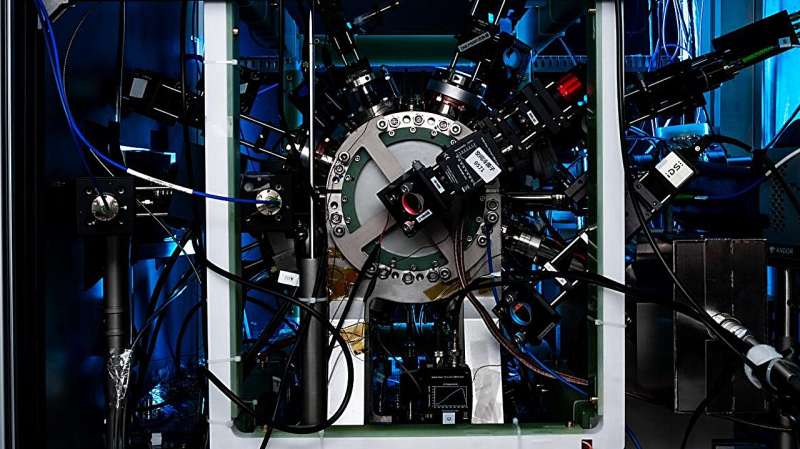
Researchers from the University of Science and Technology of China have achieved a major breakthrough in optical clock technology, developing a strontium optical lattice clock with stability and uncertainty both surpassing the 10⁻¹⁹ level, meaning the clock would lose or gain less than one second over roughly 30 billion years.
The findings are published in the journal Metrologia.
Optical clocks are considered the most precise timekeeping devices currently available. They measure time by using the frequency of light emitted when electrons transition between energy levels in atoms.
Beyond timekeeping, optical clocks can provide highly accurate time references for modern technologies such as satellite navigation, telecommunications and precision measurements. They also offer new experimental platforms for testing fundamental physics, including general relativity, as well as for the detection of gravitational waves and dark matter.
Achieving both stability and uncertainty at the 10⁻¹⁹ level opens the door to a range of frontier applications. These include millimeter-level measurements of gravitational potential and altitude, which could help monitor crustal deformation, groundwater changes and volcanic activity, as well as improve geoid mapping for disaster prevention and resource exploration.
The technology could also enable new approaches to detecting dark matter by capturing transient low-frequency signals potentially induced by dark matter interactions.
Previously, most optical clocks worldwide operated with combined stability and uncertainty at the 10⁻¹⁸ level. Only a few leading institutions, such as the National Institute of Standards and Technology in the United States and Germany’s Physikalisch-Technische Bundesanstalt, had approached this level of precision.
The new achievement provides a viable technological path for developing portable and space-based optical clocks. Researchers say it could support future applications including tests of fundamental physical laws, next-generation satellite navigation systems and the establishment of a unified ultra-precise global time standard.
Publication details
Zhi-Peng Jia et al, Improved systematic evaluation of a strontium optical clock with uncertainty below 1X10-18, Metrologia (2026). DOI: 10.1088/1681-7575/ae449e
Journal information: Metrologia
Leave a Reply