

By Stanford University March 7, 2026
Collected at: https://scitechdaily.com/room-temperature-quantum-device-could-transform-future-communications/
A new room-temperature quantum device developed at Stanford uses twisted light and advanced materials to link photons and electrons.
Modern quantum computers are typically large, costly systems that operate under extreme conditions. Many must be cooled to temperatures near -459 degrees Fahrenheit (-273.15 degrees Celsius), also known as “absolute zero.” These demanding requirements make current quantum technologies difficult to scale and impractical for widespread use.
Researchers at Stanford University have now reported a different approach. In a new study, materials scientists describe a nanoscale optical device that functions at room temperature. The device links the spin of photons (particles of light) with the spin of electrons, enabling quantum communication, which relies on the laws of quantum physics to transmit and process information. According to the researchers, this technology could help pave the way for affordable and energy-efficient quantum components capable of communicating across long distances.
“The material in question is not really new, but the way we use it is,” says Jennifer Dionne, a professor of materials science and engineering and senior author of the paper recently published in Nature Communications describing the device. “It provides a very versatile, stable spin connection between electrons and photons that is the theoretical basis of quantum communication. Typically, however, the electrons lose their spin too quickly to be useful.”
A Nanoscale Device for Twisted Light
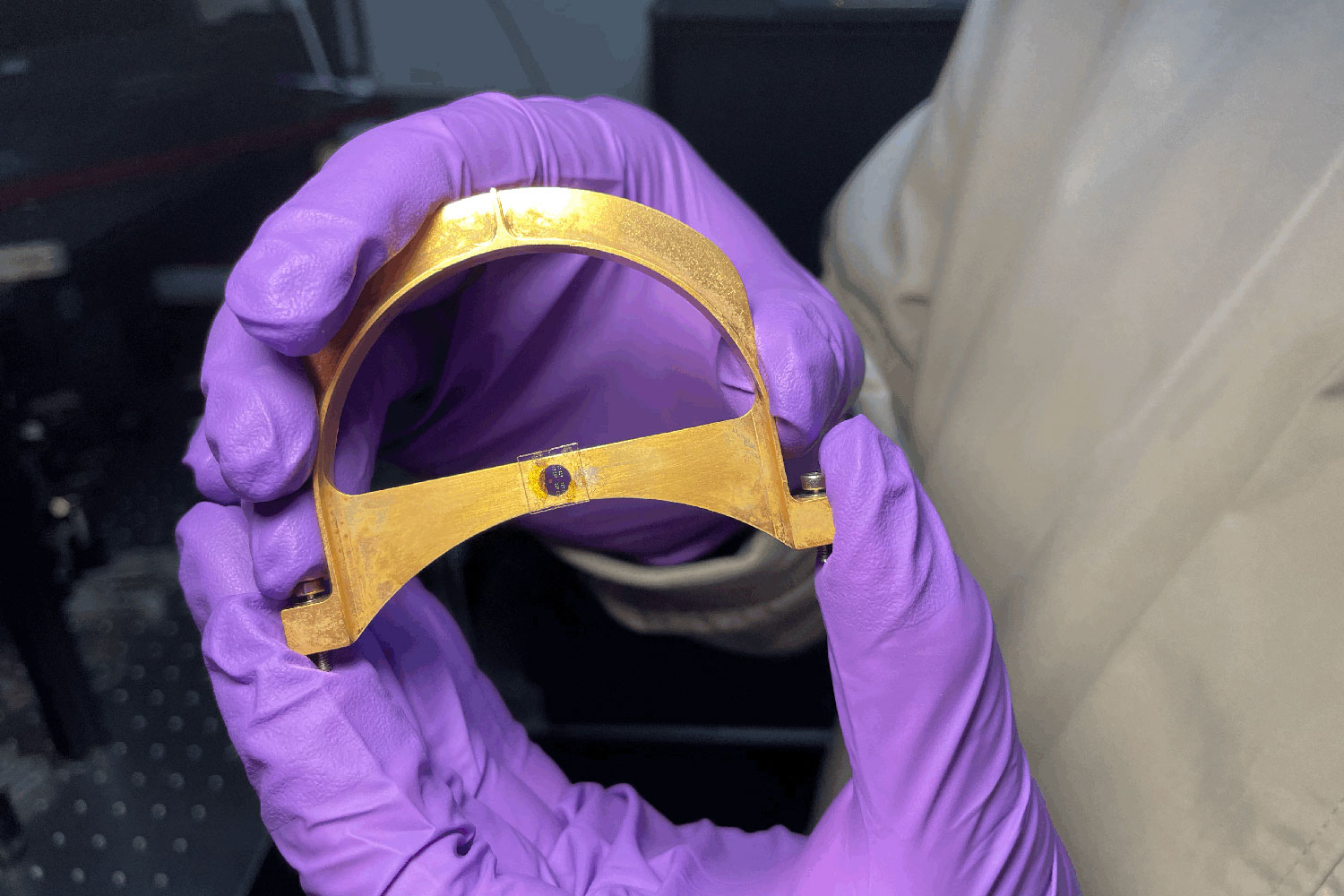
The device consists of a thin patterned layer of molybdenum diselenide (MoSe2) placed on top of a solid silicon base that has been patterned at the nanoscale. Molybdenum diselenide belongs to a group of materials known as transition metal dichalcogenides (TMDCs), which are known for their useful optical characteristics.
“The Silicon nanostructures enable what we call ‘twisted light,’” explains Feng Pan, a postdoctoral scholar in Dionne’s lab and first author of this paper and a series of others exploring room-temperature quantum devices. “The photons spin in a corkscrew fashion, but more importantly, we can use these spinning photons to impart spin on electrons that are the heart of quantum computing.”
Smaller, simpler, cheaper
“The patterned nanostructures are imperceptible to the human eye, about the size of the wavelength of visible light,” Dionne adds. “But they help us manipulate photons very precisely to make them spin – to twist them – in a specific direction, for example, up or down.”
Pan explains that this twisting motion of light can then be “entangled” with the spin of electrons, producing qubits. Qubits are the fundamental units used in quantum communication and quantum computing. In a traditional computer, information is stored as binary digits represented by 1s and 0s. In quantum systems, the spin state of a qubit plays a similar role in representing information.
Material matters
Dionne and Pan selected TMDC materials because of their unusual quantum properties. For this work, they collaborated with Stanford researchers who specialize in these materials, including professors Fang Liu and Tony Heinz.
“It all comes down to this material and our Silicon chip,” Pan says. “Together, they efficiently confine and enhance the twisting of light to create a strong coupling of spin between photons and electrons. This stabilizes the quantum state that makes quantum communication possible.”
The team is continuing to refine the device and is also testing other TMDC materials and combinations that could improve performance. Some of these materials may also enable new quantum functions that cannot currently operate at room temperature.
The researchers are also exploring how the device could be incorporated into larger quantum communication networks. Achieving this goal will require improvements in several supporting technologies, including light sources, modulators, detectors, and optical interconnects, Dionne says.
The broader goal is to shrink quantum systems enough that they could eventually be integrated into everyday electronic devices. Although that possibility remains years away, such advances could transform quantum technology from specialized laboratory systems into tools used in daily life.
“If we can do that, maybe someday we could do quantum computing in a cell phone,” Pan says with a smile. “But that’s a 10-plus-year plan.”
Reference: “Room-temperature valley-selective emission in Si-MoSe2 heterostructures enabled by high-quality-factor chiroptical cavities” by Feng Pan, Xin Li, Amalya C. Johnson, Scott Dhuey, Ashley Saunders, Meng-Xia Hu, Jefferson P. Dixon, Sahil Dagli, Sze-Cheung Lau, Tingting Weng, Chih-Yi Chen, Jun-Hao Zeng, Rajas Apte, Tony F. Heinz, Fang Liu, Zi-Lan Deng and Jennifer A. Dionne, 29 November 2025, Nature Communications.
DOI: 10.1038/s41467-025-66502-4
Funding was provided by the U.S. Department of Energy, Office of Basic Energy Sciences; Office of Naval Research, Multi-University Research Initiative (MURI); U.S. Department of Energy, Office of Science; National Quantum Information Science Research Centers; U.S. Department of Defense National Defense Science and Engineering. Work was performed in part at the Stanford Nanofabrication Facility (SNF) and the Stanford Nano Shared Facilities (SNSF) with support from the National Science Foundation; National Natural Science Foundation of China, Guangdong Basic and Applied Basic Research Foundation, Guangdong Provincial Quantum Science Strategic Initiative, and Guangzhou Science and Technology Program, and the Defense Advanced Research Projects Agency (DARPA).
Leave a Reply