
By Andy Tomaswick, Universe Today March 5, 2026
Collected at: https://scitechdaily.com/whats-really-happening-on-venus-scientists-reveal-surprising-patterns/
Regional wind patterns on Venus may stabilize mountain temperatures while generating dust storms that future landers must withstand.
For decades, the surface of Venus has remained one of the least understood environments in the solar system. With only a handful of landers ever transmitting data before succumbing to the planet’s extreme heat and pressure, scientists have had to work with limited direct measurements.
Carl Sagan once cautioned against drawing dramatic conclusions from sparse evidence, noting how easy it is to imagine fantastical scenarios such as dinosaurs roaming the planet. Yet limited data does not mean no insight. Careful analysis and modeling can extract meaningful patterns from even small datasets.
A recent study led by Maxence Lefèvre of the Sorbonne aims to do exactly that. Using the measurements that do exist from past missions, the team developed a model to estimate wind behavior and dust movement at the planet’s surface. Their goal is practical: to better prepare the next generation of Venus missions for the environmental conditions they are likely to encounter.
Sparse data, stronger models
The study, currently available as a preprint on arXiv, centers on two key factors: temperature variation and dust transport. Rather than treating Venus as a single uniform environment, the researchers divided the planet into distinct regions. This regional approach allows them to isolate the processes that shape local conditions, offering a more realistic picture of how the surface environment behaves. At the core of both temperature shifts and dust movement is the same driving force that shapes weather on Earth: wind.
Measurements from Venera, one of the only craft to ever successfully land on Venus’ surface, put the wind speed down at the bottom of the atmosphere at a measly 1 m/s. Compared to 20 m/s on Earth or even 40 m/s on Mars, that may not sound like much.
But Venus’ atmosphere is thicker than either ours or Mars’, so it would require a lot more energy to get it up to speeds equivalent to those of its sister planets. Even so, it still has a major impact on both the temperature on the surface and the amount of dust in the air.
Day-night cycles reshape the atmosphere
Venus has a “day” that is 117 Earth days long, and a night that is equally as long. This causes massive changes in the atmosphere as the planet is gradually warmed up by solar radiation during the day, and gradually cooled by its own infrared radiation at night. But those changes are different for different regions of the planet, according to the paper – and especially different from the “highlands” (i.e., mountainous regions) and the “lowlands” (i.e., the plains), and different again between the tropics and the poles.
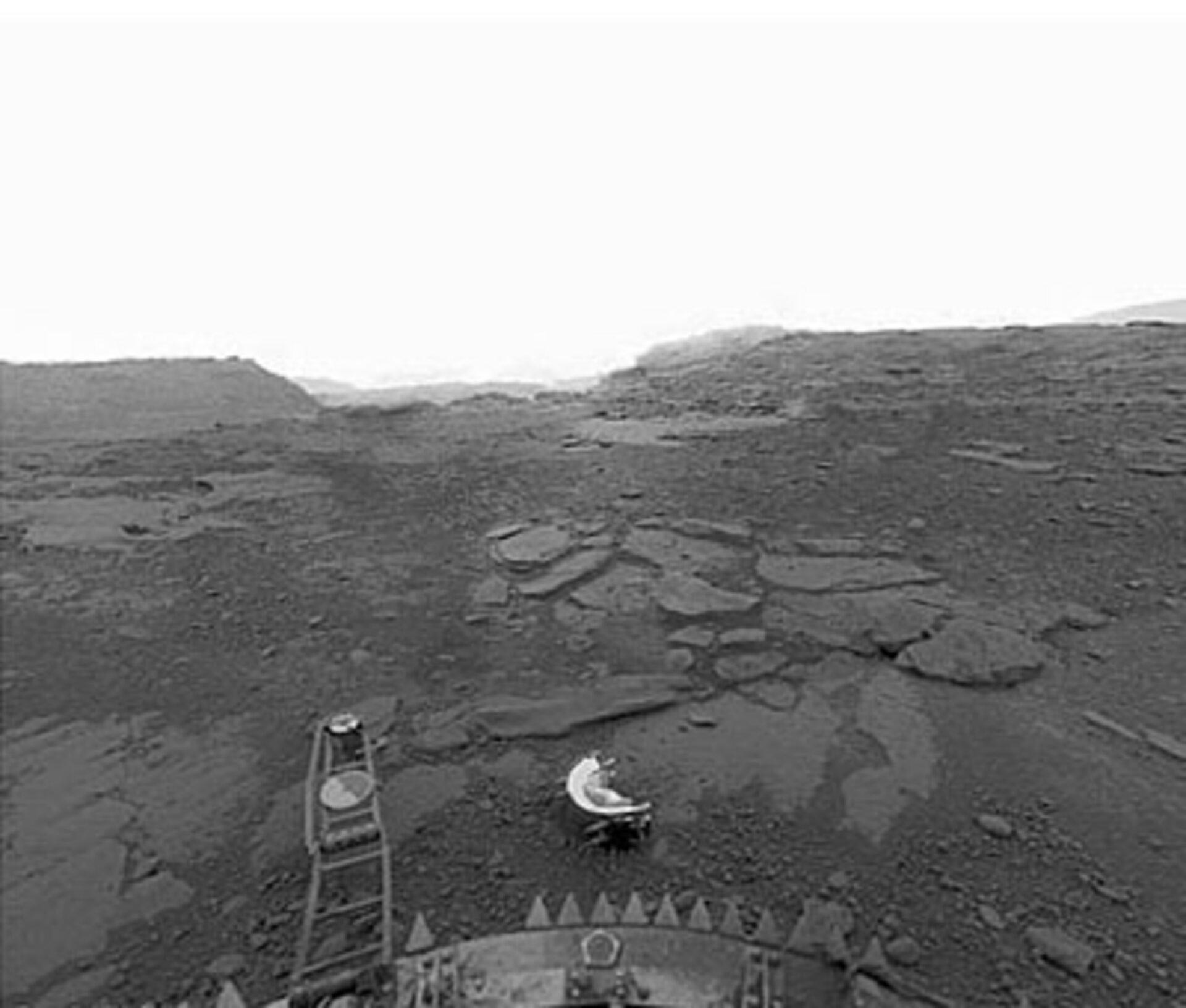
In the tropics, there is a very clear “diurnal shift,” meaning that the winds happen in very different patterns depending on whether it’s day or night on their part of the planet. During midday, the winds blow upslope (called “anabatic” in technical jargon) due to the heating of the ground underneath them, pushing it up. However, at night, this process reverses as the IR cooling of the surfaces causes the air to cool, causing downslope winds known as “katabatic.”
These processes have a direct effect on surface temperature, as the katabatic winds cause the air flowing downhill to compress, thereby heating it up, and counteracting the IR cooling from the surface in a process called adiabatic warming. Essentially, the winds in the mountains hold the temperature steady, with a swing of less than 1 degree Kelvin between the night and day cycle. Compare that to a swing of around 4 degrees Kelvin for the “lowlands” that don’t have the same cooling effect going on.
Polar winds stay in descent
Nearer the poles, this dynamic shifts, with the winds constantly in katabatic flow, which again offsets the constant IR cooling of that planet at those latitudes. Given future missions, such as Envision and Veritas, will have their eyes on the poles, its good to have an understanding of these processes before they arrive.
Another probe, DaVINCI, is currently scheduled to land on the Venusian surface for the first time in decades. The planned descent will take place in a region called Alpha Regio, a highland plateau near the equator, which would be subject to the more moderate temperature swings than some of the surrounding lowland areas. But will the DaVINCI probes be blasted by dust floating around?
Quite possibly – by the researcher’s calculations, 45% of the land in Alpha Regio has wind strengths that are enough to lift “fine sand” of 75 µm particle size. That would put DaVINCI’s planned landing zone straight in the path of an ongoing fine particle storm, which could vary depending on the time of day it arrives.
Regional modeling guides missions
All of this work was driven by a new “regional” simulation of the planet that broke up these individual areas into calculable weather models, rather than trying to model the whole surface as one singular block.
But that doesn’t mean this work can’t still be improved upon – the authors mention adding different thermal characteristics to different parts of the surface based on their albedo and thermal inertia or accounting for the thermal absorption value of CO2, which is predominant in Venus’ atmosphere, at different temperatures.
But the paper authors and other researchers looking at Venus’ atmosphere still have some time before the new batch of probes arrive at the second planet; at least when they do, they’ll have a better idea of what might be causing some of the features they find.
Reference: “The effect of near-surface winds on surface temperature and dust transport on Venus” by Maxence Lefèvre, Sébastien Lebonnois, Aymeric Spiga and François Forget, 17 October 2025, Journal of Geophysical Research: Planets.
DOI: 10.1029/2025JE009133
Adapted from an article originally published in UniverseToday.
Leave a Reply