
By PNAS Nexus March 3, 2026
Collected at: https://scitechdaily.com/asteroid-impacts-could-launch-living-microbes-from-mars/
A super-tough microbe may be able to survive being blasted from Mars into space—opening the door to interplanetary life transfer.
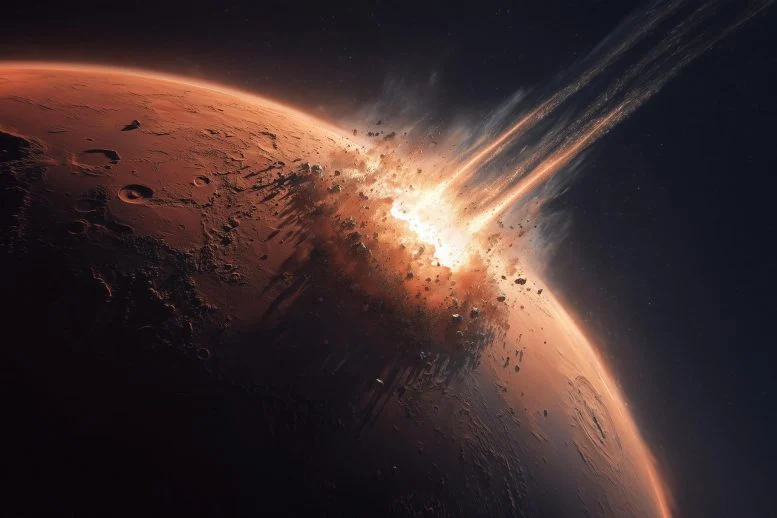
A remarkably tough bacterium known as Deinococcus radiodurans may be able to endure the intense forces created when an asteroid slams into Mars and blasts material into space. The battered surfaces of the Moon and Mars, marked by countless craters, reveal how often planets and moons are struck by space rocks. These violent collisions have shaped planetary history and may also play a role in moving material, and possibly life, between worlds.
To test this idea, researchers led by Lily Zhao and K. T. Ramesh recreated the crushing shock a microbe would experience during such an event. They placed Deinococcus radiodurans between two steel plates and then struck the setup with a third plate, generating pressures as high as 3 GPa (30,000 times atmospheric pressure). This setup mimicked the sudden, extreme compression that would occur if rocks were blasted off Mars by a powerful impact.
Extreme Pressure Tests up to 3 GPa
Deinococcus radiodurans is already known for surviving harsh conditions, including intense radiation and severe drying, which has made it a leading candidate for surviving space travel. In the new experiments, scientists monitored how the bacteria responded to escalating pressure by examining which genes were activated. This allowed them to measure biological stress and understand how the cells coped with damage.
At pressures of 2.4 GPa, some cells began to show ruptured membranes. Even so, about 60% of the microbes survived. The researchers suggest that the bacterium’s sturdy cell envelope plays a key role in protecting it under such extreme compression.
Genetic Clues to Post-Impact Recovery
Analysis of gene activity revealed that the surviving bacteria quickly shifted into repair mode after the shock. Their transcription profiles indicate that fixing cellular damage became a top priority in the aftermath of the simulated impact.
The findings suggest that microorganisms can tolerate harsher conditions than previously recognized. If microbes can survive the violent launch caused by a major asteroid strike, then it is possible that life could travel between planets, carried through space inside debris blasted from one world to another.
Reference: “Extremophile survives the transient pressures associated with impact-induced ejection from Mars” by Lily Zhao, Cesar A Perez-Fernandez, Jocelyne DiRuggiero and K T Ramesh, 3 March 2026, PNAS Nexus.
DOI: 10.1093/pnasnexus/pgag018
Leave a Reply