
March 3, 2026 by University of East London
Collected at: https://techxplore.com/news/2026-03-ai-delays.html
What if a construction project could rewrite its own schedule the moment a problem appears? A new peer-reviewed study from the University of East London (UEL) suggests that artificial intelligence could make this possible—detecting emerging risks and automatically adjusting project plans before delays spread across a site. The research is published in the journal Frontiers in Built Environment.
Breaking down the new framework
Rather than proposing a single new tool, the research outlines how existing technologies could be connected in ways they currently are not. Today, safety monitoring systems, digital risk registers and scheduling platforms typically operate in isolation. As a result, risks are identified, but the project timetable often continues unchanged.
The findings come from a systematic review of 60 peer-reviewed studies on AI in construction management. The research proposes a framework showing how risk warnings could trigger immediate, machine-readable planning decisions.
Lead author Dr. Jawed Qureshi, Senior Lecturer in Structural Engineering at UEL, said construction projects already generate the information needed to prevent delays—just not in a form that scheduling systems can use.
“Projects generate enormous amounts of warning data every day—safety alerts, design clashes, supply delays and contractual risks—but nothing in the schedule actually changes when these signals appear,” Dr. Qureshi explained. “Our work shows how those signals can be converted into scheduling constraints so the plan adapts before delays escalate.”
How the risk engine would work
The research focuses on connecting two rapidly advancing areas of AI: systems that predict risks and systems that optimize schedules. At present, they function like separate dashboards—one forecasting problems, the other planning work—with no automated link between them.
The proposed solution is a mechanism the researchers call a “risk-to-constraint translation engine.” Instead of simply logging an issue for later review, the system would translate a detected risk into a practical project constraint that scheduling software can act on.
Examples include:
- A safety hazard detected by computer vision could temporarily halt specific tasks.
- A predicted material delay could automatically re-sequence dependent activities.
- A contractual risk identified through natural language processing could introduce additional time allowances.
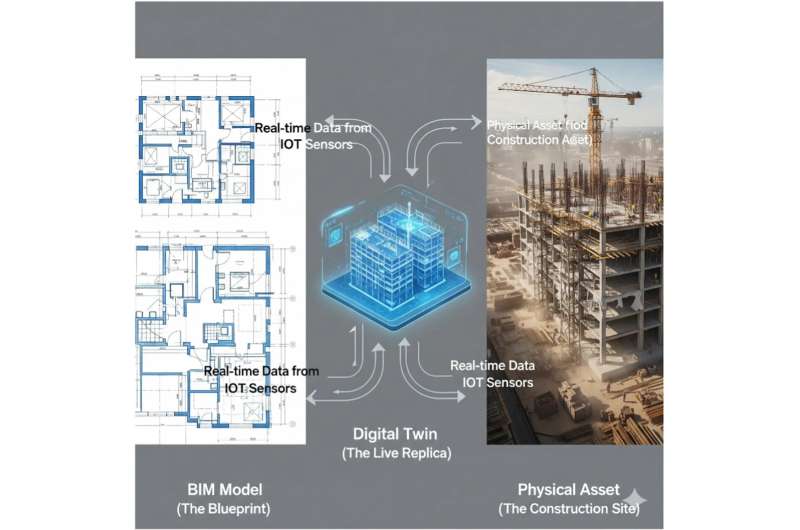
These changes would then be tested inside a digital twin—a virtual replica of the project—allowing managers to review the consequences and approve the most effective option before the real schedule is affected.
Implications for productivity and next steps
The aim is not to remove human oversight but to close the gap between early warning and actionable response.
“At the moment, we manage projects like we drive while looking in the rear-view mirror,” Dr. Qureshi said. “This approach creates a forward-looking process where risk detection and planning become one continuous activity.”
The researchers argue that this could help address a long-standing challenge. UK construction productivity has lagged behind the wider economy for decades, and major infrastructure programs frequently run late or over budget despite growing use of digital tools.
By linking prediction directly to action, projects could adapt to disruptions—such as supply shortages, safety issues or design changes—as they emerge, rather than after delays accumulate.
The authors emphasize that the work is a conceptual framework, not yet a deployed system. Real-world testing and prototype development will be required. However, they believe the approach offers a practical route toward more resilient project delivery as construction becomes more complex and data-driven.
“If technology can shift us from reacting to problems toward preventing them, it fundamentally changes how projects are managed,” Dr. Qureshi added.
More information
Jawed Qureshi et al, The socio-technical gap: an AI framework for project resilience in UK construction, Frontiers in Built Environment (2026). DOI: 10.3389/fbuil.2025.1741095
Leave a Reply