
February 28, 2026 by Ingrid Fadelli, Phys.org
Collected at: https://phys.org/news/2026-02-heavier-hydrogen-silicon-centers-brighter.html
Quantum technologies, computers or other devices that operate leveraging quantum mechanical effects, rely on the precise control of light and matter. Over the past decades, quantum physicists and material scientists have been trying to identify systems that can reliably generate photons (i.e., light particles) and could thus be used to create quantum technologies.
One approach for generating photons relies on silicon color centers, such as the emerging T center. Color centers are defects or irregularities in the crystal structure of silicon characterized by a different arrangement of atoms.
The T center and other silicon color centers can emit light in the wavelength band that is already used by fiber-optic internet cables, which is desirable for the development of quantum networks and quantum communication systems.
Researchers at Simon Fraser University, Photonic Inc. and the U.S. Naval Research Laboratory show that utilizing heavier hydrogen isotopes in T centers can increase the time for which a system remains energized before emitting light, which in turn boosts the T center’s single photon generation efficiency. Their paper, published in Physical Review Letters, could pave the way for brighter and more reliable single-photon sources, fueling the advancement of quantum technologies.
“For the past few years, we have been studying silicon color centers, which are atomic-scale defects in silicon that can emit light,” Moein Kazemi, co-first author of the paper told Phys.org.
“The T center, which consists of two carbon atoms and a hydrogen atom in the silicon lattice, can be produced in different isotopic forms. For example, the hydrogen can be either the common, lighter isotope (protium) or the rarer, heavier isotope (deuterium).”
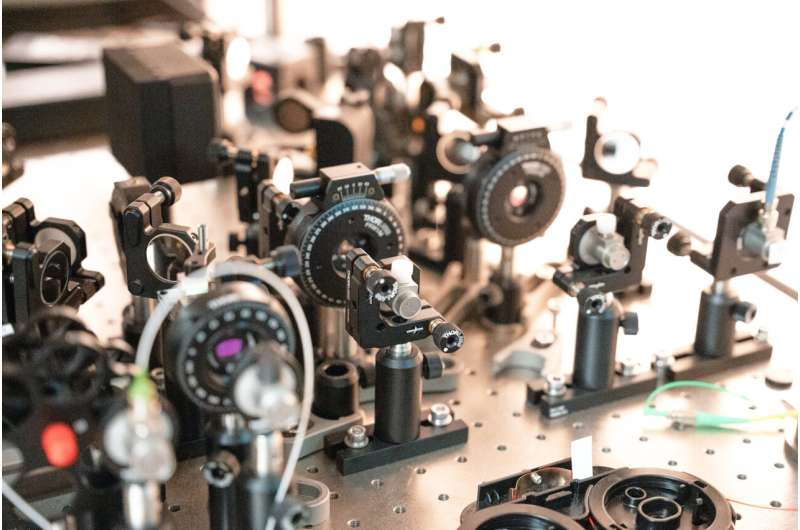
Part of the optical experiment used to study quantum color centers in silicon. Credit: Kazemi et al.
Protium and deuterium are different versions (i.e., isotopes) of hydrogen with different numbers of neutrons in their nucleus. As these two isotopes have different masses, they can lead to slightly different optical transitions in silicon defects, such as the T center.
“Historically, these isotope-dependent shifts have been used as a powerful tool to better understand the atomic structure of color centers,” said Kazemi.
The newly uncovered giant isotope effect
The team at Simon Fraser University has been exploring the potential of the silicon T center for realizing quantum networks and distributed quantum computing for a few years now. As it only recently emerged as a quantum technology platform, its underlying physics is still not fully understood.
“For example, before this work, it was known that the T center can decay non-radiatively (without emitting a photon) but not how it does so,” said Daniel Higginbottom, co-senior author of the paper. “This result began serendipitously, from my student Moein Kazemi’s work on a similar silicon color center called the M center.”
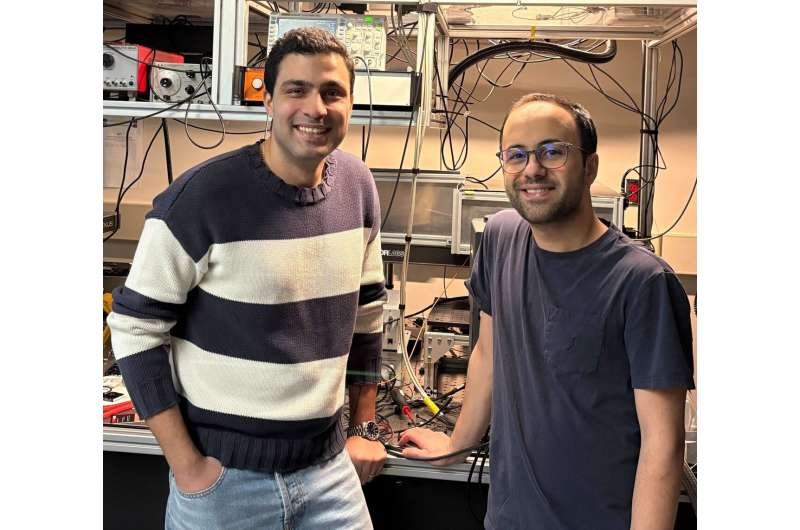
Moein Kazemi (left) and Mehdi Keshavarz (right), the lead co-authors of the paper.
As part of his earlier research, Kazemi and Mehdi Keshavarz (co-first author of the paper) had produced M center samples using different carbon and hydrogen isotopes. He found that the excited state lifetime of the resulting color centers varied depending on the isotope used, an effect that had never been reported before.
“We realized that the same effect could exist for the T center, so Moein and Mehdi began measuring the lifetimes of the T center’s isotopic variants,” explained Higginbottom. “What they found was very surprising: they observed that the excited state lifetime of the deuterated T center is 5.4x larger than the more common protium variant. This was much larger than the difference observed for the M center.”
The researchers found that the lifetime of a deuterium T center was approximately the lifetime that one would expect to observe if there was no non-radiative decay, showing that this color center is a very efficient emitter.
This observation could guide the future development of quantum technologies based on T centers, such as quantum memories and transducers, as well as for the interfacing of T center-based quantum processors.
“This work was carried out by the spectroscopy of T center ensembles in mm-sized, isotopically pure silicon samples,” said Higginbottom.
“Our lab has established expertise in these techniques over decades thanks to my colleague and co-senior author Prof. Mike Thewalt—one of the world’s leading experts in silicon spins and emitters. Isotopically pure silicon and temperatures below 4K are required to optically resolve the different isotopic variants of the T center and measuring ensembles in the bulk provides a very high level of signal for rapid characterization.”
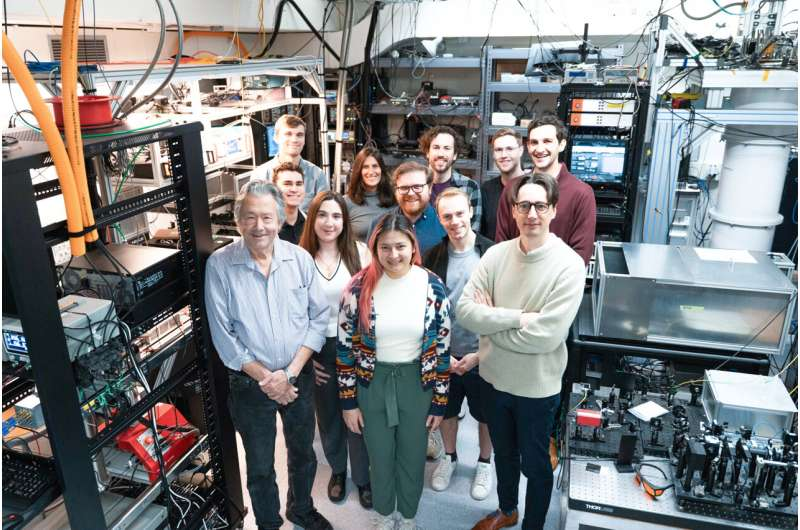
The Silicon Quantum Technologies (SQT) group. Prof. Mike Thewalt (far left) and Dr. Daniel Higginbottom (far right).
The team’s experiments
Higginbottom, Kazemi, Keshavarz and their colleagues created three different T center samples. The first included natural carbon and hydrogen isotopes, with a dominant protium T center variant.
The second sample was deliberately diffused with deuterium, which turned the deuterated T center into the dominant variant. The third sample was enriched with carbon-13, which produced several distinct carbon isotopic configurations of the T center.
“Our silicon samples were grown by our collaborators at IKZ in Germany, led by Nikolay Abrosimov,” said Higginbottom. “They developed this capability for the Avogadro project, to redefine the kg using pure silicon spheres—but the same material is very useful for studying silicon emitters. They grew us special-purpose samples with a varying carbon isotope distribution.”
To produce T centers, the researchers irradiated the three samples they produced, exposing them to high-energy particles. Subsequently, they heated them to a controlled temperature and cooled them down, a process known as annealing.
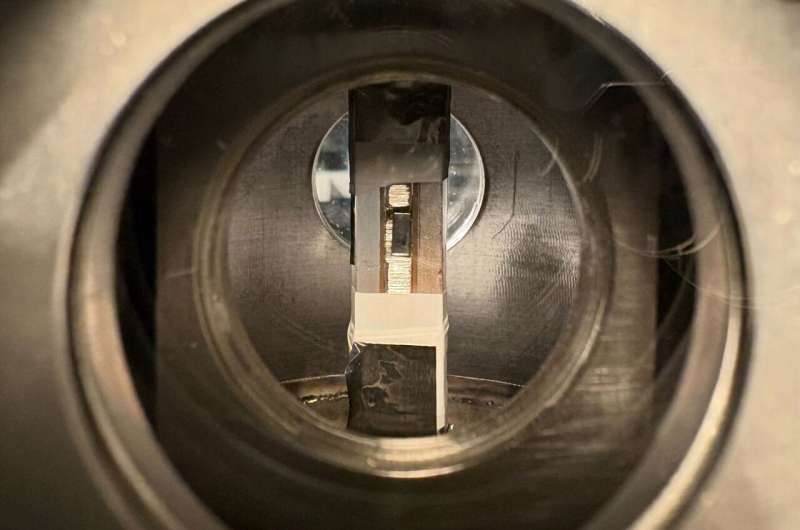
The team then placed the samples inside small holders called reflective pockets that reflect light, collecting as many emitted photons as possible. They then immersed the samples in liquid helium or helium vapor to keep them at extremely low temperatures, where they could measure their quantum properties more reliably.
“We find the emission lines of interest by photoluminescence spectroscopy with a Fourier transform infrared spectrometer,” said Higginbottom. “This sensitive apparatus allowed us to make the first measurements of the C-H local vibrational modes, confirming that the C-H stretch mode is lower energy in the deuterated T center and should (therefore) suppress vibrational decay through this mode.”
To measure the excited-state lifetimes of the different T centers they created, the researchers used a highly precise laser, whose color was carefully adjusted to target a specific type of T center. This allowed them to excite different isotopic variants at a time and measure their lifetimes.
“We measured the lifetimes by pulsed resonant excitation followed by measuring photon arrival times with time-resolved single-photon detectors,” said Higginbottom.
“Silicon emitters and silicon color centers were neglected for a long time, in part because it was widely believed that they were inefficient compared to color centers in crystals like diamond. If we are correct that the deuterated T center is more than 90% efficient, then it is the best evidence yet that silicon can host efficient color centers.”
Avenues for future research
The experiments carried out by Higginbottom, Kazemi and their colleagues also allowed them to uncover the main cause of energy loss in T centers. Specifically, they found that energy is lost via a specific vibration of the carbon-hydrogen bond inside the color center, which prompts the excited state to relax without emitting light.
“The gigantic dependence of the nonradiative decay rate on the hydrogen isotope indicates that the non-radiative decay process must be a local vibrational mode of the T center’s C-H bond,” explained Higginbottom.
“Our collaborators from the U.S. Naval Research Lab, Mark Turiansky and John Lyons, modeled this decay process and found that the standard ‘accepting mode’ approach for modeling vibrational decay completely fails in this case. We show that a very simple alternative ansatz, considering only the C-H stretch mode, matches the experiment quite well and reproduces the strong isotope dependence.”
The team’s initial estimations based on the first simplified model suggest that the deuterated T center may have an efficiency of over 98%. Currently, Turiansky is working on a more complete theoretical model that includes multiple types of atomic vibrations, instead of just one.
“Teams across the globe, including our industrial partner Photonic Inc., are developing the T center as a platform for quantum networks and quantum computing,” said the authors.
“A more efficient T center means more efficient entanglement distribution and higher-performing quantum devices. In particular, the efficiency of the deuterated T center should increase what is called ‘optical cyclicity’: the probability that the electron spin qubit is unchanged by optical excitation. “
The researchers estimated that the deuterated T center they created could be optically cycled between its ground and excited states approximately 300 times more than the protium T center before it needs to be reset. This makes it promising for the development of advanced and high-speed quantum technologies.
“The T center’s emission lifetime makes single-shot readout of the electron spin feasible and could speed up quantum operations on T centers,” said Higginbottom.
“From our result, it looks like it is broadly advantageous to work with the deuterium T center instead of the protium T centers studied before now. Our industry partner Photonic Inc. … was able to put this breakthrough directly into their own R&D pipeline. It’s a great example of how exploratory science can pair with industry. “
Overall, the findings gathered by the researchers suggest that the local vibrational modes of T centers play a crucial role in their nonradiative decay. Future works could build on the team’s observations to further explore the link between isotopic variants and the emission efficiency of these silicon color centers.
“As a next step, we are carrying out a comprehensive study of the fundamental vibrational modes across all possible isotopic variants of the T center,” said Kazemi. “These measurements will allow us to more precisely understand how the color center’s vibrational structure affects its optical properties.”
Concurrently, Higginbottom’s research group is developing devices that integrate T centers with nanophotonic and electronic circuits.
Over the next few years, they hope to successfully demonstrate the use of T center-based devices as hubs in a quantum network, which is being realized in Vancouver under the supervision of Higginbottom and Prof. Thomas Jennewein.
“This platform will enable entanglement distribution and secure quantum communication over many 10s of kms of deployed optical fiber. Since the T center emits natively into the optical telecommunications O-band, it is very well suited for such long-distance quantum networking,” added Higginbottom.
“Based on Moein and Mehdi’s measurements of deuterated T centers, we’re in the process of upgrading all of our T center devices in the lab to deuterium.”
Publication details
Moein Kazemi et al, Giant Isotope Effect on the Excited-State Lifetime and Emission Efficiency of the Silicon T Center, Physical Review Letters (2026). DOI: 10.1103/4mpw-664z. On arXiv: DOI: 10.48550/arxiv.2510.23862
Journal information: Physical Review Letters , arXiv
Leave a Reply