
By Amit Malewar Published: February 26, 2026
Collected at: https://www.techexplorist.com/star-vanish-become-black-hole/102122/
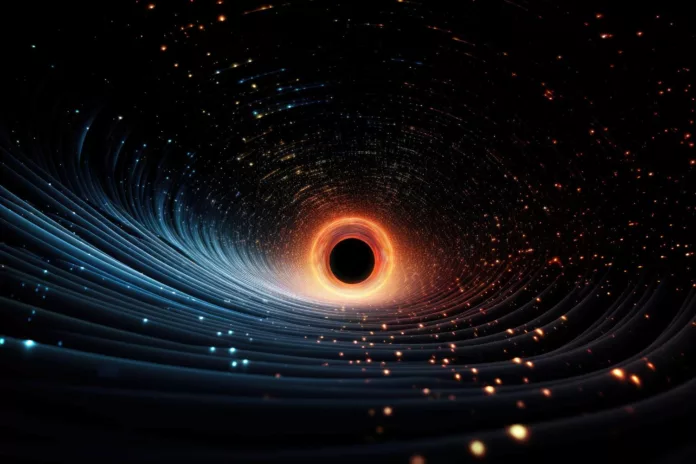
When a massive star runs out of fuel, its core collapses. This collapse releases a flood of neutrinos, which push a shock wave outward through the star’s layers. If the shock is strong enough, it blasts the outer layers into space, creating a supernova. If the shock is too weak, the outer layers fall back onto the core. The core continues to collapse until it forms a black hole, and the star effectively vanishes.
In a new study, astronomers report observations of M31-2014-DS1, a hydrogen-depleted supergiant in the Andromeda Galaxy. Astronomers recently witnessed the quiet death of a giant star. Instead of going out in a blaze of glory with a supernova, the star faded, collapsing into a black hole. For scientists, it was like watching the final chapter of a cosmic drama unfold in real time, the clearest record yet of how a star transforms into one of the universe’s darkest mysteries.
They pieced the story together using fresh observations and more than ten years of old data. What they saw confirmed long-held theories: the star’s core gave way, sinking into a black hole, while its outer layers slowly unraveled and drifted into space.
The findings, published on February 12 in Science, are stirring excitement. For the first time, astronomers can trace step by step how some stars vanish into black holes, while others explode in brilliant supernovae. It’s a rare glimpse into the secret endings of stars and the beginnings of black holes.
Kishalay De, an associate research scientist at the Simons Foundation’s Flatiron Institute and lead author on the new study, said, “This is just the beginning of the story. Light from dusty debris surrounding the newborn black hole is going to be visible for decades at the sensitivity level of telescopes like the James Webb Space Telescope, because it’s going to continue to fade very slowly. And this may end up being a benchmark for understanding how stellar black holes form in the universe.”
Far away in the Andromeda Galaxy, about 2.5 million light-years from Earth, astronomers followed the life of a star called M31-2014-DS. For years, they watched it through NASA’s NEOWISE project and other telescopes, gathering clues from 2005 to 2023.
In 2014, the star began to glow brighter in infrared light, as if gathering strength. But just two years later, in 2016, it dimmed dramatically, its brilliance fading in barely a year.
By 2022 and 2023, the star had all but vanished. In visible and near-infrared light, it was only a faint shadow of itself, shining just one ten-thousandth as bright as before. What remains now is a ghostly ember, detectable only in mid-infrared light, glowing at a fraction, one-tenth, of its former power.
De says, “This star used to be one of the most luminous stars in the Andromeda Galaxy, and now it is nowhere to be seen. Imagine if the star Betelgeuse suddenly disappeared. Everybody would lose their minds! The same kind of thing [was] happening with this star in the Andromeda Galaxy.”
Astronomers compared their observations with long-standing theories and found strong evidence that the fading star had collapsed into a black hole.
Stars typically glow as a result of hydrogen being fused into helium in their cores. The outward pressure generated by this fusion counteracts the inward gravitational pull. However, that equilibrium is upset when a big star, which is around ten times heavier than our Sun, runs out of fuel.
When gravity takes over, it crushes the star. It begins with a collapsing core that leads to the formation of a dense neutron star. This collapse oftenreleases a flood of neutrinos that drives a powerful shock wave, blasting the star apart in a supernova. But sometimes the shock is too weak. Instead of exploding, the star’s outer layers fall back inward, piling onto the neutron star until it becomes a black hole.
This fading star seems to have followed that quieter path, slipping into darkness, leaving behind only the telltale signs of a black hole’s birth.
“We’ve known for almost 50 years now that black holes exist,” says De, “yet we are barely scratching the surface of understanding which stars turn into black holes and how they do it.”
By studying M31-2014-DS1, astronomers were able to rethink what happened to another fading star, NGC 6946-BH1. The missing piece of the puzzle turned out to be convection, the restless movement of hot and cool gases inside a star.
Deep within, the star’s center blazes with heat, while its outer layers are cooler. This difference sets the gases in motion, rising and falling like boiling water. When the star’s core finally collapsed into a black hole, its outer layers were still churning with this convective motion.
Instead of falling straight into the black hole, the innermost layers swirled around it. This swirling helped push the outermost layers away, ejecting them into space. As the expelled material drifted outward, it cooled and formed dust.
That dust hid the hot gas circling the black hole, but in doing so, it glowed faintly in infrared light. This lingering red glow can shine for decades, a quiet afterimage of a star that has vanished.
Andrea Antoni, a Flatiron Research Fellow, had earlier predicted how convection might change the way stars collapse. With the new evidence from M31-2014-DS1, her ideas came to life. She explained that the material falling into the black hole moves much more slowly than expected. Instead of plunging straight in, the swirling gas carries momentum, circling the black hole like water spinning around a drain.
Because of this, the collapse stretches out over decades rather than months. The star doesn’t disappear right away. Instead, it shines a little brighter for a while and then slowly fades. Inside the star, moving gases (called convection) stop the collapse from happening all at once. Some of this material keeps circling around the new black hole and falls back bit by bit.
In the end, only about one percent of the star’s outer gas actually feeds the black hole. That tiny amount is enough to keep the black hole glowing faintly, which is the light we can still see today.
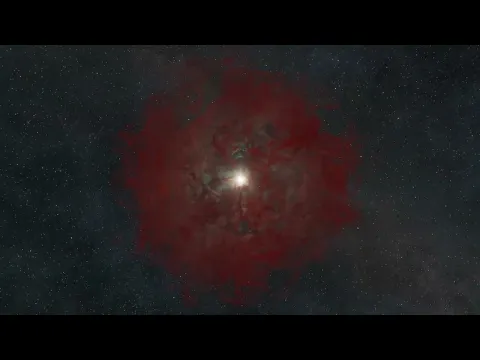
By reexamining M31-2014-DS1, astronomers also revisited another fading star, NGC 6946-BH1, first studied ten years ago. What once seemed like an oddball case now appears to be part of a larger family of stars that die quietly, collapsing into black holes but leaving behind a long, glowing afterimage.
Journal reference:
- Kishalay De, Morgan Macleod, Jacob Jencson et al. Disappearance of a massive star in the Andromeda Galaxy due to formation of a black hole. Science. DOI: 10.1126/science.adt4853
Leave a Reply