
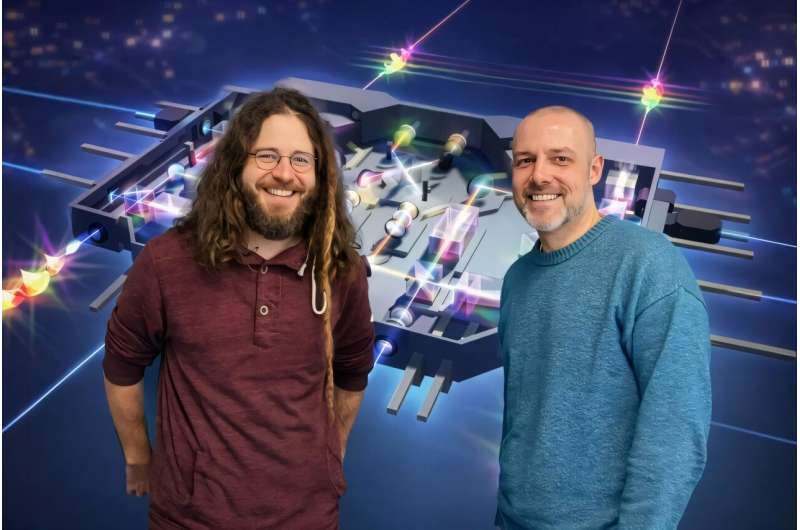
February 23, 2026 by Vienna University of Technology
Collected at: https://phys.org/news/2026-02-quantum-high-dimensional-state-photon.html
The collaboration of TU Wien with research groups in China has resulted in a crucial building block for a new kind of quantum computer: The realization of a novel type of quantum logic gate makes it possible to carry out quantum computations on pairs of photons that are each in four different quantum states, or combinations thereof. The advancement is an important milestone for optical quantum computers. The study has now been published in Nature Photonics.
Qudits instead of qubits
The basic idea of quantum computers is simple: While a classical computer only works with the values “0” and “1,” quantum physics allows for arbitrary combinations of these states. In a certain sense, a quantum bit (“qubit”) can be in the states 0 and 1 simultaneously. This makes it possible to develop algorithms that can solve some problems much faster than a comparable classical computer.
However, such superpositions can in principle involve more than two states. Depending on what degree of freedom one considers, a quantum system such as a photon may not just have two different settings—two different outcomes of a potential measurement—but many. In this case, one refers to the system as a “qudit” rather than a “qubit.”
For quantum computations, this can bring along significant advantages, but ultimately it requires a mechanism by which two such qudits can interact in a controlled way. The research team at TU Wien was able to theoretically design a scheme to jointly process two qudits encoded in two photons—and a team in China successfully realized this scheme in their laboratory, resulting in a novel type of quantum gate, with potentially revolutionary applications.
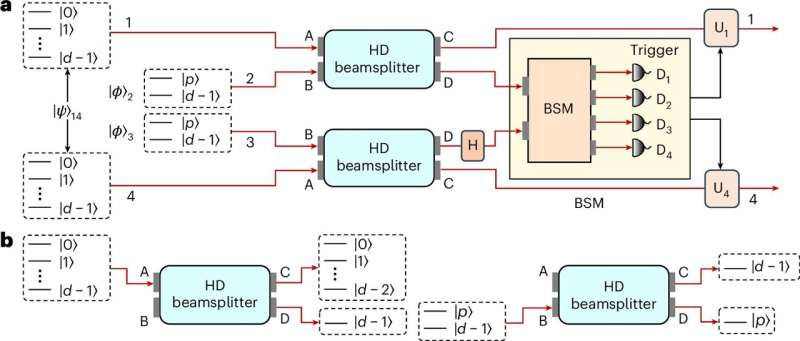
Protocol for realizing a two-qudit CPF gate. Credit: Nature Photonics (2026). DOI: 10.1038/s41566-026-01846-x
Quantum physics in four dimensions
Until now, quantum-computing experiments with photons have often been carried out by relying on the polarization of photons—a property with two different possible measurement outcomes. From the point of view of quantum physics, the photon can be in a superposition of these two options, like moving simultaneously north and east when walking northeast.
“We use photons in a fundamentally different way,” explains Nicolai Friis from the Institute of Atomic and Subatomic Physics of TU Wien. “We aren’t interested in the polarization, but in the spatial wave form of the photons, which can be in infinitely many different states, corresponding to different orbital angular momenta.”
The team surrounding Friis has developed a procedure that works with two such photons: Both can be in arbitrary superpositions of different wave forms. Through sophisticated manipulation, two initially independent photons can be brought into a joint state—a so-called “entangled” state. Likewise, the new quantum gate can also be used to separate two entangled photons in a controlled way to make the states of the photons independent of each other again.
Exactly such an operation—an entangling quantum gate—is needed to build quantum computers, to carry out calculations on multiple inputs. For a first experiment, the researchers decided to work with four different states. “This is as if, in addition to the north-south and east-west directions, one would have access to two additional axes,” says Friis. “In some sense one is moving in a four-dimensional space, and we can work with arbitrary combinations of such states.”
Finding out if it worked
Realizing their theoretical ideas did not just require a new protocol but also made it necessary to significantly improve the state of the art in technology and experimental precision—an area in which the team of Hui-Tian Wang in China made remarkable progress.
“We were successful in realizing a quantum logic gate that works with two photons that can be prepared in combinations of four different states,” says Friis. “We can entangle the photons—and we can do so in a heralded fashion, meaning that we can tell when the protocol worked. And if it did not, we can repeat the procedure. This is what is needed in practice.”
It is hoped that the new approach will make quantum information technology more efficient and stable. “We need fewer particles to carry the same amount of quantum information,” says Marcus Huber (also from the Institute of Atomic and Subatomic Physics of TU Wien). “This has many advantages, also with a view toward the reliability of quantum operations.” The new study thus—quite literally—opens up new dimensions for quantum technologies.
Publication details
Zhi-Feng Liu et al, Heralded high-dimensional photon–photon quantum gate, Nature Photonics (2026). DOI: 10.1038/s41566-026-01846-x
Journal information: Nature Photonics
Leave a Reply