
By Tohoku UniversityFebruary 22, 2026
Collected at: https://scitechdaily.com/mars-missing-water-mystery-takes-an-unexpected-turn/
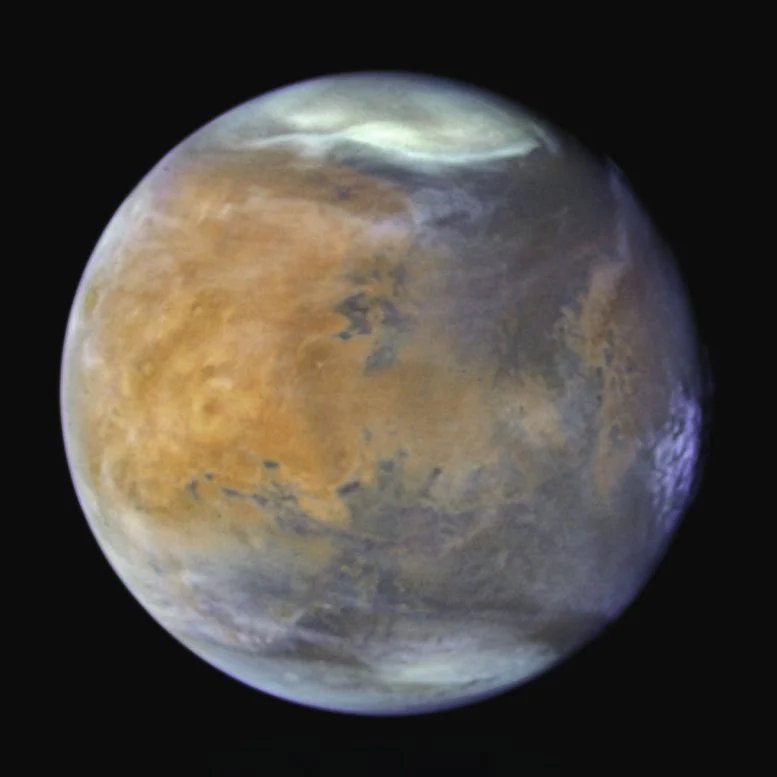
New research shows that an intense regional dust storm transported unusually high amounts of water vapor into Mars’ upper atmosphere, boosting hydrogen escape. The discovery reshapes understanding of how the planet gradually lost its water.
Today, Mars is known as a cold, dry desert. Yet its landscape tells a very different story about its distant past. Networks of channels, water-altered minerals, and other geological features show that the planet once had abundant liquid water and a far more active environment.
Scientists have spent decades trying to understand how that wetter world transformed into the barren planet we see now. Although several mechanisms have been identified that could account for part of the water loss, a large portion of it has remained unexplained.
An international team of researchers has now taken an important step toward solving that mystery. In a study published in Communications: Earth & Environment, they report the first clear evidence that an unusual, intense, but localized dust storm was able to carry water vapor into the upper atmosphere during the Northern Hemisphere summer. Previously, scientists believed this season played only a minor role in water loss.
“The findings reveal the impact of this type of storm on the planet’s climate evolution and open a new path for understanding how Mars lost much of its water over time,” says Adrián Brines, a researcher at the Instituto de Astrofísica de Andalucía (IAA-CSIC) and co-lead author of the study along with Shohei Aoki, a researcher from the Graduate School of Frontier Sciences at the University of Tokyo and the Graduate School of Science at Tohoku University.
Regional Dust Storms and Unexpected Summer Effects
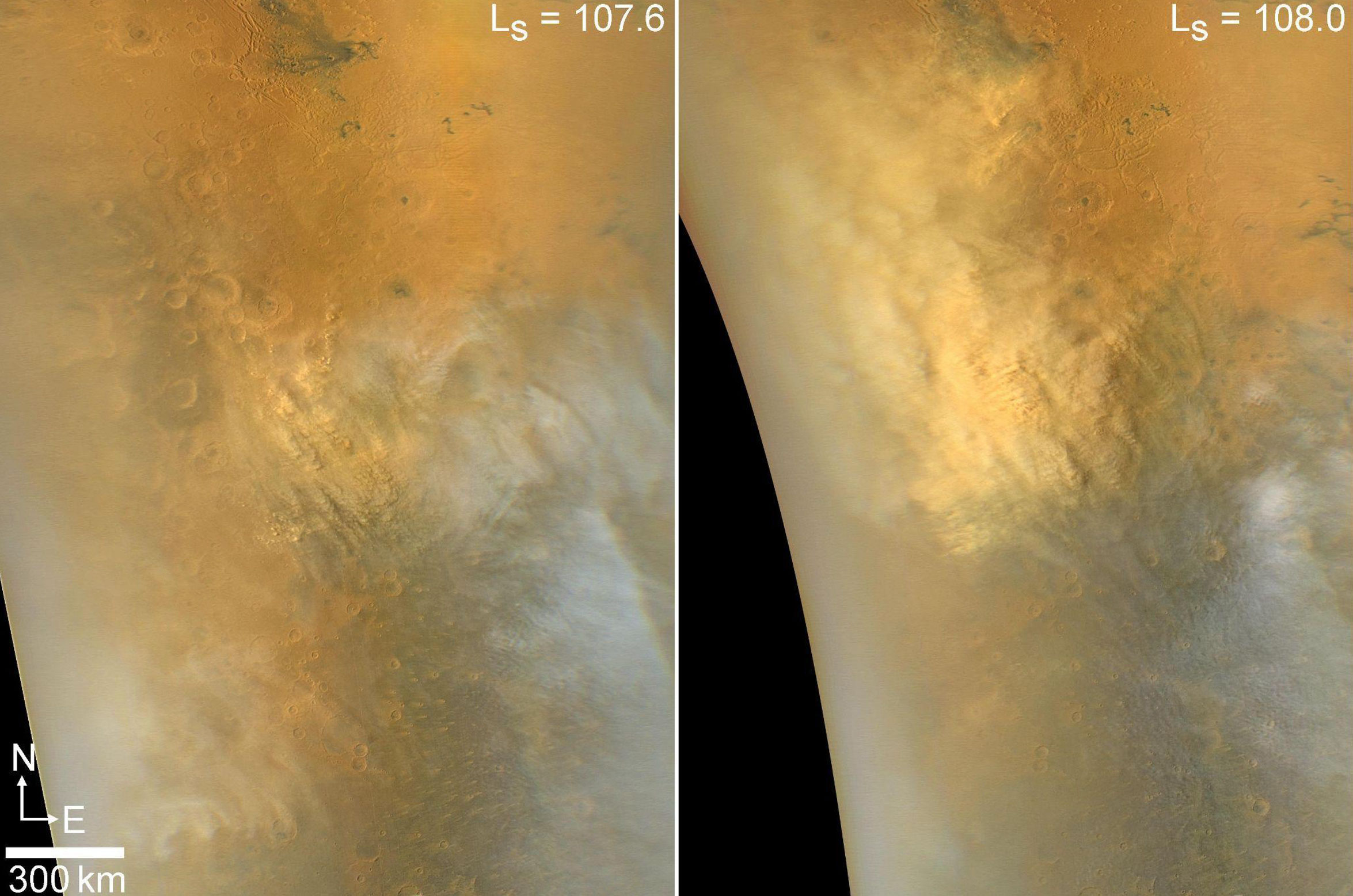
For years, researchers have understood that dust storms can influence how water escapes from Mars. However, most attention has centered on massive storms that engulf the entire planet. The new study shifts that focus by showing that smaller, regional storms can also propel significant amounts of water to very high altitudes, where it can more easily drift off into space.
In addition, earlier work emphasized the Southern Hemisphere summer, which is generally considered the main season for atmospheric water loss because of its warmer and more energetic conditions.
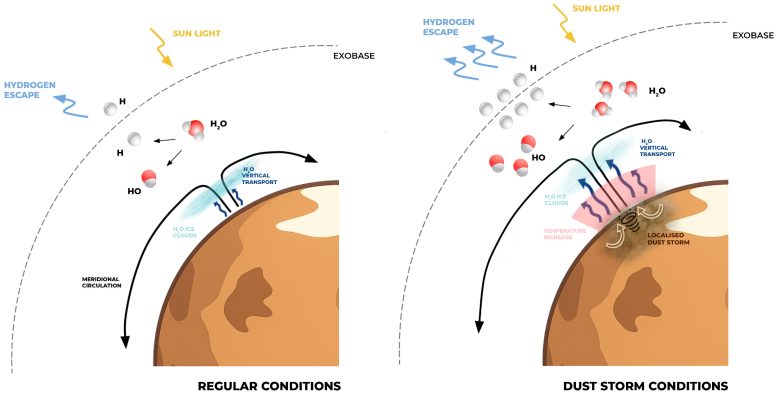
The team observed an unusual surge of water vapor in the middle layers of the Martian atmosphere during the Northern Hemisphere summer of Martian year 37 (2022-2023 on Earth). This spike was linked to an anomalous dust storm. At those heights, water concentrations were up to ten times higher than typical levels. Such an increase had not been recorded in earlier Martian years and was not anticipated by existing climate models.
Hydrogen Escape and Climate Evolution Implications
Soon after this spike in water vapor, scientists detected a marked rise in hydrogen at the exobase – the region where the atmosphere merges with space. Hydrogen levels reached 2.5 times those measured during the same season in previous years. Tracking hydrogen is crucial because when water molecules break apart in the atmosphere, hydrogen can escape into space. Measuring how much hydrogen is lost helps researchers estimate how much water the planet has permanently shed.
“These results add a vital new piece to the incomplete puzzle of how Mars has been losing its water over billions of years, and shows that short but intense episodes can play a relevant role in the climate evolution of the Red Planet,” concludes Aoki (University of Tokyo and Tohoku University).
Reference: “Out-of-season water escape during Mars’ northern summer triggered by a strong localized dust storm” by Adrián Brines, Shohei Aoki, Frank Daerden, Michael S. Chaffin, Samuel A. Atwood, Susarla Raghuram, Bruce A. Cantor, Yannick Willame, Loïc Trompet, Geronimo L. Villanueva, Michael J. Wolff, Michael D. Smith, Christopher S. Edwards, Ian R. Thomas, Giuliano Liuzzi, Lori Neary, Manish R. Patel, Miguel Angel López-Valverde, Armin Kleinböhl, Hoor AlMazmi, James Whiteway, AnnCarine Vandaele, Bojan Ristic and Giancarlo Bellucci, 2 February 2026, Communications Earth & Environment.
DOI: 10.1038/s43247-025-03157-5
Leave a Reply