
February 18, 2026 by Ingrid Fadelli, Phys.org
Collected at: https://phys.org/news/2026-02-ultra-stable-lasers-crystalline-mirrors.html
Lasers, devices that emit intense beams of coherent light in specific directions, are widely used in research settings and are central components of various technologies, including optical clocks (i.e., systems that can keep time relying on light waves as opposed to the vibrations of quartz crystals) and gravitational wave detections.
Over the past decades, physicists have been trying to develop increasingly stable and highly performing lasers that emit more phase-coherent beams of light and could advance the precision of optical interferometry and optical time-keeping devices.
The most dominant approach to stabilize lasers entails the use of pairs of reflective mirrors that face each other, forming a so-called Fabry–Pérot optical cavity. Light bounces back and forth from these mirrors at specific resonant frequencies, forcing a laser to remain at one precise frequency, instead of fluctuating in response to temperature changes or other environmental factors.
Researchers at JILA and Physikalisch-Technische Bundesanstalt (PTB) have introduced a new promising strategy to further stabilize lasers using cavities based on alternative mirror materials, called crystalline mirrors. This strategy, outlined in a paper published in Physical Review Letters, enabled the development of ultrastable lasers that significantly outperform most previously proposed solutions.
JILA is an institute jointly administered by the National Institute of Standards and Technology and the University of Colorado Boulder.
“Our recent work is an extension of a long line of collaborative research between JILA and PTB on ultrastable lasers that has continued over almost two decades,” Dahyeon Lee, first author of the paper, told Phys.org.
Credit: JILA; Physikalisch-Technische Bundesanstalt.
The main objective of the team’s research was to develop more stable lasers using optical cavities based on different types of mirror materials. They thus set out to identify mirrors that would be less affected by noise than dielectric mirror materials commonly employed in the past.
“Frequency stable lasers have played critical roles in advancing the whole field of AMO physics and quantum science,” said Jun Ye, senior author of the paper.
“With system engineering for robust performance at the state-of-the-art level becoming a more urgent task for many groups to advance the functionality of quantum systems, building lasers with improved frequency/phase stability has taken on a more empowering role.”
Using alternative mirror materials
The performance of most ultrastable lasers developed to date has so far been limited by the thermal fluctuations of dielectric mirror coatings, ultra-thin insulating layers deposited on mirror substrates in optical cavities that improve their reflective qualities. To mitigate these fluctuations, Lee, Ye and their colleagues decided to use alternative mirror coatings, specifically crystalline coatings.
“Examples of these materials are crystalline aluminum gallium arsenide (AlGaAs) coatings,” explained Lee. “With crystalline mirrors, we were able to achieve a performance level that is four times better than would be achievable with conventional mirrors. Conventional coating methods, such as ion beam sputtering or vapor deposition, produce amorphous thin films, which typically have more mechanical losses than crystalline coatings.”
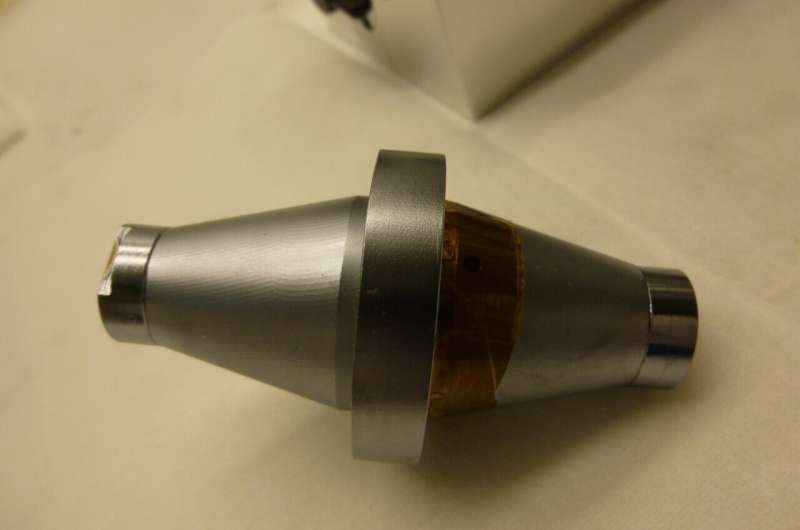
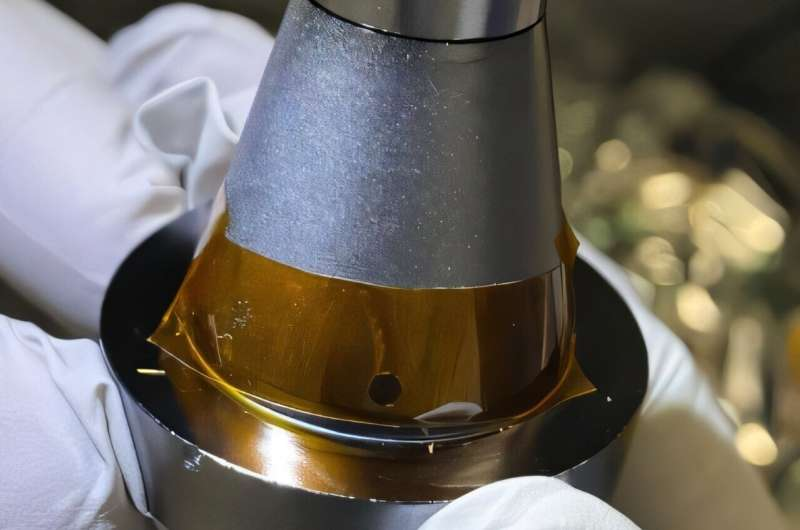
The crystalline coatings used by the researchers are based on AlGaAs, a crystalline semiconductor often used to create optoelectronic devices. The team used these coatings manufactured by Thorlabs and incorporated them in a small silicon optical cavity that was cooled down to 17 K, to reach a zero thermal expansion coefficient for the silicon spacer.
They then locked a laser to this cavity and assessed the extent to which its frequency remained stable over time using another stable cavity and their Sr optical atomic clock in the lab. Their findings were highly promising, as the laser was found to be about four times more stable than other lasers locked to a cavity coated with conventional dielectric coatings.
“So far, there have been lingering questions on whether crystalline mirrors would be competitive for state-of-the-art ultrastable lasers because they were found to exhibit some unexpected noise, including birefringence,” said Lee.
“While the origin of this extra noise is still under investigation, we showed that crystalline mirrors can offer a clear performance advantage over conventional mirrors at the state-of-the-art level, setting a new record for cavity-stabilized lasers.”
Record performance and future possibilities
This study highlights the potential of crystalline mirror coatings for the development of ultrastable lasers. Other researchers could soon draw inspiration from the team’s findings and set out to create similar optical cavities based on crystalline mirrors.
“This confirmation will prompt other researchers to seriously consider crystalline mirrors for their new optical reference cavities or in general, precision optical interferometry,” said Ye.
In the future, the efforts by Lee, Ye and their colleagues could contribute to the advancement of lasers and of various technologies that can benefit from these lasers, including next-generation optical clocks and highly precise navigation systems. Meanwhile, the researchers are planning further studies aimed at boosting the stability of lasers even further.
“Tremendous progress has been made in the last few decades, but there are still ideas for improvement,” added Lee. “In fact, our group is already working on a next-generation optical cavity that is projected to set a new record, and we are also exploring new ideas on how to apply these stable lasers for a range of scientific explorations, including space-based interferometry, communication and navigation.
“We are also interested in continuing to collaborate with the developers of the crystalline coating and explore possibilities for further advancing the coating quality.”
Publication details
Dahyeon Lee et al, Frequency Stability of 2.5×10⁻¹⁷ from a Si Cavity with AlGaAs Crystalline Mirrors, Physical Review Letters (2026). DOI: 10.1103/zgrm-cjbb. On arXiv: DOI: 10.48550/arxiv.2509.13503
Journal information: Physical Review Letters , arXiv
Leave a Reply