
February 16, 2026 by Syl Kacapyr, Cornell University
Collected at: https://phys.org/news/2026-02-blockchain-platform-credibility-carbon-registries.html
As governments and companies race to meet climate pledges, from net-zero goals to near-term emissions cuts, Cornell researchers have developed a blockchain-based platform to improve how those commitments are recorded and verified. Carbon registries serve as repositories for documenting emissions reductions, third-party verification and the issuance of carbon credits that can be bought and sold. But according to Cornell researchers, flaws in how most registries operate can lead to weak verification standards, double counting and misleading claims about how environmentally friendly a product or service is.
“If you can’t measure something in a credible, consistent way, you can’t improve it,” said H. Oliver Gao, professor in the School of Civil and Environmental Engineering and the Systems Engineering program in the Cornell Duffield College of Engineering. “That problem is especially serious for climate action, where trust and credibility really matter.”
New blockchain tool for registries
To address this, Gao and his research group developed a new platform called Climate Action in Transportation (CATchain-R), that uses blockchain technology to improve how carbon registries track emissions reductions, particularly in the transportation sector, where accurate measuring can be a challenge.
The research was published Feb. 13 in the journal npj Climate Action and development of the platform was led by Gao and Xinlai Liu, an Ezra Systems Postdoctoral Associate and visiting lecturer.
How CATchain-R secures climate data
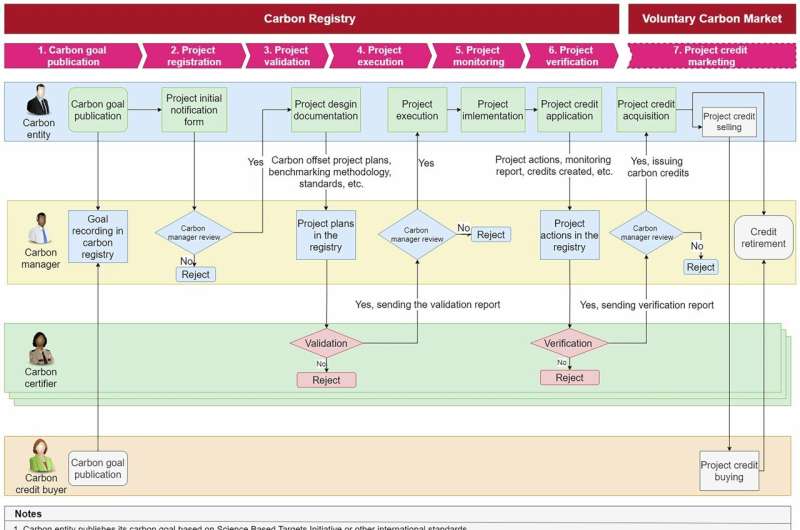
CATchain-R works as a shared digital ledger that records climate commitments, project design documents, verification reports and carbon credits in a permanent, time-stamped sequence. Once information is approved and added, it cannot be altered, creating a traceable record that prevents double counting and can be audited.
Carbon registries involve multiple parties, including project developers, auditors and registry regulators who all rely on the same records. CATchain-R decouples development from verification through registry-mediated auditor selection and automated smart contracts, helping to overcome weak oversight and conflicts of interest.
“A permissioned blockchain provides a shared, tamper-evident digital “Great Wall’ to mitigate climate risks,” Liu said. “Stakeholder submissions and reviews, along with credit issuance, retirement and enforcement actions, become blocks in the digital wall as a permanent record. Over time, that traceability strengthens trust and credibility.”
Rating real-world carbon performance
Beyond certifying individual projects, the platform introduces a carbon credibility index that compares the carbon reduction goals of organizations with what they achieve. The index then assigns or updates a credibility rating, much like a credit rating agency tailored to the transportation sector.
“The goal is to incentivize and motivate what we call carbon entities to become better actors,” said Gao, who also directs the Center for Transportation, Environment, and Community Health at Cornell. “Rather than making promises and failing to deliver, the system encourages them to improve their credibility over time.”
Testing the system in New York City
To test how the platform could inform real-world decision-making, the researchers applied it to New York City’s transportation systems, modeling emissions trends from 2005 through 2050 under two scenarios: a business-as-usual pathway and a pathway following some of the U.S.’ former carbon-reduction goals under the Paris Agreement. The results suggest that the U.S.-aligned pathway can keep transportation emissions closer to the required trajectory for the city, whereas business as usual would reduce emissions too slowly, potentially increasing reliance on external credits.
Co-authors include doctoral student Tolkien Bagchi and Charlle Sy, professor of practice in the Systems Engineering Program.
Publication details
Xinlai Liu et al, A blockchain-based carbon registry platform for credible climate action in transportation, npj Climate Action (2026). DOI: 10.1038/s44168-026-00342-w
Journal information: npj Climate Action
Leave a Reply