
February 14, 2026 by Ingrid Fadelli, Phys.org
Collected at: https://techxplore.com/news/2026-02-atom-thin-ferroelectric-transistor-polarization.html
Over the past few decades, electronics engineers have been trying to develop new neuromorphic hardware, systems that mirror the organization of neurons in the human brain. These systems could run artificial intelligence (AI) models, particularly artificial neural networks (ANNs) more reliably and efficiently than existing devices.
An advantage of neuromorphic systems would be the ability to store many stable memory states, similarly to how synapses (i.e., junctions between neurons) store different connection strengths. A promising route to realize these devices entails the use of ferroelectric materials, which exhibit spontaneous electric polarization and can maintain this polarization even in the absence of electricity.
This property of ferroelectric materials makes them advantageous for the creation of non-volatile memories, devices that can store information without having to be continuously powered. They could also be used to create transistors, components that control the flow of current through electronic devices.
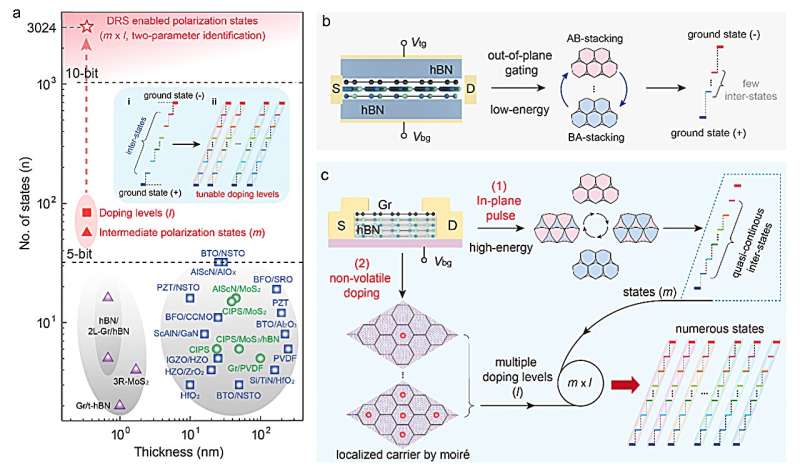
Researchers at Nanjing University of Aeronautics and Astronautics recently introduced a new ferroelectric transistor in which layers of atom-thin materials can slide slightly in relation to each other. This sliding transistor, introduced in a recent paper published in Nature Electronics, was found to store 3,024 stable polarization states, which essentially means that it can hold electric charge patterns in a wide range of different ways.
“Many previous studies investigated sliding ferroelectric devices based on van der Waals homo-bilayers,” Xiaofan Wang, first author of the paper, told Tech Xplore. “These devices exhibit large-area ferroelectric domains comparable in size to the device dimensions, enabling fast and fatigue-resistant switching between two polarization states. However, in the context of artificial intelligence, their ability to achieve multi-state polarization modulation for neuromorphic functionalities remains insufficient.”
The main objective of the recent study by Wang and his colleagues was to improve the performance of sliding ferroelectric devices. To do this, they used graphene (Gr)/hexagonal boron nitride (hBN) heterostructures (i.e., structures with stacked layers of different materials). The two materials in their structures do not line up perfectly and create a characteristic pattern, known as moiré pattern.
Boosting the performance of sliding ferroelectric devices
To create their ferroelectric sliding transistor, the researchers first prepared Gr and hBN layers via mechanical exfoliation, a method to obtain very thin sheets of materials. Subsequently, they built the Gr/hBN heterostructures using a dry-transfer method, an approach to transfer layers of materials without wet solvents.
“Finally, we fabricated source and drain electrodes using a method called electron-beam metal evaporation,” explained Wang. “During electrical measurements, multi-state ferroelectric polarization modulation was achieved by applying a sequence of DC voltage pulses between the source and drain. Furthermore, through the cooperative application of source-drain pulses and gate voltage, we were able to realize on-demand modulation of localized carriers by the moiré potential.”
Two key advantages of the transistor developed by Wang and his colleagues are its simple structure and that it is only a few atoms thick. These qualities facilitate its use for the development of smaller neuromorphic hardware.
“Our device also exhibits superior performance,” said Wang. “The number of tunable polarization states is two orders of magnitude higher than that of existing ferroelectric systems, which can significantly improve the operational energy efficiency of neuromorphic systems.”
Contributing to the advancement of brain-inspired hardware
In initial tests, the new sliding ferroelectric transistor was found to generate more than 36 polarization states when locked in a single operating mode (i.e., doping level). Using gate voltage, the team realized 84 different operating modes (i.e., doping levels). Therefore, the device could store a total of 3,024 unique polarization states.
Remarkably, the states it stored were found to be remarkably stable, lasting more than 100,000 seconds. The researchers also used their transistor to run an AI algorithm for image recognition and found that it achieved an accuracy of approximately 93%.
“Our work significantly expands the number of manipulable polarization states in ferroelectric systems at the nanoscale,” said Wang. “Moreover, this effect can be stably modulated at room temperature and even elevated temperatures, while the material system also holds potential for scalability.”
This recent study could open new possibilities for the realization of miniaturized and high-performance neuromorphic hardware. The new transistor created by the researchers could soon be integrated with other components to create AI-powered devices for specific applications.
“In our future research, we aim to advance the Gr/hBN sliding ferroelectric transistor toward wafer-scale, scalable application, while continuing to enhance its performance in aspects such as response speed, durability and the number of achievable polarization states,” added Wang.
More information: Xiaofan Wang et al, Manipulating thousands of non-volatile polarization states within one sliding ferroelectric transistor at room temperature, Nature Electronics (2026). DOI: 10.1038/s41928-025-01551-7
Journal information: Nature Electronics
Leave a Reply