
February 13, 2026 by Sam Jarman, Phys.org
Collected at: https://phys.org/news/2026-02-crystals-accurate-efficient-timekeepers.html
Time crystals could one day provide a reliable foundation for ultra-precise quantum clocks, new mathematical analysis has revealed. Published in Physical Review Letters, the research was led by Ludmila Viotti at the Abdus Salam International Center for Theoretical Physics in Italy. The team shows that these exotic systems could, in principle, offer higher timekeeping precision than more conventional designs, which rely on external excitations to generate reliably repeating oscillations.
In physics, a crystal can be defined as any system that hosts a repeating pattern in its microscopic structure. In conventional crystals, this pattern repeats in space—but more exotic behavior can emerge in materials whose configurations repeat over time. Known as “time crystals,” these systems were first demonstrated experimentally in 2016. Since then, researchers have been working to understand the full extent of their possible applications.
A reliable timekeeper
In their study, Viotti’s team explored how time crystals could be used to design a practical quantum clock. In existing high-precision designs, devices often operate by cooling trapped ions or atoms to ultra-low temperatures using lasers, then exciting their electrons to higher energy levels. The frequencies of the photons emitted as these electrons decay back to lower energy states, provide an extremely stable reference signal.
Because these optical frequencies are far higher than the microwave frequencies used in older atomic clocks, they enable far more precise timekeeping. However, this improved accuracy comes at a cost: these systems are complex, energy-intensive, and can be challenging to deploy outside specialized lab settings.
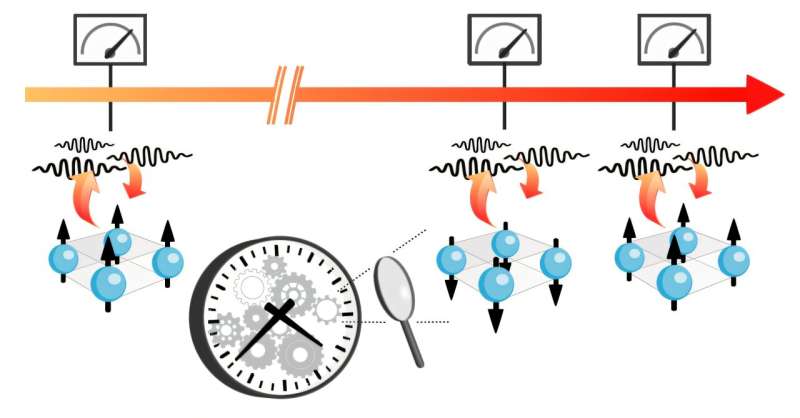
By contrast, time crystals don’t require continuous energy-intensive excitation to sustain their oscillations. Instead, a repeating pattern in a collective observable can emerge and persist due to intrinsic interactions within the system, providing a natural, built-in rhythm.
Comparing phases
To explore this idea, the team simulated an ensemble of 100 quantum particles, each of which could exist in one of two spin states: up or down. Together, these particles generate a vast number of possible collective spin configurations, which evolve over time according to the system’s dynamics.
The system could operate in two distinct phases. In a conventional phase, the evolution of the collective spin configuration can be driven to oscillate by an external laser field. In a time-crystalline phase, by contrast, a self-sustaining repeating pattern emerges without the need for such ongoing excitation.
To test the timekeeping ability of each phase, the researchers compared how accurately the system could resolve increasingly short intervals of time. They found that in the conventional phase, the precision of the clock degraded rapidly as finer time resolutions were probed. In the time-crystalline phase, however, the precision remained far more robust under the same conditions.
Long road to practical applications
For now, significant technological advances will be needed before time crystals can realistically be implemented in practical quantum clocks. Nonetheless, Viotti and colleagues hope their mathematical demonstration will encourage further experimental and theoretical studies.
If the approach can eventually be realized in the laboratory, it could open new possibilities for technologies ranging from satellite navigation systems, to ultra-sensitive detectors of magnetic fields.
Publication details
Anonymous, Quantum time crystal clock and its performance, Physical Review Letters (2026). DOI: 10.1103/dj21-gmdj . On arXiv: arxiv.org/abs/2505.08276
Journal information: arXiv , Physical Review Letters
Leave a Reply