
February 11, 2026 by Sam Jarman, Phys.org
Collected at: https://phys.org/news/2026-02-electronic-friction-tuned.html
Researchers in China have isolated the effects of electronic friction, showing for the first time how the subtle drag force it imparts at sliding interfaces can be controlled. They demonstrate that it can be tuned by applying a voltage, or switched off entirely simply by applying mechanical pressure. The results, published in Physical Review X, could inform new designs that allow engineers to fine-tune the drag forces materials experience as they slide over each other.
Friction’s hidden electronic side
In engineering, friction causes materials to wear and degrade over time, and also causes useful energy to be wasted as heat. While this problem can be mitigated through lubricants and smoother surfaces, friction can also arise from deeper, more subtle effects.
Among these is an effect which can occur at metallic or chemically active surfaces as they slide past one another. In these cases, atomic nuclei in one surface can transfer some of their energy to electrons in the other surface, exciting them to higher energy levels. This lost energy produces a drag force that increases with sliding velocity: an effect known as “electronic friction.”
So far, this effect has proven difficult to study because it cannot easily be separated from phononic friction: a better-known mechanism generated by atomic-scale vibrations, which also dissipate the energy of moving surfaces.
Building a platform to isolate drag
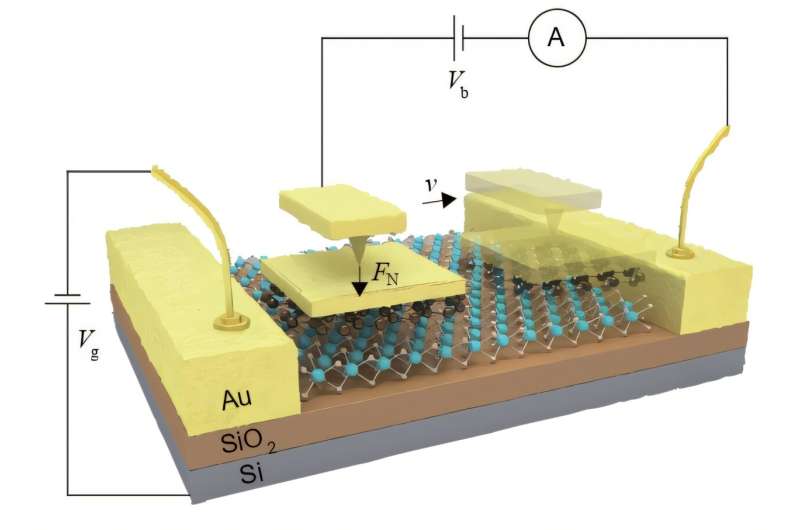
To tackle this challenge, a team led by Zhiping Xu at Tsinghua University, Beijing, designed an experimental setup involving a moving graphite surface sliding over a fixed bottom surface. For the lower layer, they repeated the experiment with several different materials, including metallic, semiconducting and insulating samples.
By slightly rotating the atomic lattices of the two surfaces relative to each other, they exploited structural superlubricity: a state in which atomic-scale vibrations are almost entirely suppressed. With phononic friction minimized, any remaining friction could be attributed primarily to electronic effects. Using this platform, the team carried out a series of experiments guided by theoretical models predicting how electronic friction should vary.
Turning electronic friction on and off
When they applied mechanical pressure to the top surface, they found that the electronic states in the two layers began to overlap and hybridize into a single, shared system. This reduced the electronic excitations generated during sliding, allowing them to switch off electronic friction entirely.
They also applied a bias voltage across the device, which altered the electronic coupling and charge distribution at the interface. Rather than eliminating electronic friction, this approach allowed the researchers to fine-tune its magnitude simply by adjusting the applied voltage.
By disentangling the effects of electronic and phononic friction, the team’s results provide clear insights into how friction can be controlled and reduced with far greater precision. With further technological advances, the approach could eventually lead to devices that enable precise, real-time control over friction in nanoscale systems.
Publication details
Zhaokuan Yu et al, On-device control of electronic friction, Physical Review X (2026). DOI: 10.1103/jlc2-qmr1. On arXiv: DOI: 10.48550/arxiv.2507.03986
Journal information: arXiv , Physical Review X
Leave a Reply