
February 13, 2026 by Kanazawa University
Collected at: https://techxplore.com/news/2026-02-ai-powered-digital-twin-enables.html
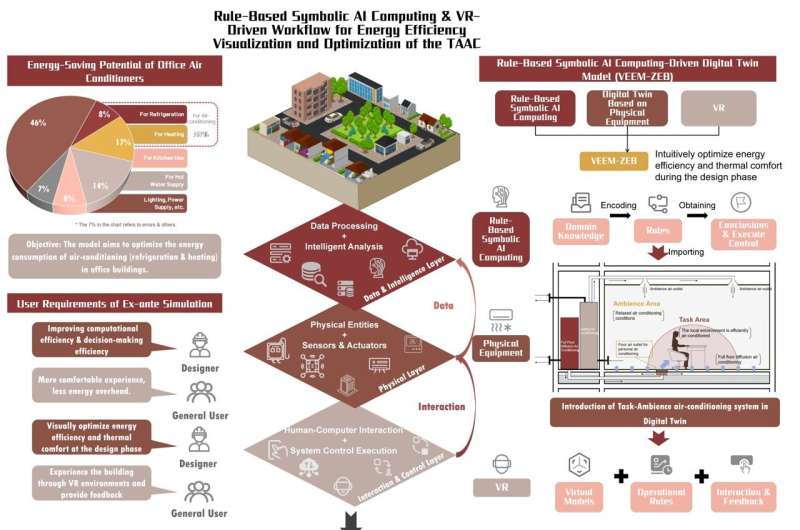
In the context of global decarbonization, reducing energy consumption in the building sector is an urgent issue. Researchers have developed a next-generation building energy evaluation model that combines rule-based symbolic AI computing with VR technology. This model enables real-time visualization and simultaneous evaluation of the energy-saving effects and indoor thermal comfort during the design stage of a Zero-Energy Building. This approach will have a wide range of applications in the design of next-generation smart buildings.
The work is published in the journal Sustainable Cities and Society.
Why conventional design tools fall short
In recent years, in the context of global decarbonization, reducing energy consumption in buildings has become an important issue. In designing a zero-energy building (ZEB), achieving both energy efficiency and occupant comfort is a crucial challenge in realizing sustainable architecture. However, static simulation methods widely used up until now have difficulty in fully evaluating changes in heat load and indoor environment during the design stage. This has led to uncertainty in design decisions.
In particular, Task-Ambience air conditioning (TAAC) systems, which separately control the workspaces of individual occupants and the entire room, have been reported to save energy during operation. However, evaluation methods were not readily available for use at the design stage.
Developing a digital twin evaluation model
In this study, therefore, the researchers aimed to develop a digital twin-type evaluation model that can be used from the design stage to visualize and evaluate in advance the energy-saving effects and comfort of air conditioning.
The research group led by Prof. Teng of College of Transdisciplinary Sciences for Innovation, Kanazawa University, in collaboration with a scientist of Fushou University, China, developed a rule-based symbolic AI computing-driven digital twin model, “VEEM-ZEB,” that can simultaneously evaluate energy consumption and indoor thermal comfort during the architectural design stage (ex-ante) of a ZEB using a TAAC system.
How the VEEM-ZEB system works
This model is characterized by its ability to explicitly separate the thermal loads of task air conditioning and ambience air conditioning, and to perform integrated thermal comfort and energy evaluations based on PMV/PPD indices. Furthermore, the visualization environment integrated with VR shows energy consumption and comfort indices in real time, realizing a design support mechanism that allows designers to instantaneously check evaluation results while manipulating conditions.
In addition, based on standardized parameter settings, the model is able to systematically generate and analyze approximately 48,000 design and operating scenarios. As a result of sensitivity analysis taking into account differences in seasonal conditions, occupancy density, and behavioral modes, as well as demonstration in office spaces, this method was able to reduce air conditioning energy consumption by approximately 7.0 to 8.5% with a stable average annual energy-saving effect of 7.62%.
Impact on ZEB design and practice
The novelty of this research lies in that it enables TAAC performance evaluation, which previously relied on the operational stage, to be carried out at the design stage, and that it has established a three-layered digital twin evaluation platform that integrates a highly explainable and reproducible computing method using rule-based symbolic AI with an intuitive visualization environment using VR. This makes it possible to quantitatively compare air conditioning methods and control strategies at an early design stage.
The results of this research make it possible to simultaneously visualize and evaluate the energy-saving effects and indoor comfort of air conditioning systems at the design stage before building completion. The model developed here is expected to be introduced into architectural design practice as a decision-making support tool for rational ZEB design that achieves both comfort and energy efficiency.
This technology can be applied to a wide range of architectural applications, including offices and public, educational and medical facilities, and will contribute to reducing energy consumption and utility costs through the spreading of efficient air conditioning designs. Furthermore, as a pre-assessment method integrating rule-based symbolic AI and digital twins, this technology is expected to contribute to the development of architectural environmental engineering and ZEB design research.
More information: Xiao Teng et al, Rule-based symbolic AI computing-driven digital twin model for ex-ante energy evaluation of task-ambience air conditioning systems in zero-energy buildings, Sustainable Cities and Society (2025). DOI: 10.1016/j.scs.2025.106947
Leave a Reply