
February 10, 2026 by Zhang Nannan, Chinese Academy of Sciences
Collected at: https://phys.org/news/2026-02-situ-sensor-enables-real-soil.html
Accurate measurement of soil NO₃⁻-N is essential for precision fertilization and stable crop yields. Real-time monitoring of NO₃⁻-N has long been a challenge in agriculture. Conventional soil nutrient testing relies on time-consuming laboratory-based chemical analysis. Existing nitrogen monitoring technologies also have limitations regarding in situ deployment, temporal resolution, and continuous tracking. Furthermore, they are susceptible to interference from soil moisture, salinity, and complex field conditions. This makes them inadequate for the high-frequency, large-scale monitoring required by modern precision agriculture.
Researchers from the Institute of Applied Ecology (IAE) of the Chinese Academy of Sciences have developed a new sensor that can rapidly monitor soil nitrate nitrogen (NO₃⁻-N), a key nutrient for crop growth. Their study is published in ACS Sensors.
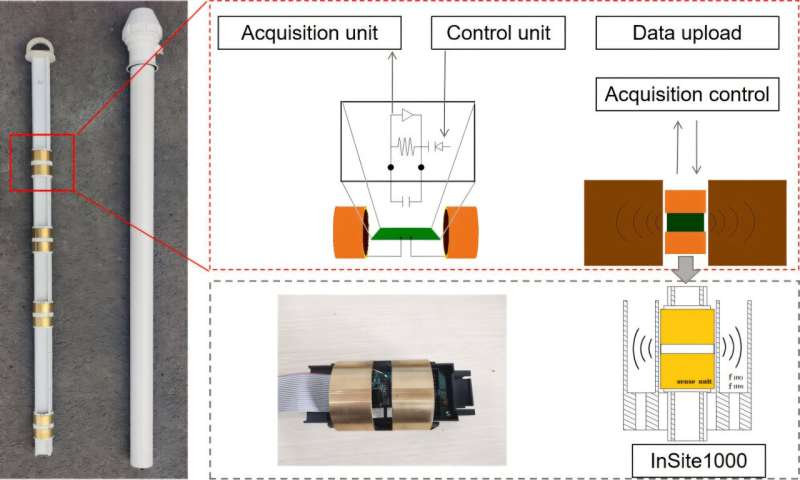
Gu Jian’s team at IAE, together with collaborators, developed their in-situ NO₃⁻-N sensor based on dielectric spectroscopy micro domain mediation analysis and component response algorithm construction theory. This approach enables the separation of overlapping signals from different soil components.
The sensor operates through a dual-band frequency-splitting mechanism. In the low-frequency range of 1–50 MHz, stable impedance matching helps suppress interference from soil moisture and salinity. In the high-frequency range of 100–500 MHz, enhanced electromagnetic coupling allows the sensor to capture the characteristic relaxation signals of NO₃⁻-N with high sensitivity.
According to the researchers, the coordinated use of the two frequency bands enables more reliable identification of NO₃⁻-N under complex field conditions. Field tests were carried out across five soil types, including brown, black, red, saline-alkali, and loess soils.
The results showed strong agreement between the sensor readings and the values measured in the laboratory, with determination coefficient (R²) values ranging from 0.943 to 0.987, which indicates high accuracy.
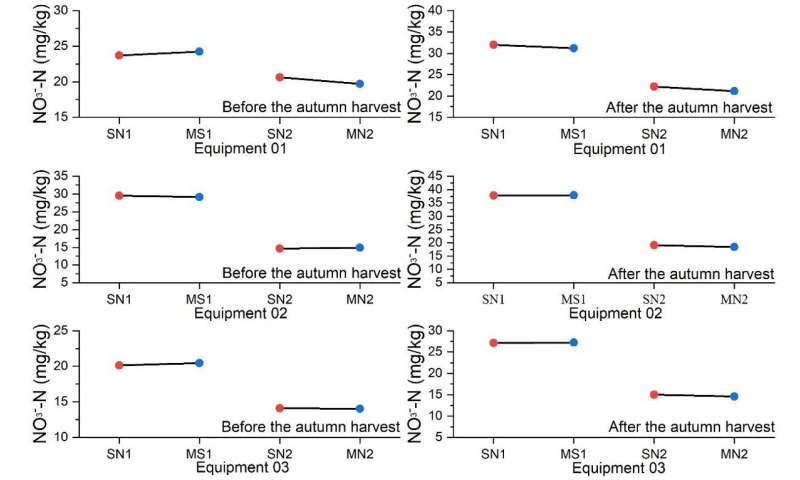
The researchers also tested the sensor under typical agricultural scenarios, including before and after critical events such as fertilization, precipitation events and autumn harvest activities. Even in these dynamic conditions, the monitoring results closely tracked actual changes in soil NO₃⁻-N, demonstrating the sensor’s suitability for continuous field use.
The sensor achieved millisecond-level response times while maintaining low measurement error. Even under extreme conditions such as subzero temperatures and high humidity, signal drift remained minimal, indicating stable performance.
By providing high-resolution, real-time data on soil nitrate, this technology is expected to support more precise fertilizer application, and contribute to the development of intelligent and sustainable agricultural systems.
Publication details
Yongqi Liu et al, In Situ Rapid Detection of Soil Nitrate Nitrogen via Dielectric Spectroscopy Using a Dual-Band Frequency-Splitting Coupled Sensor, ACS Sensors (2025). DOI: 10.1021/acssensors.5c03028
Journal information: ACS Sensors
Leave a Reply