
February 9, 2026 by Rice University
Collected at: https://techxplore.com/news/2026-02-scientists-camouflage-heart-invasive-radar.html
It’s a typical workday and you sign onto your computer. Unbeknownst to you, a high-frequency sensing system embedded in your work device is now tracking your heart rate, allowing your employer to monitor your breaks, engagement, and stress levels and infer alertness. It sounds like a dystopian scenario, but some believe it’s not so far from current reality.
Biometric tracking is already common in everyday technology, from radar-based imaging used for facial authentication to wearables that monitor signals like heart rate and sleep cycles. Designed to make everyday life safe and easy, these technologies also open the door to privacy infringement. Off-the-shelf devices such as millimeter-wave radars can be used to eavesdrop on phone conversations and monitor daily movement patterns or even subtler signals like breathing and heart rate to determine a target’s presence and emotional state.
Researchers at Rice University explored the scenario above in a recent study using two characters—Trudy, a malicious intruder with a radar, and Alice, the unwitting target—to show that millimeter-wave sensing could be used to determine whether someone is present and to potentially infer stress, fatigue, or other details about their physical or emotional state by tracking their heart rate.
The study is published in the journal Computer Communications.
“We used this scenario to stage a technologically possible use case for a radar-based heart rate monitoring system,” said Dora Zivanovic, a graduate student in the lab of Edward Knightly, the Sheafor-Lindsay Professor of Electrical and Computer Engineering at Rice.
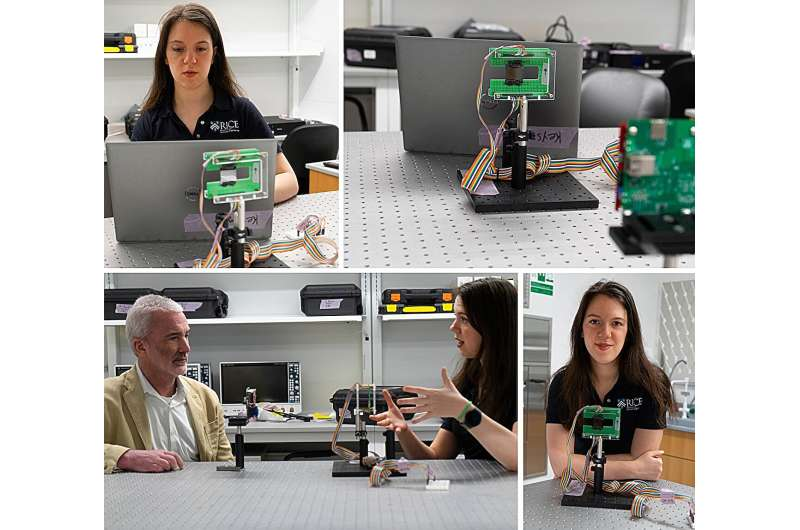
MetaHeart can also make it appear that someone is present when they are not. Credit: Rice University
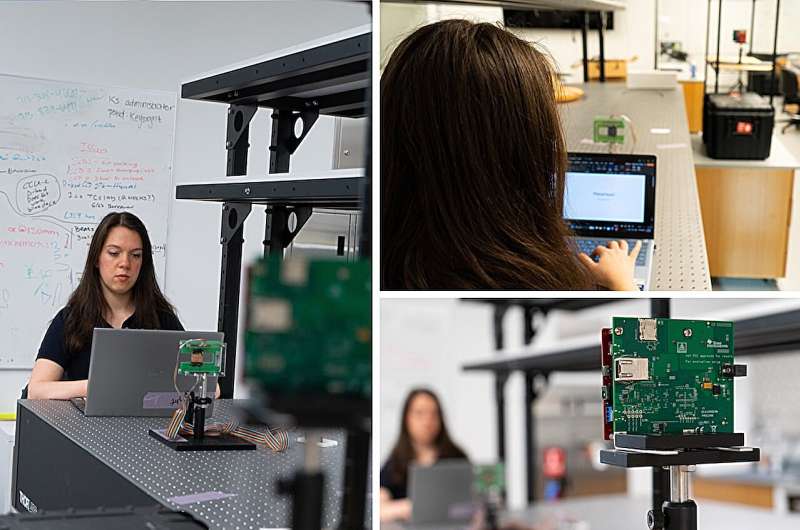
The study also equips Alice with the means to retaliate by not just camouflaging their biometric signal but also spoofing the intruder. The research team’s countermeasure, called MetaHeart, misleads the radar through a programmable metasurface that reflects back to the tracker a fabricated heartbeat pattern, i.e., a sort of biometric decoy.
“We fool the radar on the level of the electromagnetic signal itself,” Zivanovic said. “You can program the device with any heartbeat pattern you like.”
In lab tests using a 77-gigahertz radar, MetaHeart was able to spoof heartbeat inferences with an accuracy above 98%. The metasurface-based device can even make it appear that someone is present when they are not.
“Sensing technologies are becoming higher resolution and more pervasive, and concerns around what that means for privacy should be taken seriously,” said Knightly, the senior researcher on the study. “It is important to explore potential vulnerabilities and think about how we might address them.”
More information: Dora Zivanovic et al, MetaHeart: Metasurface enabled biometrics camouflage, Computer Communications (2026). DOI: 10.1016/j.comcom.2025.108405
Leave a Reply