

By Nuclear Science and Techniques February 5, 2026
Collected at: https://scitechdaily.com/a-tiny-particle-flip-could-reveal-new-laws-of-the-universe/
A high-precision experiment is hunting for a forbidden particle flip that could expose new physics hiding in plain sight.
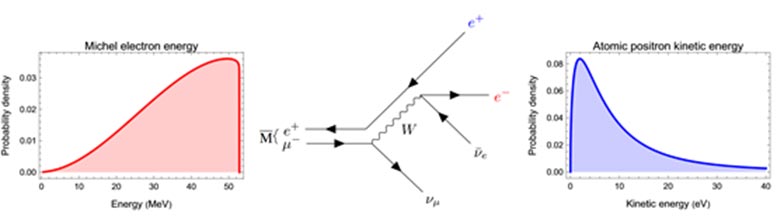
A major international research effort led by scientists at Sun Yat-sen University and the Institute of Modern Physics of the Chinese Academy of Sciences is behind a new experiment called MACE. The goal is to investigate whether muonium, a short-lived system made of a positive muon and an electron, can spontaneously convert into antimuonium, its antimatter counterpart.
According to current physics theory, such a change should never occur. Detecting it would signal a breakdown of lepton flavor conservation, a core principle of the Standard Model of particle physics, and would provide direct evidence of physics beyond today’s framework.
“The conversion of muonium to antimuonium represents a clean and unique probe of new physics in the leptonic sector,” explains the research team. “Unlike other charged lepton flavor violation processes, this conversion is sensitive to ∆Lℓ = 2 models that are fundamentally distinct and could reveal physics inaccessible to other experiments.”
Building an Experiment With Unprecedented Sensitivity
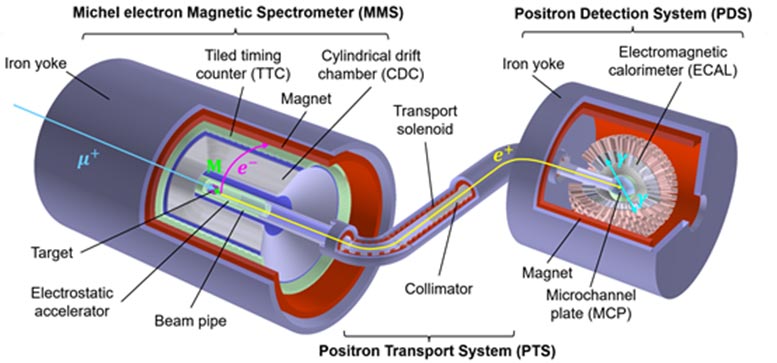
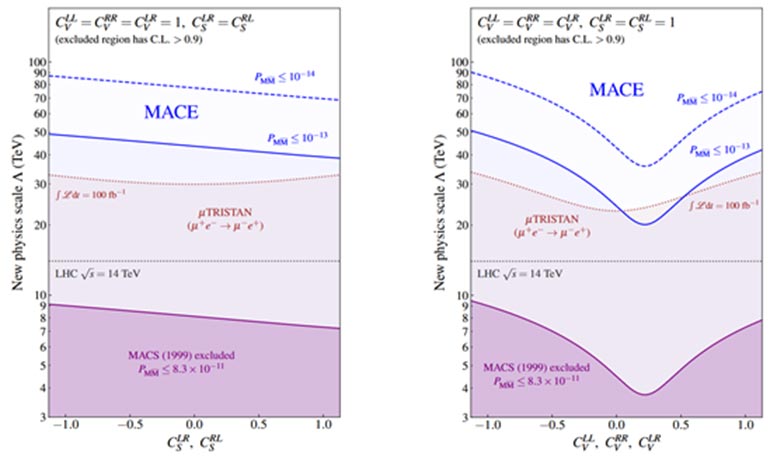
The strongest experimental constraint on muonium converting into antimuonium dates back to 1999, when it was set at the Paul Scherrer Institute in Switzerland. MACE is designed to go far beyond that result, improving sensitivity by more than two orders of magnitude and aiming to detect conversion probabilities as small as O(10-13). Achieving this level of precision requires advances across the entire experimental system, from the particle beam to the detectors.
Key components include a high-intensity surface muon beam, a newly developed silica aerogel target optimized for muonium production, and an advanced detector system capable of separating an extremely rare signal from overwhelming background noise.
“Our design integrates advanced beam, muonium production target, and detector technology to isolate the signal from formidable backgrounds,” says the team. “This makes MACE one of the most sensitive low-energy experiments searching for lepton flavor violation.”
What Discovery Would Mean for Physics
A successful observation would allow scientists to explore new physics at energy scales reaching 10-100 TeV, a range comparable to or even beyond what future particle colliders are expected to access. MACE also includes a planned Phase-I program that will search for additional rare muonium decays and lepton flavor-violating processes, including M→γγ and μ→eγγ, with sensitivity levels never achieved before.
The benefits of the project extend beyond fundamental physics. Technologies developed for MACE, such as advanced muonium production targets, low-energy positron transport systems, and high-resolution detectors, could also support research in materials science, medical technology, and other applied fields.
A Broader Push in Global Particle Physics
MACE is part of a larger scientific effort based at Huizhou’s major research facilities, including the High-intensity heavy-ion Accelerator Facility (HIAF) and the China initiative Accelerator Driven System (CiADS). Together, these projects aim to strengthen China’s role in high-precision nuclear and particle physics. By using these world-class facilities, MACE highlights how fundamental research can drive both technological development and international collaboration.
“We are not just building an experiment; we are opening a new window into the laws of nature,” the team notes. “Each component of MACE—from the beamline to the software—has been optimized to explore physics that could redefine our understanding of matter, symmetry, and the universe itself.”
Reference: “Conceptual design of the muonium-to-antimuonium conversion experiment (MACE)” by Ai-Yu Bai, Han-Jie Cai, Chang-Lin Chen, Si-Yuan Chen, Xu-Rong Chen, Yu Chen, Wei-Bin Cheng, Ling-Yun Dai, Rui-Rui Fan, Li Gong, Zi-Hao Guo, Yuan He, Zhi-Long Hou, Yin-Yuan Huang, Huan Jia, Hao Jiang, Han-Tao Jing, Xiao-Shen Kang, Hai-Bo Li, Jin-Cheng Li, Yang Li, Da-Ming Liu, Shu-Lin Liu, Gui-Hao Lu, Han Miao, Yun-Song Ning, Jian-Wei Niu, Hua-Xing Peng, Alexey A. Petrov, Yuan-Shuai Qin, Ming-Chen Sun, Jian Tang, Jing-Yu Tang, Ye Tian, Rong Wang, Xiao-Dong Wang, Yi Wang, Zhi-Chao Wang, Chen Wu, Tian-Yu Xing, Wei-Zhi Xiong, Yu Xu, Bao-Jun Yan, De-Liang Yao, Tao Yu, Ye Yuan, Yi Yuan, Yao Zhang, Yongchao Zhang, Zhi-Lv Zhang, Guang Zhao and Shi-Han Zhao, 28 January 2026, Nuclear Science and Techniques.
DOI: 10.1007/s41365-025-01876-0
Leave a Reply