
February 6, 2026 by Krystal Kasal, Phys.org
Collected at: https://phys.org/news/2026-02-quantum-encryption-method-city-sized.html
Concerns that quantum computers may start easily hacking into previously secure communications has motivated researchers to work on innovative new ways to encrypt information. One such method is quantum key distribution (QKD), a secure, quantum-based method in which eavesdropping attempts disrupt the quantum state, making unauthorized interception immediately detectable.
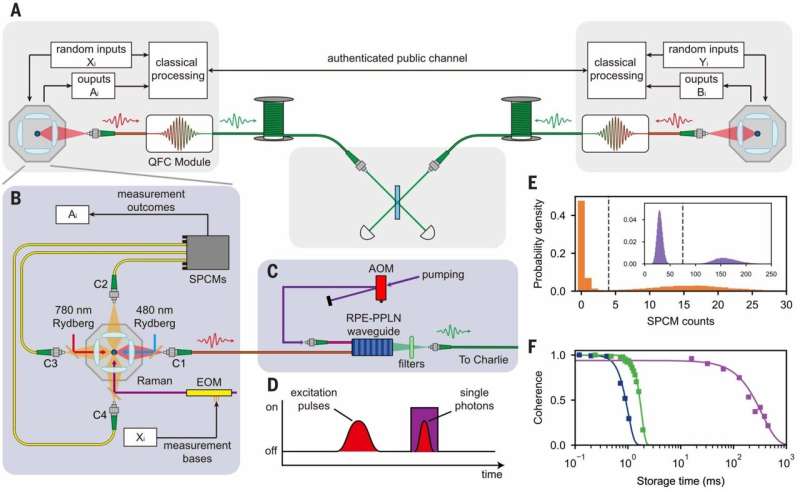
Previous attempts at this solution were limited by short distances and reliance on special devices, but a research team in China recently demonstrated the ability to maintain quantum encryption over longer distances. The research, published in Science, describes device-independent QKD (DI-QKD) between two single-atom nodes over up to 100 km of optical fiber.
Device independence in QKD
QKD enables secure communication but still requires the use of a medium, like fiber optic cables. The transmission efficiency of quantum particles decreases exponentially with distance within these optical fibers. To increase the travel distance, devices are used to boost transmission efficiency. Yet, these devices present another issue. The devices require precise calibrations to ensure security, which equates to inconvenience in real-world applications, limiting scalability.
The solution is thought to be device-independence in QKD, or DI-QKD systems, which use quantum entangled particles. If a hacker attempts to intercept, the entangled state gets disrupted. Communication must stay only between the sender and the intended receiver.
However, this method suffers from its own limitations. Early DI-QKD used trapped ions or photons, which achieved positive key rates only over short distances of up to a few hundred meters. Later advances in quantum frequency conversion and single-photon interference improved entanglement distance, but not enough for practical use in DI-QKD. Technical difficulties in entanglement fidelity and detection efficiency have continued to plague researchers developing these technologies.
Pushing the limits
In the new study, researchers were able to reduce fiber loss by employing single-photon interference—in which quantum-entangled pairs are produced on demand by using a detector to announce the successful creation of the state. They also employed quantum frequency conversion to lower-loss telecom wavelengths. This achieved high-fidelity atom-atom entanglement and positive secure key rates at tested distances of 11, 20, 50, 70, and 100 km.
The study authors write, “The use of single-photon interference scheme for remote entanglement heralding enabled us to obtain a metropolitan entangling speed that is orders of magnitude higher than the two-photon–based schemes used in previous DI-QKD experiments.”
The team notes that CHSH Bell inequality violations, which guarantee security by proving the presence of quantum entanglement, were maintained at all distances, with secure key generation up to 100 km.
Remaining limitations and future potential
Despite the achievement, it will likely be a while before DI-QKD is practical enough for widespread use. All nodes in the experiment were in the same lab, so the locality loophole is not closed. And event rates still decrease with distance, due to fiber loss. However, further distance extension may be possible with lower-loss fibers and improved frequency conversion in the future.
The study authors write, “The demonstration of device-independent QKD at the metropolitan scale helps close the gap between proof-of-principle quantum network experiments and real-world applications. Beyond DI-QKD, the architecture demonstrated here offers a versatile platform for device-independent quantum random number generation (DI-QRNG), self-testing of quantum devices, and a fundamental test of quantum mechanics.
“Moreover, the high-fidelity entanglement we demonstrate can serve not only as a valuable resource for quantum network applications but also as a fundamental building block for scaling up quantum networks.”
Publication details
Bo-Wei Lu et al, Device-independent quantum key distribution over 100 km with single atoms, Science (2026). DOI: 10.1126/science.aec6243
Journal information: Science
Leave a Reply