
February 5, 2026 by Benny Evangelista, Lawrence Livermore National Laboratory
Collected at: https://phys.org/news/2026-02-lasers-brighter-plasma.html
Measuring conditions in volatile clouds of superheated gases known as plasmas is central to pursuing greater scientific understanding of how stars, nuclear detonations and fusion energy work. For decades, scientists have relied on a technique called Thomson scattering, which uses a single laser beam to scatter from plasma waves as a way to measure critical information such as plasma temperature, density and flow.
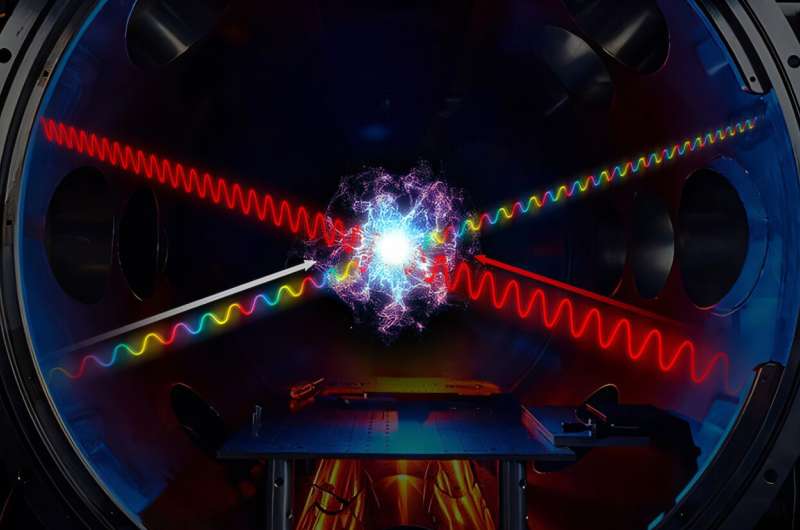
Now, however, a multidisciplinary team of Lawrence Livermore National Laboratory (LLNL) researchers has successfully demonstrated a potentially simpler, more accurate way to measure plasma conditions with two laser beams that cross paths, creating a data signal that is about a billion times stronger than what is available from the Thomson scattering method.
This method could give physicists working on complex high energy density science and inertial confinement fusion (ICF) research at facilities like LLNL’s National Ignition Facility (NIF) an innovative new tool.
The work is published in the journal Physical Review Letters.
“The proof of principle worked beautifully and now we’re exploring how we can take this to the next level,” said LLNL experimental physicist Andrew Longman, the lead author of the paper.
Thomson scattering
Plasma, a fast‑moving, superheated mix of free electrons and ions, is sometimes called the “fourth state of matter” and behaves differently than familiar solids, liquids and gases.
For decades, physicists have typically used Thomson scattering, with instruments like spectrometers detecting tiny amounts of light that scatter off energized plasma particles. The data gleaned from this scattered light can be used to characterize the density, temperature and velocity of those electrons.
“When we’re doing implosions at NIF, knowing the conditions where all these lasers cross is really important because that tells us how energy is transferred from one to another,” Longman said. “It affects the implosion symmetry. NIF and other facilities have struggled to measure these conditions.”
Improvements such as NIF’s sophisticated Optical Thomson Scattering Laser System helped refine ICF experiments at NIF, the world’s most energetic laser system and the only lab on earth where fusion ignition has been achieved. Ignition, which produces more fusion energy than the amount of laser energy delivered to the NIF target, has provided more opportunities to understand the environments found inside stars or nuclear explosions.
However, the weak Thomson scattering signals that come back remain a challenge.
“Basically, the signal that you measure is really like enhanced noise from the plasma, but it’s very tiny,” said LLNL physicist Pierre Michel. “A lot of background noise gets added to it.”
Crossed-beam energy transfer
Several years ago, however, a team of LLNL researchers that included then-NIF & Photon Science summer scholar Joshua Ludwig theorized that the interaction of two crossed beams could provide a novel solution.
Ludwig and Michel, his mentor, were researching the effects of crossed-beam energy transfer (CBET) in ICF experiments, when NIF fires up to 192 laser beams into a small, hollow cylinder called a hohlraum. The resulting bath of X-rays triggers the fusion of light atoms inside a peppercorn-sized fuel capsule suspended inside the hohlraum. CBET, which is the exchange of energy between overlapping laser beams as they enter the hohlraum’s entrance holes, is now used to fine-tune the energy balance of NIF implosions.
But Ludwig and Michel also began developing a theory that CBET could be used as a plasma diagnostic.
“We kept pulling the strings (of the theory) a little bit and Josh, with the best simulation tools that we have here at the Lab, showed that it should work in an experiment,” Michel said.
One shot, two beams
With the CBET technique, one “pump” beam is aimed into the plasma. A second weaker “probe” beam that contains different color wavelengths of light is aimed to intersect that pump beam. The energy transfer to the probe beam includes characteristics of the plasma that are picked up by the pump beam.
With Thomson scattering, several shots might be required to look for different plasma characteristics. But at busy facilities like NIF, the time for multiple shots is scarce and strictly allocated, and the plasma conditions can change from shot to shot.
Because the new technique uses a probe beam tuned to a broadband spectrum, it provides a more comprehensive look at all the plasma’s properties in just one shot with a signal that is more than a billion times stronger than with Thomson scattering. In other words, what used to be a whisper can now come back as a shout.
In addition, the probe beam’s lower power does not introduce its own unintended changes in the plasma. That is important because the measurement itself should not disturb the very conditions scientists are trying to understand.
The novel theory became a spinoff student project that resulted in a paper, “Single Shot High Bandwidth Laser Plasma Probe,” published in November 2019 in Physics of Plasmas.
STILETTO
At the time that paper was published, the researchers were not able to test the technique in real-world experiments because the necessary equipment was not yet available. That would soon change with the four-year refurbishment project at LLNL’s Jupiter Laser Facility (JLF).
One notable addition to JLF was an advanced laser pulse-shaping technology called STILETTO (Space-Time Induced Linearly Encoded Transcription for Temporal Optimization). Invented at LLNL, STILETTO lets researchers shape laser pulses in “very sophisticated and exquisite ways,” Michel said.
Longman, who joined the Lab in 2021, was part of the NIF&PS team that helped implement STILETTO at JLF. He designed an experiment to test the crossed-beam plasma measurement theory. It was the first experiment to use STILETTO.
“The probe laser that you send through has to be the same wavelength as those drive lasers, but it has to have a lot of bandwidth,” Longman said. “And adding bandwidth and shaping requires specialized lasers and specialized tools.”
With Thomson scattering, only one of every billion photons sent in comes back to the measurement detectors. With the CBET solution, all the incoming photons can be directly collected.
“The signal was so bright that we had to filter it down by about a factor of 10,000 just so it wasn’t blinding the camera,” Longman said. “Usually it’s the complete opposite problem, we don’t have enough light. And in this situation, too much is definitely better than not enough.”
Setting up the initial experiment at JLF in early 2025 took about six or seven weeks of fine tuning “to try to find the magical recipe,” he said. “But then when we did it, we realized that it really works well.”
“A lot of people fail when they’re trying to do Thomson scattering just because it requires a lot of experience and finesse, whereas this new mechanism is reasonably straightforward,” he said. “We were able to set this up for the first time and demonstrate it in seven weeks. That plays into just how simple this new technique is.”
Team science
Longman noted the experiment was an excellent example of the team research that is a noted strength of LLNL.
“It’s really been a remarkable experiment in that it brought together lots of different components from different parts of the Lab,” Longman said. “We had the physicists working on this problem from their side. We’ve had laser physicists working on designing and building this new STILLETO device. We had the laser technicians and the Jupiter Laser Facility supporting it. It’s really opened a lot of doors.”
Michel also praised Longman’s experiment.
“Usually, when you try something like that in an experiment, it takes a few tries until it actually works,” Michel said. “And that’s where Andrew was wonderful because he set up an experiment that was just exceptional. The fact that it worked so well the first time, that doesn’t happen very often.”
Longman and Michel say the new technique won’t be a replacement for Thomson scattering but instead will be complementary. They are now investigating how it can be implemented at NIF.
At NIF, the pump beam would be the same wavelength as the beams that drive the implosion and aiming the second beam is “just like pointing a red laser pointer across the room and aligning it into a spectrometer,” Longman said. “And almost everyone can do that.”
Publication details
A. Longman et al, Pump with Broadband Probe Experiments for Single-Shot Measurements of Plasma Conditions and Crossed-Beam Energy Transfer, Physical Review Letters (2025). DOI: 10.1103/96yh-96pw. On arXiv: DOI: 10.48550/arxiv.2508.11156
Journal information: Physics of Plasmas , Physical Review Letters , arXiv
Leave a Reply