
February 3, 2026 by University of Adelaide
Collected at: https://phys.org/news/2026-02-ai-math-anxiety-student-feedback.html
Math anxiety is a significant challenge for students worldwide. While personalized support is widely recognized as the most effective way to address it, many teachers struggle to deliver this level of support at scale within busy classrooms. New research from Adelaide University shows how artificial intelligence (AI) could help address challenges such as math anxiety by using a student’s inputs and identifying signs of anxiety or disengagement during learning.
Published in npj Science of Learning, the study suggests that when AI systems are designed to use the right data and goals, they can adapt their responses to help counteract negative emotional experiences associated with math, before these feelings escalate.
Lead researcher Dr. Florence Gabriel says AI has the potential to transform how math anxiety is supported, by offering timely, tailored interventions that step through learning and build student well-being.
“Math anxiety is an emotional response characterized by fear, tension, and apprehension when a student is faced with a mathematical problem or test. In some cases, it can be so paralyzing that it limits a student’s learning and performance,” Dr. Gabriel says.
“While it’s normal to feel some level of anxiety when encountering challenging subjects, excessive math anxiety can lead to avoidance, reduced self-confidence and a loss of control—even long-term aversion to mathematical learning.
“Tailored AI models have the potential to change the way students engage with math. By helping students set realistic, motivating goals aligned with their individual capabilities, and by responding with encouragement when signs of frustration appear, AI can help students feel more competent, motivated and in control of their learning.”
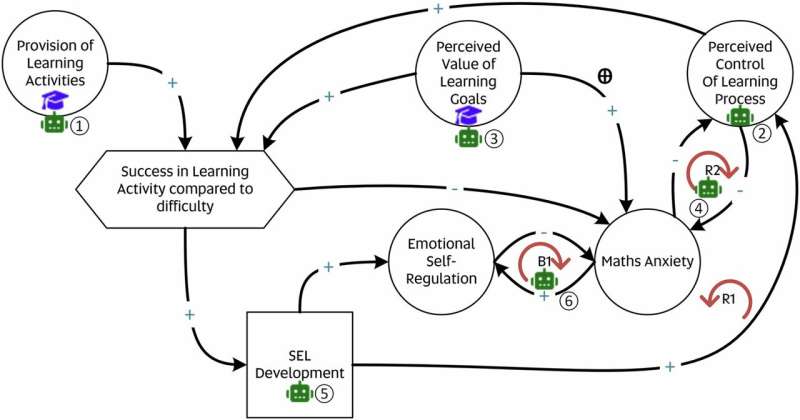
The research proposes a new model of mathematics learning where emotional development is treated as central to the design of AI rather than secondary. Key recommendations suggest AI could support learning by:
- Tailoring learning activities: Adjusting the difficulty of math tasks in real time to balance challenge and success.
- Providing emotionally intelligent feedback: Recognizing patterns of frustration or disengagement and responding in constructive, personalized ways.
- Supporting student autonomy: Enabling goal-setting and personalized learning pathways that give students greater control.
- Helping teachers: Offering real-time insights to support more targeted emotional and instructional interventions for students who need it most.
More than a third of adults and children experience math anxiety. Those with the greatest math anxiety can perform almost four years behind those with the lower levels of math anxiety.
Co-researcher Dr. John Kennedy says there is a need to develop and refine AI models that are better suited to the realities of education.
“Current AI models are trained to provide users with answers they’re happy with, but this can bypass the cognitive processes of learning,” Dr. Kennedy says. “When students rely on tools that simply generate answers, they only learn how to prompt the system rather than how to think through a problem.
“We need to go beyond this basic use of AI and towards tools designed from the ground up for education—tools that understand local contexts, diverse learning goals and the emotional dimensions of learning. This requires a shift in the way researchers work: away from asking what AI can do for educators, and towards asking how educators can shape AI for the benefit of all learners.
“Effective educational AI should not only break problems into simpler steps but also tailor the type of hints it gives and the emotional tone of its responses to support positive attitudes to learning. That might include recognizing delays in responses, deleted text, or patterns of hesitation during problem-solving. But this requires a different approach to training the AI to that commonly used today.
“When AI can adapt to a learner’s emotional state as well as their cognitive needs, it brings us closer to truly supportive and intuitive learning tools.”
The research team has made available an AI Math tutor that provides a working example of what AI can currently do in the classroom using simple prompts.
Publication details
Florence Gabriel et al, Pragmatic AI in education and its role in mathematics learning and teaching, npj Science of Learning (2025). DOI: 10.1038/s41539-025-00315-4
Journal information: npj Science of Learning
Leave a Reply