
January 30, 2026 by JooHyeon Heo, Ulsan National Institute of Science and Technology
Collected at: https://techxplore.com/news/2026-01-unveils-ultra-high-sensitivity-broadband.html
A research team, affiliated with UNIST, has unveiled a flexible photodetector, capable of converting light across a broad spectrum—from visible to near-infrared—into electrical signals. This innovation promises significant advancements in technologies that require simultaneous detection of object colors and internal structures or materials.
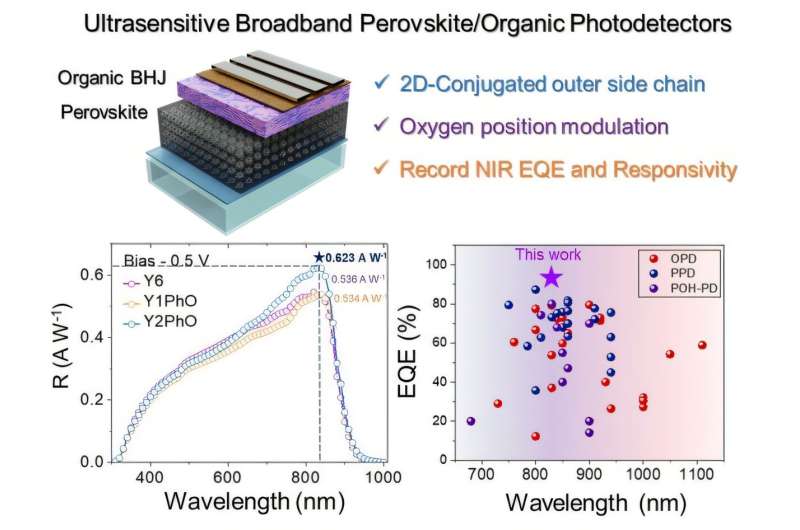
Led by Professor Changduk Yang from the Department of Energy & Chemical Engineering, the research team developed perovskite-organic heterojunction photodetectors (POH-PDs) that combine high sensitivity with exceptional accuracy in the near-infrared (NIR) region. The findings have been published in Advanced Functional Materials.
Photodetectors are essential components in numerous applications, including smartphone displays that automatically adjust brightness and security systems that utilize vein recognition.
The new sensor distinguishes itself by its ability to detect a wider range of wavelengths, from visible light to invisible NIR, thanks to its hybrid structure. This design integrates perovskite materials—renowned for their sensitivity in visible wavelengths—with organic semiconductors optimized for NIR detection.
Heterojunction structures often face challenges such as reduced detection efficiency and accuracy in the NIR range. The UNIST team addressed these issues through precise molecular engineering—specifically by controlling the position of oxygen atoms attached to the organic semiconductor molecules.
This subtle adjustment enhances charge separation efficiency, suppresses excessive molecular aggregation, and ensures a seamless interface between the organic and perovskite layers.
By optimizing interfacial contact, the researchers minimized charge loss during transfer, significantly boosting sensor accuracy and sensitivity.
First author Jeewon Park explained, “This simple and effective molecular design—manipulating only the position of oxygen atoms—demonstrates a practical solution to longstanding challenges in extending detection ranges and improving accuracy in perovskite-organic heterojunction sensors.”
Experimental results showed that sensors incorporating the organic semiconductor Y2PhO achieved an external quantum efficiency (EQE) exceeding 90% at a wavelength of 830 nm. This means that over 90 out of 100 incident photons are successfully converted into electrical signals, setting a new benchmark among solution-processed broadband photodetectors.
The device also exhibits a significantly reduced dark current, enabling the detection of extremely weak signals. Its linear dynamic range (LDR)—a measure of the sensor’s ability to distinguish different light intensities—reached 109.1 dB, allowing precise operation even in environments with a mixture of bright and dim light.
Professor Yang said, “Broadband, flexible sensing technology that covers both visible and near-infrared wavelengths has the potential to serve as a foundational platform for advances in optical communication, imaging, and wearable electronics.”
More information: Jeewon Park et al, Oxygen‐Positional 2D Side‐Chain Engineering of n‐Type Acceptors for Record >90% Near‐Infrared External Quantum Efficiency in Broadband Perovskite–Organic Photodetectors, Advanced Functional Materials (2025). DOI: 10.1002/adfm.202521677
Journal information: Advanced Functional Materials
Leave a Reply