
January 30, 2026 by Newcastle University
Collected at: https://techxplore.com/news/2026-01-hydrogen-powered-ground-vehicles-route.html
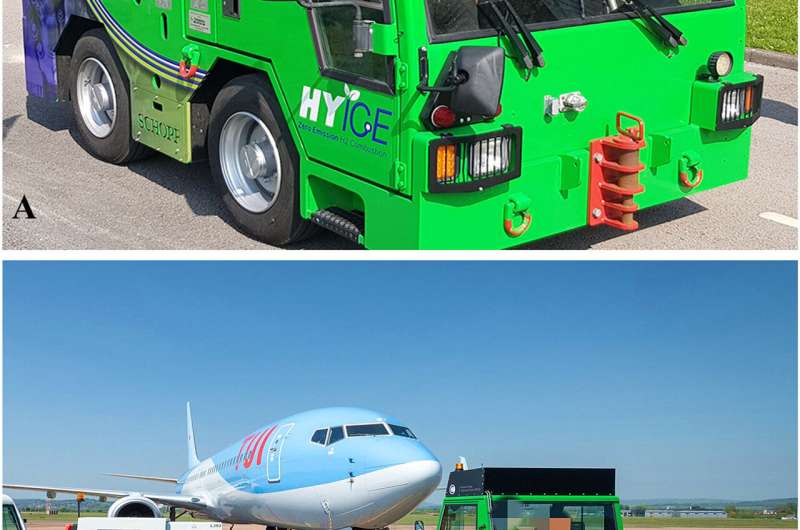
Hydrogen-powered vehicles used on ground operations could help slash carbon emissions and support airports to reach net-zero targets, new research suggests. The Newcastle University research shows that key airport stakeholders have positive attitudes towards hydrogen-powered ground support equipment (GSE). This highlights their environmental, operational, and health benefits, including zero direct emissions at the point of use, less smell and reduced noise, making them a promising option for supporting airport decarbonization.
Published in the Journal of the Air Transport Research Society, the study gathered views from airport operators, car manufacturers, hydrogen suppliers and infrastructure providers. These key airport stakeholders shared their attitudes and operational needs regarding hydrogen-powered GSE.
Overall, airport partners were strongly supportive of hydrogen-powered GSE, seeing it as a clean and practical alternative to diesel. Key benefits highlighted included zero exhaust emissions at the point of use, quieter operation, faster refueling than battery-powered vehicles, and the ability to operate for long periods without recharging.
The research also helped identify barriers to adoption of hydrogen-powered equipment, such as high costs, a lack of refueling infrastructure, uncertainty around safety regulations, and limited public understanding of hydrogen technology.
In addition, stakeholders indicated training as a crucial factor for success. They highlighted the importance of both specialist training for hydrogen-powered vehicles and broader hydrogen safety awareness to build confidence among airport staff and ensure safe operation.
Study author, Dr. Yanghanzi Zhang, Research Associate, Future Mobility Group, Newcastle University School of Engineering, said, “Hydrogen-powered ground support equipment is not just a future concept—stakeholders see it as a realistic option for airport decarbonization, particularly when supported by the targeted financial incentives and transitional technologies such as hydrogen internal combustion engine vehicles.”
Study author, Dr. Shuo Li, Senior Research Associate of Intelligent Transport Systems, Newcastle University School of Engineering, said, “Our research shows that building confidence in hydrogen technology requires more than engineering solutions alone—it also relies on training, clear communication, improved public understanding, and investment in supporting infrastructure.”
Professor Phil Blythe CBE, Professor of Intelligent Transport Systems, Newcastle University, and another of the study authors, added, “I was delighted to lead this research as this is the first time anyone has attempted to quantify the views of a range of partners who would invest in, use and operate such hydrogen-powered vehicles and equipment in an airport setting. I hope it encourages others to consider this option for future decarbonization as the UK has a leading role in some of these technologies.”
Liverpool-based ULEMCo led the engineering project. Amanda Lyne, Managing Director of ULEMCo adds, “This research reinforces what we’ve seen first-hand through projects like ZEHyDA: hydrogen-powered ground vehicles are not a distant aspiration, they are a practical, deployable solution for airports today. By delivering zero exhaust emissions, rapid refueling and the duty cycles airports need, hydrogen can play a critical role in cutting carbon while maintaining operational performance.
“What’s now essential is continued collaboration across industry, regulators and operators to scale infrastructure, build skills and give operators the confidence to adopt these technologies at pace.”
More information: Yanghanzi Zhang et al, Accelerating airport decarbonisation: Qualitative investigation of stakeholders’ perceptions and requirements towards hydrogen-powered ground support equipment, Journal of the Air Transport Research Society (2026). DOI: 10.1016/j.jatrs.2025.100097
Leave a Reply