
January 30, 2026 by Ingrid Fadelli, Phys.org
Collected at: https://techxplore.com/news/2026-01-brain-hardware-spike-coding-ai.html
The use of artificial intelligence (AI) systems, such as the models underpinning the functioning of ChatGPT and various other online platforms, has grown exponentially over the past few years. Current hardware and electronic devices, however, might not be best suited for running these systems, which are computationally intensive and can drain huge amounts of energy.
Electronics engineers worldwide have thus been trying to develop alternative hardware that better reflects how the human brain processes information and could thus run AI systems more reliably, while consuming less power. Many of these brain-inspired hardware systems rely on memristors, electronic components that can both store and process information.
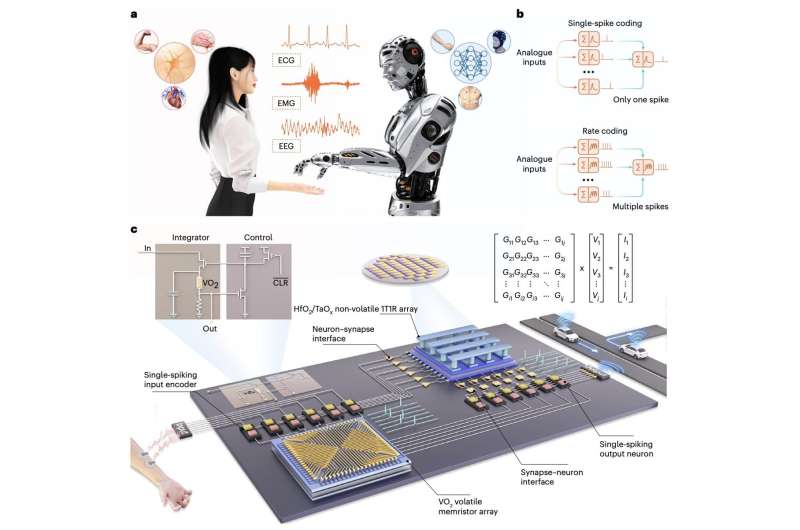
Researchers at Peking University and Southwest University recently introduced a new neuromorphic hardware system that combines different types of memristors. This system, introduced in a paper published in Nature Electronics, could be used to create new innovative brain-machine interfaces and AI-powered wearable devices.
“Memristive hardware can emulate the neuron dynamics of biological systems, but typically uses rate coding, whereas single-spike coding (in which information is expressed by the firing time of a sole spike per neuron and the relative firing times between neurons) is faster and more energy efficient,” wrote Pek Jun Tiw, Rui Yuan and their colleagues in their paper. “We report a robust memristive hardware system that uses single-spike coding.”
Brain-inspired hardware designed especially for AI
The new hardware system consists of several memristors made of vanadium oxide, which essentially serve as electronic “neurons.” These memristors fire single and well-timed electrical signals (i.e., spikes) that resemble those that biological neurons fire to communicate with each other.
The team’s memristor-based neurons are connected by artificial synapses, which are established via a hafnium oxide/tantalanum oxide memristor integrated circuit. The researchers also introduced an approach to limit unwanted changes in electrical conductance over time and avoid energy from going to waste.
“For input encoding and neural processing, we use uniform vanadium oxide memristors to create a single-spiking circuit with under 1% coding variability,” wrote the researchers. “For synaptic computations, we developed a conductance consolidation strategy and mapping scheme to limit conductance drift due to relaxation in a hafnium oxide/tantalum oxide memristor chip, achieving relaxed conductance states with standard deviations within 1.2 μS. We also developed an incremental step and width-pulse programming strategy to prevent resource wastage.”
A shift towards low-power neuromorphic hardware
In initial tests, the team’s neuromorphic hardware was found to perform remarkably well, consuming less energy than previously introduced neuromorphic systems. To further evaluate its potential, the researchers also combined it with a technique called surface electromyography (sEMG) to enable the real-time control of a vehicle via electrical signals originating from a user’s muscles.
“The combined end-to-end hardware single-spike-coded system exhibits an accuracy degradation under 1.5% relative to a software baseline,” wrote the authors. “We show that this approach can be used for real-time vehicle control from surface electromyography. Simulations show that our system consumes around 38 times lower energy with around 6.4 times lower latency than a conventional rate coding system.”
In the future, the hardware system created by this research team could be scaled up, improved further and integrated with other electronic components to create devices for specific AI-enhanced applications. In addition, it could inspire the development of other brain-inspired hardware with similar designs and underlying components.
More information: Pek Jun Tiw et al, An end-to-end memristive hardware system based on single-spike coding for human–machine interfaces, Nature Electronics (2026). DOI: 10.1038/s41928-025-01544-6. www.nature.com/articles/s41928-025-01544-6
Journal information: Nature Electronics
Leave a Reply