
January 29, 2026 by Paul Arnold, Phys.org
Collected at: https://techxplore.com/news/2026-01-flexible-ai-chip-smart-wearables.html
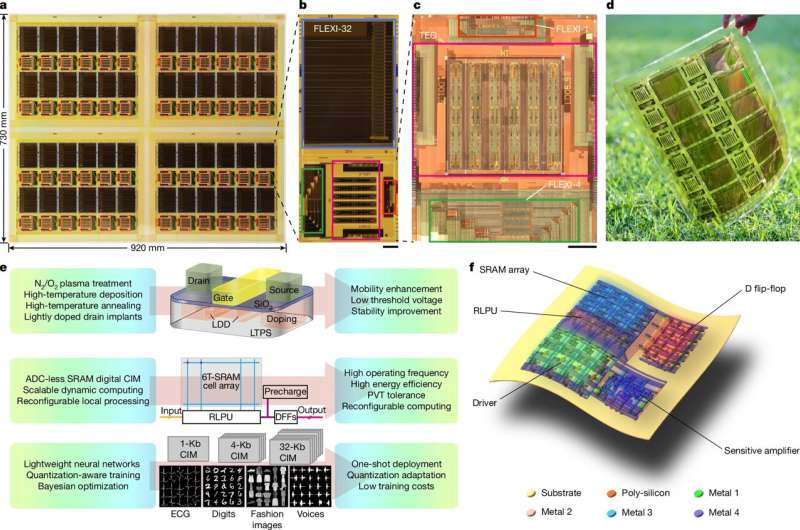
The promise of smart wearables is often talked up, and while there have been some impressive innovations, we are still not seeing their full potential. Among the things holding them back is that the chips that operate them are stiff, brittle, and power-hungry. To overcome these problems, researchers from Tsinghua University and Peking University in China have developed FLEXI, a new family of flexible chips. They are thinner than a human hair, flexible enough to be folded thousands of times, and incorporate AI.
A flexible solution
In a paper published in the journal Nature, the team details the design of their chip and how it can handle complex AI tasks, such as processing data from body sensors to identify health indicators, such as irregular heartbeats, in real time.
This is based on one of FLEXI’s most impressive feats: it can process information directly on the chip rather than sending it to an external computer, unlike most current wearables. AI is hardwired into the chip’s circuitry, meaning that memory components perform calculations on the data stored there. This removes the need for data to travel between different parts of the chip, saving time and power.
The actual chip itself is not a stiff, solid block of silicon but a thin, plastic film. It uses low-temperature polycrystalline silicon (LTPS) circuits built on a flexible plastic base. Because the entire system is printed onto this flexible surface, it can be stretched, twisted, and even crumpled without breaking the tiny AI circuits inside, ideal for use in smart wearables.
To prove its durability, the team put FLEXI through a series of torture tests. It was subjected to over 40,000 bending cycles and folded to a radius of just one millimeter without losing performance.
Real-world results
They also tested FLEXI on real-world health tasks, collecting data from a group of volunteers. It identified irregular heartbeats (arrhythmia) with 99.2% accuracy and tracked daily movements, such as walking and cycling, with 97.4% accuracy. But the impressive results don’t stop there.
During research, the chip consumed less than 1% of the energy of a standard chip. It is also cheap. FLEXI is designed to cost less than $1 each to mass-produce. “FLEXI delivers a cost-effective, high-yield, and robust solution capable of withstanding mechanical stress and ensuring long-term operational stability,” wrote the scientists in their paper.
The team now plans to integrate more sensors into their chip and increase its complexity.
A News and Views article on the research was also published in Nature.
More information: Anzhi Yan et al, A flexible digital compute-in-memory chip for edge intelligence, Nature (2026). DOI: 10.1038/s41586-025-09931-x
Kris Myny et al, A bendable AI chip for wearable technology, Nature (2026). DOI: 10.1038/d41586-026-00037-6
Journal information: Nature
Leave a Reply