
January 29, 2026 by Krystal Kasal, Phys.org
Collected at: https://phys.org/news/2026-01-2d-discrete-crystals-quantum.html
Physical systems become inherently more complicated and difficult to produce in a lab as the number of dimensions they exist in increases—even more so in quantum systems. While discrete time crystals (DTCs) had been previously demonstrated in one dimension, two-dimensional DTCs were known to exist only theoretically. But now, a new study, published in Nature Communications, has demonstrated the existence of a DTC in a two-dimensional system using a 144-qubit quantum processor.
What is a discrete time crystal?
Like regular crystalline materials, DTCs exhibit a kind of periodicity. However, the crystalline materials most people are familiar with have a periodically repeating structure in space, while the particles in DTCs exhibit periodic motion over time. They represent a phase of matter that breaks time-translation symmetry under a periodic driving force and cannot experience an equilibrium state.
“Consequently, local observables exhibit oscillations with a period that is a multiple of the driving frequency, persisting indefinitely in perfectly isolated systems. This subharmonic response represents a spontaneous breaking of discrete time-translation symmetry, analogous to the breaking of continuous spatial symmetry in conventional solid-state crystals,” the authors of the new study explain.
DTCs have been observed in one-dimensional Ising models and in a few experimental setups, although theoretical arguments have questioned the stability of the many-body localization (MBL)—from which DTCs—emerge in two dimensions.
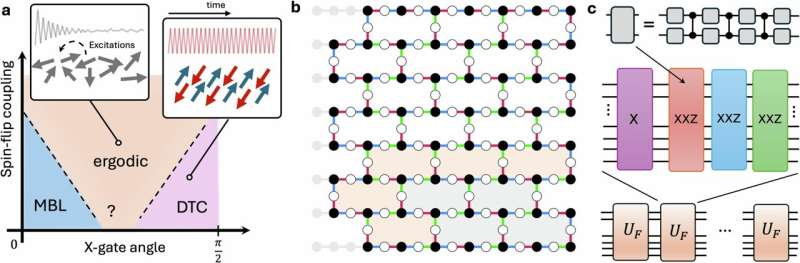
Two-dimensional transitions driven by spin-flip coupling. Credit: Nature Communications (2026). DOI: 10.1038/s41467-025-67787-1
Graduating to two dimensions
In the new study, researchers combined the latest generation of IBM quantum processors with state-of-the-art tensor
network methods, to realize the existence of a DTC in a two-dimensional system. To do this, they used IBM’s 156-qubit Heron r2 quantum processor, focusing on a 144-qubit decorated hexagonal lattice.
The DTC system was governed by anisotropic Heisenberg interactions, in which exchange coupling strengths differ along distinct spatial or spin directions. The work demonstrates that periodic driving in higher dimensions with complex spin interactions can produce stable nonequilibrium phases, stabilizing DTCs in two dimensions, even with weaker localization. The many-body localization mechanisms involved provide sufficient protection against thermalization, which allows for the stable subharmonic response.
The team was also able to construct a phase diagram for the DTC—a diagram that shows which phase the matter that makes up time crystals will exist in under different conditions. For this case, these phases include: spin-glass, ergodic, and the time-crystalline phases.
The study demonstrates the power of current quantum computers to probe new states of matter and presents opportunities for additional discoveries.
The study authors write, “The methods proposed in this work open avenues for exploring large quantum systems and the emergence of exotic phases of matter on current quantum hardware even in the presence of noise.”
Publication details
Eric D. Switzer et al, Realization of two-dimensional discrete time crystals with anisotropic Heisenberg coupling, Nature Communications (2026). DOI: 10.1038/s41467-025-67787-1
Journal information: Nature Communications
Leave a Reply