
By Pranjal Malewar Published: January 27, 2026
Collected at: https://www.techexplorist.com/nasa-finds-new-evidence-dark-matter-steers-cosmos/101904/
For hundreds of years, scientists have looked at the stars without knowing that most of the universe is hidden. The matter that makes up everything we see, like oceans, planets, and galaxies, is only one-sixth of all the matter in the universe. The rest is dark matter, a ghostly presence that neither emits nor absorbs light, yet shapes the grand architecture of the universe.
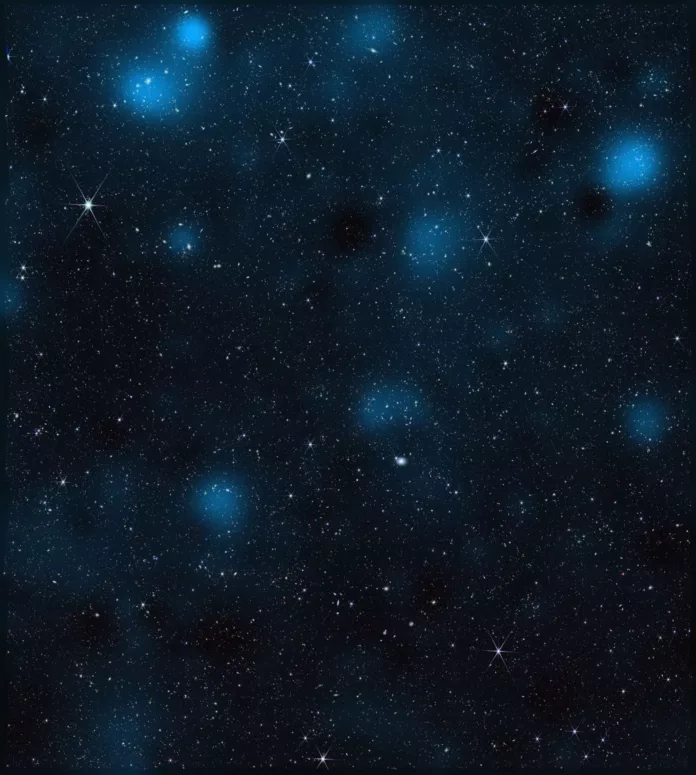
Now, with the James Webb Space Telescope’s extraordinary sensitivity, scientists have unveiled one of the sharpest, most detailed maps of dark matter ever created.
The map not only confirms astronomers’ ideas, but it also shows how dark matter mixes with visible matter, forming the framework that shapes galaxies, stars, and even planets like Earth.
Weak gravitational lensing, the bending of light from distant galaxies by intervening mass, remains one of the most direct ways to probe dark matter. For decades, astronomers relied on Hubble and ground-based observatories to trace these distortions. But Webb’s resolution has transformed the view.
“This is the largest dark matter map we’ve made with Webb, and it’s twice as sharp as any dark matter map made by other observatories,” said Diana Scognamiglio, lead author of the paper and an astrophysicist at NASA’s Jet Propulsion Laboratory in Southern California.
“Previously, we were looking at a blurry picture of dark matter. Now we’re seeing the invisible scaffolding of the universe in stunning detail, thanks to Webb’s incredible resolution.”

The new map focuses on a patch of sky in the constellation Sextans, spanning an area about 2.5 times larger than the full Moon. This region has long been a cosmic laboratory: the Cosmic Evolution Survey (COSMOS) has brought together data from at least 15 telescopes to compare the distribution of visible matter with its unseen counterpart.
The first dark matter map of this area was made in 2007 with Hubble, in a project led by Jason Rhodes of JPL and Richard Massey of Durham University.
Webb stared at this region for 255 hours, identifying nearly 800,000 galaxies, many of which were seen for the first time. By studying how their light was warped, Scognamiglio’s team traced the hidden contours of dark matter. To the human imagination, it’s as if the galaxies’ light passed through a warped windowpane, revealing the invisible hand of gravity.
The Webb map shows many more galaxies, ten times more than ground surveys and twice as many as Hubble. It also finds new dark matter groups and gives a clearer picture of what was seen before. Webb’s Mid-Infrared Instrument (MIRI) helped a lot by spotting galaxies hidden in dust and measuring their distances more exactly..
Richard Massey, a coauthor of the study, emphasized the intimate relationship between the visible and the invisible: “This map shows us that dark matter and regular matter have always been in the same place. They grew up together.”
While Webb offers unmatched resolution, the upcoming Nancy Grace Roman Space Telescope will expand the scale of dark matter mapping dramatically, covering an area 4,400 times larger than the COSMOS field.
Roman’s mission will probe dark matter’s fundamental properties and test whether those properties have changed over cosmic history. Yet, Roman’s maps won’t surpass Webb’s sharpness. For that, astronomers look to the future Habitable Worlds Observatory, NASA’s next flagship concept, which promises even more detailed glimpses into the universe’s invisible framework.
Dark matter remains elusive, a silent architect of galaxies and clusters. But with Webb’s lens, scientists are finally sketching its outlines with clarity. The new map is not just a big scientific success. It tells us that the part of the universe we can see is small, and the hidden parts still guide how stars, planets, and maybe even life will grow in the future.
Journal Reference:
- Scognamiglio, D., Leroy, G., Harvey, D. et al. An ultra-high-resolution map of (dark) matter. Nat Astron (2026). DOI: 10.1038/s41550-025-02763-9
Leave a Reply