
January 26, 2026 by Kristin Nölting, University of Rostock
Collected at: https://phys.org/news/2026-01-collaboration-elementary-particles-teamwork-photon.html
Some things are easier to achieve if you’re not alone. As researchers from the University of Rostock, Germany have shown, this very human insight also applies to the most fundamental building blocks of nature.
At its very core, quantum mechanics postulates that everything is made out of elementary particles, which cannot be split up into even smaller units. This made Ph.D. candidate Vera Neef, first author of the recent publication “Pairing particles into holonomies,” wonder: “What can two particles only accomplish if they work as a team? Can they jointly achieve something, that is impossible for one particle alone?”
How photons behave in experiments
In their experimental study, the researchers were particularly interested in photons, the fundamental particles of light. “Photons have this weird property. Two photons can be in the exact same place at the exact same time. Something we really don’t see in a lot of other particles,” Dr. Tom Wolterink explains.
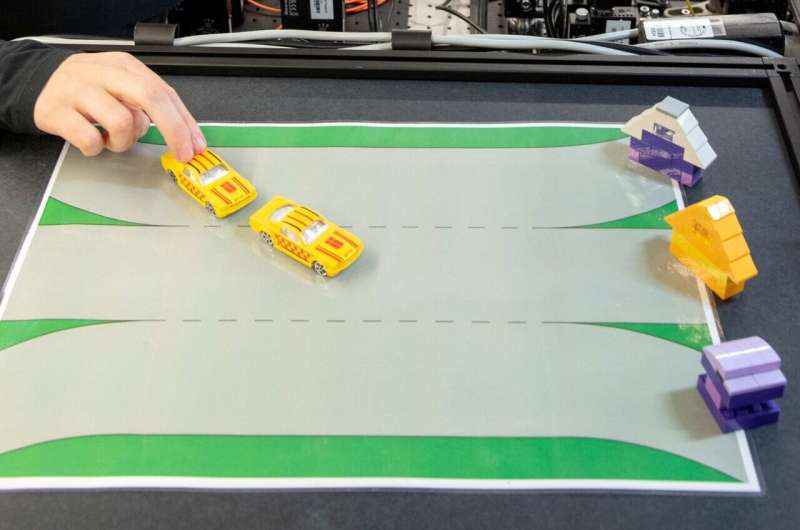
Dr. Matthias Heinrich says, “We use a high-power laser to create so-called waveguides in a glass chip.” These waveguides can be understood as a highway for light. Like a car can easily change lanes on the highway, a photon can jump from one waveguide to the next. Here, the overall shape of the light highway determines the photon’s direction.
Let us imagine a multi-lane highway, where each lane leads to a different destination, and a car that is transporting a very important message. Prof. Alexander Szameit, head of the department of experimental solid-state optics, explains the significance of their work: “To eventually build a quantum computer, we have to be able to control very precisely where the photons go.
Improving reliability with photon pairs
In other words, along which exit the figurative car leaves the highway is of great importance. Yet, even small errors can easily force the car to the wrong lane. Prof. Alexander Szameit goes on: “Photons are quite delicate. Even the best engineering cannot guarantee that a photon never ends up in the wrong waveguide.”
“Our solution is to encode the data not in a single photon, but in a pair of photons—essentially spreading the message across two cars,” Neef explains excitedly.
While individually, both cars still have a chance of ending up in the wrong lane, if only one car arrives at a certain destination, the message is recognizable as corrupted and can be swiftly discarded. This strategy works so well because the chance of both cars accidentally ending up in the same wrong lane is small.
Neef comments, “Knowing this, we were still really surprised at how stable our device turned out to be. Even changing its properties by 10% barely made a dent in our measurement results.”
Broader implications for quantum research
Recently published in Science Advances, this research extends the mathematical concept of holonomies from single particles to pairs and even larger groups of particles. Beyond laying the groundwork for future quantum computers, this research might also inspire a deeper understanding of the fundamental particles that make up atoms.
Some things really are easier to achieve when working together—even as a team of photons.
Publication details
Vera Neef et al, Pairing particles into holonomies, Science Advances (2026). DOI: 10.1126/sciadv.ady3856
Journal information: Science Advances
Leave a Reply