
January 26, 2026 by Paul Arnold, Phys.org
Collected at: https://techxplore.com/news/2026-01-sushi-flexible-fiber-chip-thin.html
Scientists led by a team from Fudan University in Shanghai have created a new flexible fiber chip as thin as a human hair. The development could usher in a new generation of even smarter wearables for a range of applications, including health monitoring and interactive clothing.
No matter how sophisticated the current generation of electronic wearable clothing may be, they still have limited functions and can’t perform complex tasks on their own. That’s because they lack information-processing circuits within the fibers, which would allow them to handle data and make decisions without being plugged into external chips.
Sushi inspiration
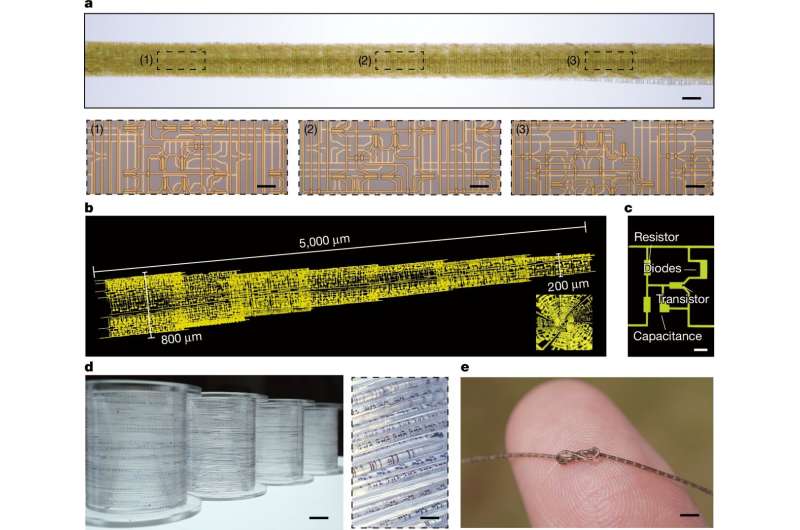
Traditional chips tend to be rigid and brittle, making them difficult to bend or fold and impractical for wearables. To create their new chips, the team took their inspiration from how sushi rolls are made, as they detail in a paper published in the journal Nature.
Instead of building the electronics on the sheet, as on traditional chips, the team placed the circuits on a very thin, elastic sheet. During this process, they also added a protective polymer layer to make the chip more resilient.
Following this, the researchers rolled the sheet into a tight, multilayered spiral like a sushi roll. This allowed them to pack 100,000 transistors per centimeter into a tiny space without the circuits snapping or losing their connection. The fiber chip was then sealed to keep the electronics inside.
In tests, the fiber proved to be incredibly durable. It kept working perfectly even after being run over by a 15.6-ton container truck. It also survived 100,000 bends, being stretched by over 30% and 100,000 rounds of rubbing. The fiber is also powerful, and scales to length.
According to the team, while a short segment can run basic sensors, a one-meter strand contains enough transistors to match the power of a standard computer chip.
A wearable future
Because these fibers are closed loops, containing power, sensors, and processors in one string, they can function as independent intelligent systems without any external hardware.
“Our fiber integrated circuits bridge the gap between flexible wearables and true intelligent systems, enabling new ways for people to interact with electronics,” wrote Huisheng Peng, co-author of the paper.
Possible applications using this new fiber technology include wearables for health monitoring and interactive clothing that can track body movements or display digital information. They could even be used for remote surgery with doctors wearing gloves containing these fibers to provide haptic feedback. This would allow them to “feel” the texture and resistance of tissues and organs as if they were physically present.
More information: Zhen Wang et al, Fibre integrated circuits by a multilayered spiral architecture, Nature (2026). DOI: 10.1038/s41586-025-09974-0
Journal information: Nature
Leave a Reply