
By Osaka Metropolitan University January 20, 2026
Collected at: https://scitechdaily.com/scientists-found-a-hidden-switch-inside-quantum-matter/
Quantum materials can behave in surprising ways when many tiny spins act together, producing effects that don’t exist in single particles.
In condensed matter physics, some of the most surprising behavior appears only when many quantum particles interact as a group. Individual quantum spins can behave predictably on their own, but when they influence one another, entirely new effects emerge. Explaining how these spins interact collectively is a core goal of modern physics because it helps scientists understand the deeper rules governing quantum matter.
One of the most influential collective effects is the Kondo effect, which describes how localized spins interact with mobile electrons. This interaction plays a key role in shaping the behavior of many quantum materials.
Why the Kondo Effect Is Hard to Isolate
Studying the Kondo effect in real materials is challenging because electrons do more than just carry spin. They also move through the material and occupy different orbitals, bringing additional charge and motion into the system. When all of these factors overlap, it becomes difficult to pinpoint which effects come specifically from spin interactions and which come from everything else.
To overcome this complexity, physicists have long relied on simplified theoretical models. One of the most important is the Kondo necklace model, introduced in 1977 by Sebastian Doniach. This model strips away electron motion and orbital effects, focusing only on interacting spins. For decades, it has served as a powerful idea for exploring new quantum states, even though no one had managed to fully realize it in an experiment.
A Longstanding Question About Spin Size
A major unresolved issue has been whether the Kondo effect behaves differently depending on the size of the localized spin. If true, this would have broad implications for the study of quantum materials and how their properties can be controlled.
That question has now been addressed by a research team led by Associate Professor Hironori Yamaguchi of the Graduate School of Science at Osaka Metropolitan University. The researchers created a new version of the Kondo necklace using a carefully engineered organic inorganic hybrid material made from organic radicals and nickel ions. Their success relied on RaX-D, a molecular design framework that allows precise control over crystal structure and magnetic interactions.
From Nonmagnetic to Magnetic Order
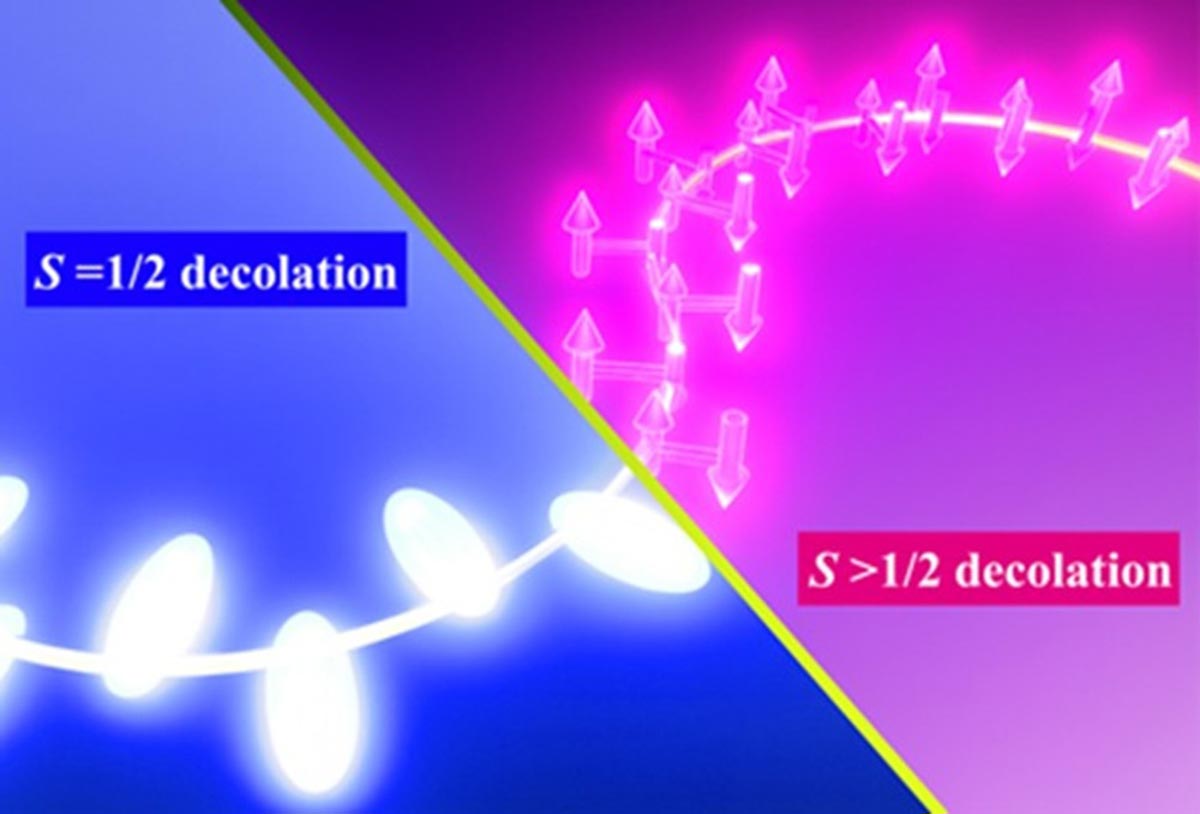
The team had previously realized a spin-1/2 Kondo necklace. In their latest work, they extended this approach to a system where the localized spin (decollated spin) increases from 1/2 to 1. Measurements of thermodynamic properties showed a clear phase transition, revealing the emergence of an ordered magnetic state.
Further quantum analysis explained why this happens. The Kondo coupling creates an effective magnetic interaction between spin-1 moments, which stabilizes long range magnetic order across the system.
Rethinking a Core Assumption in Physics
For many years, the Kondo effect was thought to mainly suppress magnetism by pairing spins into singlets, a maximally entangled state with zero total spin. The new results challenge that idea. When the localized spin exceeds 1/2, the same Kondo interaction no longer weakens magnetism. Instead, it actively supports magnetic order.
By directly comparing spin-1/2 and spin-1 systems within a clean, spin-only platform, the researchers uncovered a clear quantum boundary. In spin-1/2 systems, the Kondo effect always produces local singlets. In spin-1 and higher systems, it promotes stable magnetic order.
This marks the first direct experimental proof that the fundamental role of the Kondo effect depends on spin size.
Implications for Quantum Materials and Technology
“The discovery of a quantum principle dependent on spin size in the Kondo effect opens up a whole new area of research in quantum materials,” Yamaguchi said. “The ability to switch quantum states between nonmagnetic and magnetic regimes by controlling the spin size represents a powerful design strategy for next-generation quantum materials.”
Showing that the Kondo effect can operate in opposite ways depending on spin size offers a new lens for understanding quantum matter. It also provides a foundation for designing spin-based quantum devices.
Being able to control whether a Kondo lattice becomes magnetic or non-magnetic is especially important for future quantum technologies. It could allow scientists to tune properties such as entanglement, magnetic noise, and quantum critical behavior. The researchers believe their findings will guide the creation of new quantum materials and may eventually contribute to advances in quantum information devices and quantum computing.
Reference: “Emergence of Kondo-assisted Néel order in a Kondo necklace model” by Hironori Yamaguchi, Shunsuke C. Furuya, Yu Tominaga, Takanori Kida, Koji Araki and Masayuki Hagiwara, 19 January 2026, Communications Materials.
DOI: 10.1038/s43246-025-01027-3
Leave a Reply