
January 20, 2026 by Jeff Shepard
Collected at: https://www.eeworldonline.com/what-are-the-applications-of-physical-artificial-intelligence/
Physical artificial intelligence (PAI) enables machines to perceive, reason, and act within the real world, bridging the gap between digital AI (DAI), sometimes called virtual AI, and physical action. PAI often leverages spatial artificial intelligence (SAI) technology. PAI applications span numerous industries, from basic automation to autonomous vehicles and complex surgical procedures.
PAI applications represent an advancement beyond DAI. DAI operates purely in software, analyzing data for use in chatbots, recommendation engines, and similar language-based applications.
Instead of simply talking about a situation like DAI, PAI uses the information to act and implement solutions using motors, actuators, and real-time feedback from sensors (Figure 1).

PAI can be especially useful in applications that are themselves in motion, like autonomous vehicles. In the case of autonomous construction equipment and agricultural vehicles, PAI can analyze the terrain and soil conditions to ensure optimal results from grading operations, planting crops, and so on.
In autonomous vehicles like cars, trucks, and robots, PAI can support navigation in dynamic environments, detect and avoid obstacles like traffic jams, and identify the most efficient travel routes. Autonomous drones supported by PAI can more effectively perform inspections of critical infrastructure like pipelines, power lines, and bridges.
Surgical robots can use PAI to perform operations with microscopic accuracy. They can assist surgeons by eliminating hand tremors, providing enhanced visualization, and monitoring complex data regarding vital signs and making nearly instantaneous adjustments to procedures.
PAI and spatial intelligence
Some PAI applications rely heavily on SAI. SAI extends conventional image recognition by tracking movement and understanding spatial relationships between objects in three dimensions. Understanding where specific things are and their relative motions is critical in many PAI applications.
SAI provides the contextual awareness needed for effective implementation of PAI, especially in dynamic and complex environments. Edge computing is often a key element of both SAI and PAI since it supports the ability to make quick decisions that can be important in applications like autonomous vehicles and complex medical and surgical procedures.
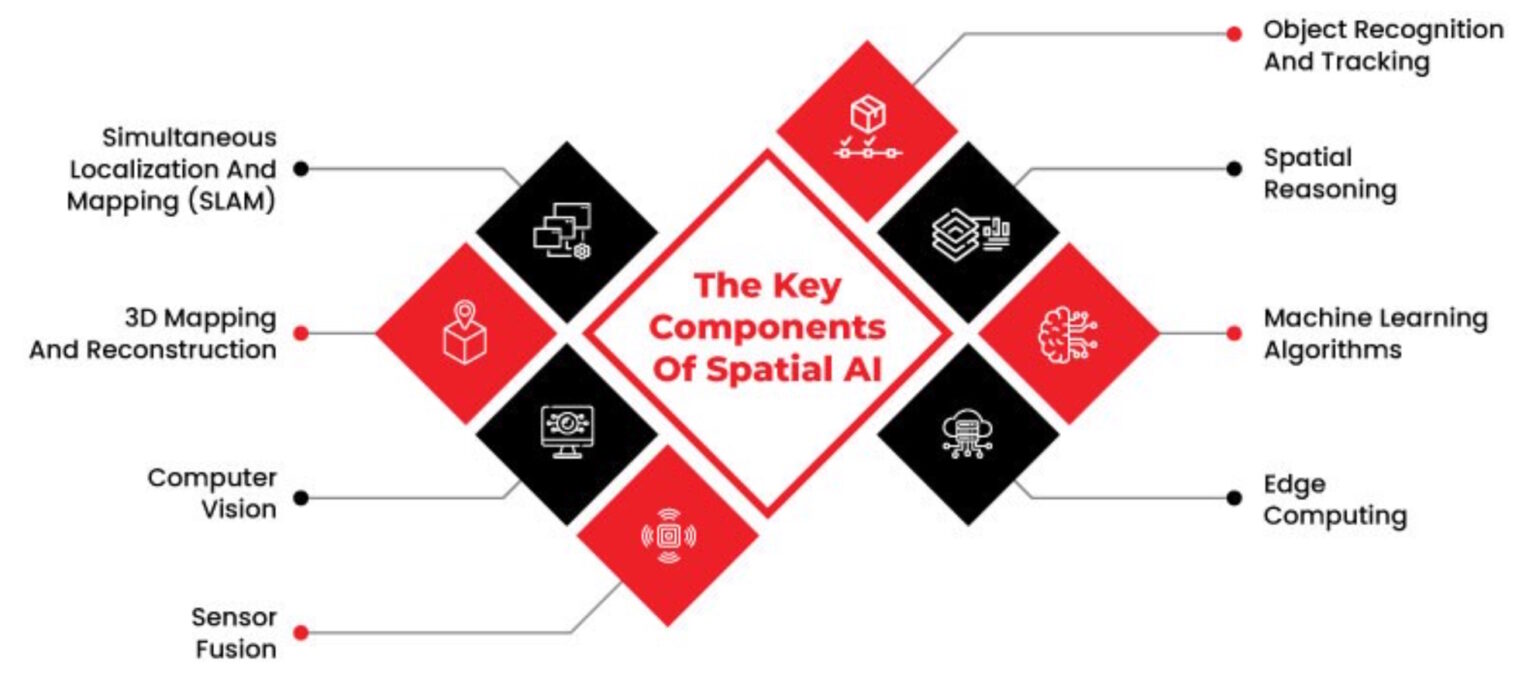
In addition to edge computing, there are several technologies that are often needed for effective SAI (Figure 2):
- Machine learning (ML) algorithms form the basis of SAI and enable it to identify objects, predict object behavior, and improve overall performance over time.
- Computer vision using ML and enabling object recognition is the first step in implementing high-performance SAI.
- In addition to object recognition, computer vision is used for tracking the motion of objects.
- A single sensor, like a camera, is limited in its utility for object recognition and tracking. That’s where sensor fusion comes in and combines data from multiple sources like LiDAR, radar, cameras, inertial sensors, and so on, to build a more accurate picture of objects in the environment.
- Sensor fusion is also a key enabler for 3D mapping and environment reconstruction that can enable PAI to understand complex relationships like nearby hills that need to be traversed by autonomous vehicles.
- Those object and environmental recognition tools are only of limited use in isolation; their utility is in the support for simultaneous localization and mapping (SLAM). SLAM is the key technology, supported by edge computing, that enables real-time PAI applications.

Using SAI to extend PAI
SAI can extend the reach of PAI in areas like healthcare, smart cities, and environmental monitoring. In some cases, it’s being used to extend the definition of PAI beyond controlling movement to modifying spaces to control human interactions. Some examples include:
- SAI can use computer vision and other sensors to analyze movement patterns of elderly patients in real-time, predicting fall risks by detecting subtle gait changes or unusual activities, enabling proactive alerts to caregivers.
- Airports and other transportation hubs can use SAI for predictive queuing to minimize wait time at security checkpoints. PAI combined with SAI can also support dynamic signage, intrusion detection, and abandoned object detection.
- In retail spaces, SAI can be used for improved product placement and better shelf usage that can support dynamic pricing using PAI, boosting both customer satisfaction and retailer returns.
- In smart cities, SAI can help optimize traffic flows, reduce congestion, minimize the overall energy consumption of transportation systems, and optimize emergency response times.
- SAI can also incorporate satellite imagery for wider ranging environmental monitoring of events beyond the immediate vicinity, enabling improved environmental management approaches and better responses to natural disasters.
Summary
PAI represents the latest advancement in artificial intelligence. It enables machines to use AI to act in the real world in applications from autonomous vehicles to surgical robots. SAI can be used to enhance the situational awareness of PAI applications. The combination of PAI and SAI is being used in areas like healthcare, smart cities, and environmental monitoring.
References
3 Real-World Use Cases of Spatial AI You Need to Know, Leaniar
AI goes physical: Navigating the convergence of AI and robotics, Deloitte
All About Spatial Intelligence In AI And Robotics, Techdogs
Exploring Physical AI: Innovations, Applications, and Future Prospects, Rinf Tech
Physical AI: Bridging the Gap Between AI and the Real World, Techvify
Physical AI: The Intelligence Behind Smarter Spaces, kloudspot
Physical AI: The Next Frontier of Industrial Digitalization, International Research Journal of Engineering and Technology
Spatial AI: The Invisible Intelligence Revolutionizing Our World, Kloudspot
Spatial Artificial Intelligence: The Future of Proactive Fall Prevention, Virtusense
The Role of Smart Linear Motors in Intelligent Machines, Iris
Top 10 Physical AI Use Cases, Key Examples & Benefits, Appinventiv
Understanding Physical AI: The Next Wave of AI, SSON
What is Physical AI, HPE
Leave a Reply