

January 23, 2026 by Ingrid Fadelli, Phys.org
Collected at: https://phys.org/news/2026-01-particle-permutation-task-tackled-quantum.html
Quantum computers, systems that process information leveraging quantum mechanical effects, are expected to outperform classical computers on some complex tasks. Over the past few decades, many physicists and quantum engineers have tried to demonstrate the advantages of quantum systems over their classical counterparts on specific types of computations.
Researchers at Autonomous University of Barcelona and Hunter College of CUNY recently showed that quantum systems could tackle a problem that cannot be solved by classical systems, namely determining the even or odd nature of particle permutations without marking all and each one of the particles with a distinct label. This task essentially entails uncovering whether re-arranging particles from their original order to a new order requires an even or odd number of swaps in the position of particle pairs.
These researchers have been conducting research focusing on problems that entail the discrimination between quantum states for several years. Their recent paper, published in Physical Review Letters, demonstrates that quantum technologies could solve one of these problems in ways that are unfeasible for classical systems.
“The basic scenario for these problems is that you are given a system that has the possibility to be in one of several different quantum states, and you want to design a measurement to tell you what state it is actually in,” Mark Hillery, co-senior author of the paper, told Phys.org.
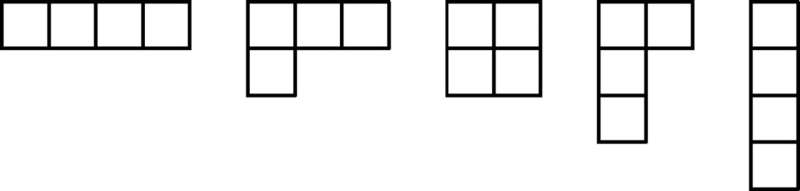
The YDs corresponding to the five partitions of 4. Credit: Physical Review Letters (2025). DOI: 10.1103/yhyv-xnwq
“In the current case, this idea is taken further. You start with a system of particles in an initial quantum state, and you permute them which changes their state. There can be as many possible final states as there are permutations. Then you want to measure the final state to determine whether the permutation is even or odd (even or odd on number of interchanges).”
Unveiling if the permutation of particles is even or odd
Rather than determining what permutation occurred (i.e., the new arrangement or final state of particles), the researchers were interested in uncovering a specific property of the final state. To explain the nature of this task, Hillery uses the analogy of a game in which two players re-arrange a set number of balls.
“Let’s explain this with an example involving the usual players, Alice and Bob,” said Hillery. “Alice has 4 balls, arranged in some order. She turns her back, and Bob rearranges them. Alice now turns around and tries to determine whether the rearrangement (permutation) was even or odd (i.e., if it can be accomplished by making an even or an odd number of swaps in the positions of two balls).
“To uncover this classically, the balls must be labeled, say, with different colors, and each ball must have a unique color. If two or more of them have the same color, Alice just cannot tell whether the permutation was even or odd. In our example, then, you need 4 different colors.”
If the particles in a system are qubits (i.e., two-dimensional quantum units of information), they cannot be labeled to be entirely distinguishable from one another in 4 different ways. This is because a qubit cannot contain that much information.
“You can only fit two perfectly distinguishable labels into a qubit, which, classically would translate into only being able to use two colors,” explained Hillery. “Nonetheless, if Alice starts the qubits in an entangled state, and Bob permutes them, Alice can make a measurement to determine whether the permutation was even or odd. Putting it briefly, entanglement can substitute for labels.”
To explore the possibility of detecting the parity of qubit permutations leveraging entanglement, the researchers relied on a construct rooted in group theory. Group theory is a mathematical framework that focuses on symmetries and structured action sequences (e.g., rotations, swaps, etc.) that follow a clear set of rules.
“The main tool used in our investigation was the representation theory of the permutation group (the symmetric group) acting on the Hilbert space of states of the particles (the balls in the example). Representation theory provides an ideal way of studying the role of symmetry in quantum mechanics,” said Emili Bagan, co-senior author of the paper.
A new quantum advantage demonstration
The team’s analyses demonstrate that quantum mechanical effects could be leveraged to determine the parity of particle permutations without the need to use as many distinguishable labels as particles, a task that cannot be tackled by classical means. This is a further demonstration of how quantum systems could exhibit an advantage over classical ones.
Identifying tasks on which quantum computers could outperform classical ones could have important implications for the future development of task-specific algorithms and for the optimization of quantum systems. Bagan, Hillery and their colleagues are now trying to identify other problems that could be tackled more effectively leveraging quantum mechanical effects.
“The most striking aspect of the result is its simplicity,” added Bagan. “By merely permuting particles—without applying any additional transformations—and by asking a very basic question (whether the number of swaps is even or odd), one can already demonstrate a clear quantum advantage.
“We now aim to explore more general scenarios in which quantum advantage may arise, involving different symmetry groups and going beyond purely binary questions. This work is part of our broader research program on the role of symmetry in quantum state discrimination.”
Publication details
A. Diebra et al, Quantum Advantage in Identifying the Parity of Permutations with Certainty, Physical Review Letters (2025). DOI: 10.1103/yhyv-xnwq. On arXiv: DOI: 10.48550/arxiv.2508.04310
Journal information: Physical Review Letters , arXiv
Leave a Reply