
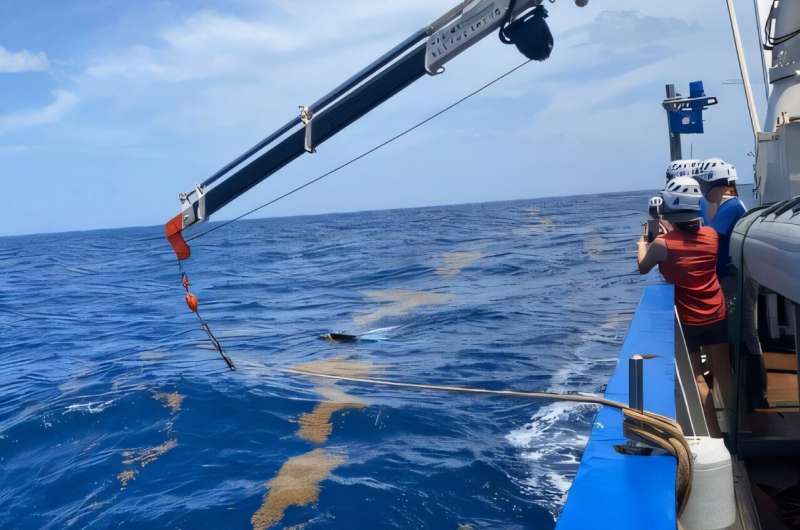
January 19, 2026 by University of South Florida
Collected at: https://phys.org/news/2026-01-ai-reveal-global-surge-algae.html
For the first time and with help from artificial intelligence, researchers have conducted a comprehensive study of global floating algae and found that blooms are expanding across the ocean. These trends are likely the result of changes to ocean temperature, currents and nutrients, according to the authors, and could have a significant impact on marine life, tourism, and coastal economies.
Led by researchers at the University of South Florida and the National Oceanic and Atmospheric Administration, the study demonstrates the power of artificial intelligence as a tool for processing large amounts of ocean data. The findings were published in Nature Communications
“While regional studies have been published, our paper gives the first global picture of floating algae, including macroalgal mats and microalgal scum,” said Chuanmin Hu, professor of oceanography at the USF College of Marine Science and senior author of the paper. “Our results show that the global ocean now favors the growth of floating macroalgae.”
Hu refers to macroalgae such as seaweed as a double-edged sword. In open water, they can provide critical habitat for marine life and have a positive impact on fisheries—serving as nurseries for many species. But once the algae reach coastal waters, the decaying biomass can cause considerable harm to tourism, economies and the health of people and marine life.
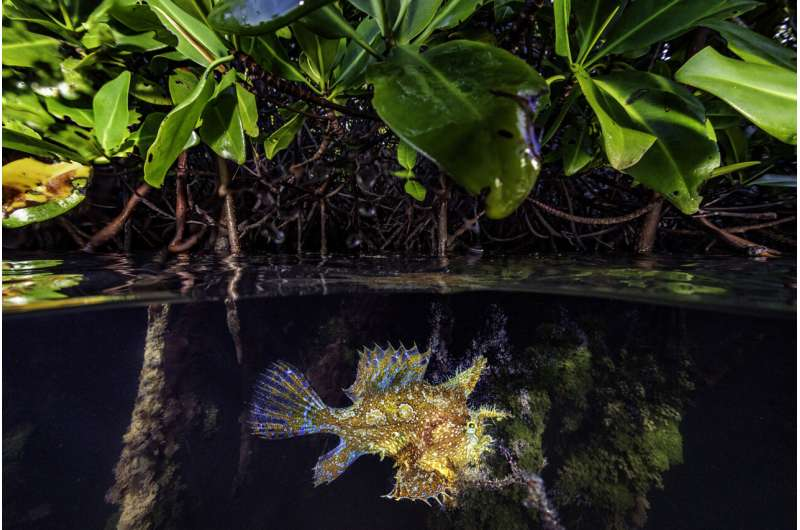
Macroalgal mats can serve as valuable habitat for many marine species, such as this sargassum fish. Credit: Ocean Image Bank, Lorenzo Mittiga
Algae bloom trends and impacts
Between 2003 and 2022, both microalgal scum and macroalgal mats expanded around the globe. Microalgae on the ocean surface saw a modest but significant increase of 1% per year. However, blooms of macroalgae increased by 13.4% per year in the tropical Atlantic and western Pacific, the authors found, with the most dramatic increase in biomass occurring after 2008.
The cumulative size of these microalgal blooms reached 43.8 million square kilometers (16.9 million square miles), breaking with historic trends.
The tipping points for macroalgae blooms occurred around 2010. The first major bloom of the green seaweed known as Ulva happened in the Yellow Sea in 2008. A significant bloom of the brown seaweed sargassum took place in the tropical Atlantic in 2011. Another sargassum bloom occurred in the East China Sea in 2012.
“Before 2008, there were no major blooms of macroalgae reported except for sargassum in the Sargasso Sea,” Hu said. “On a global scale, we appear to be witnessing a regime shift from a macroalgae-poor ocean to a macroalgae-rich ocean.”
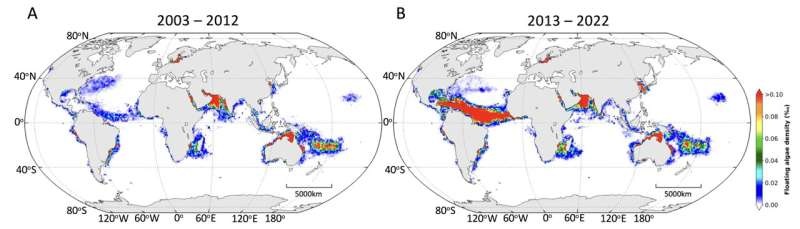
These figures show the change in density of global floating algae in the 20 years between 2003 and 2022. Credit: Qi et al
How artificial intelligence enabled the study
To conduct the study, Hu and his colleagues used artificial intelligence to scan 1.2 million satellite images of the ocean, focusing on 13 zones and five types of algae. They trained a deep-learning model to spot features that signal the presence of algae floating on the ocean surface. In most cases, these features appear across many image pixels, but they typically comprise less than one percent of each pixel.
Lin Qi, an oceanographer at the NOAA Center for Satellite Applications and Research and first author of the study, updated a computer model previously developed by the same research team, allowing them to analyze images from the global ocean for 20 years. It took several months and millions of image features to train Qi’s model.
The authors credit USF’s Research Computing for its critical role in the study. The facility provided access to high-performance infrastructure that processed multiple groups of images simultaneously. Even still, it still took several months to process and analyze the 1.2 million satellite images.
“This work would be impossible without the high-performance computing facility or the long-term collaborations between NOAA and USF,” Qi said.
Causes and future research directions
The study attributed the bloom expansions to both human activities, such as nutrient runoff into the ocean, and climate variability, such as ocean warming, while acknowledging that the reasons may differ among regions. Looking forward, Qi said, “we are going to explore more satellite data and look for a better understanding of the expansions.”
Publication details
Lin Qi et al, Global floating algae blooms are expanding, Nature Communications (2025). DOI: 10.1038/s41467-025-66822-5
Journal information: Nature Communications
Leave a Reply