
January 14, 2026 by David Bidwell, University of British Columbia
Collected at: https://techxplore.com/news/2026-01-roadmap-cleaner-ev-cold-weather.html
Electrifying cars and trucks can cut greenhouse gas emissions, but in cold regions the climate benefits hinge on what powers the grid.
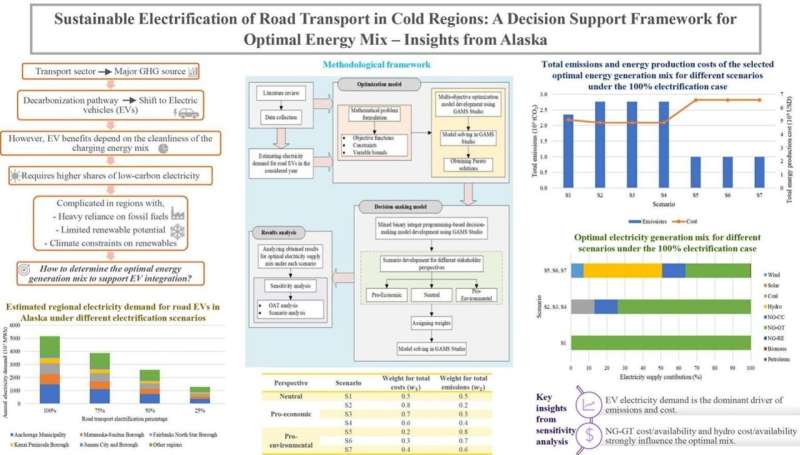
A new study led by UBC Okanagan doctoral student Sandali Walgama proposes a decision-making framework to help policymakers plan the best electricity generation mix for growing electric vehicle charging needs, using Alaska as a real-world test case.
Published in Energy Conversion and Management, the research models how Alaska could meet rising electric vehicle power demand using existing energy sources—including natural gas, coal, hydro, wind and solar—and compares options that prioritize lowest cost, lowest emissions or a balanced approach.
“EVs are often framed as a simple swap from gas to electric,” says Walgama, the study’s corresponding author. “In reality, cold regions face constraints that make planning the power mix just as important as deploying chargers. Our framework is designed to make those trade-offs explicit so decision-makers can be better informed.”
Key findings of the research include:
- The least-cost options leaned heavily on coal and natural gas.
- The lowest-emissions options relied more on hydropower, wind and solar, but were limited by capacity and winter performance constraints
- A balanced strategy reduced emissions by 15% compared with the least-cost option, and cost 22% less than the lowest-emissions scenario.
The framework pairs two tools: one that shows the best cost-emissions trade-offs, and another to help decision-makers pick the option that fits their priorities: cost, emissions or a balance of both.
The study also flags that electric vehicle charging demand and natural gas prices strongly influence what the “best” mix looks like, suggesting planners should stress-test strategies against a range of adoption and fuel-price scenarios.
“This planning tool can help decision-makers extensively prioritize life cycle-based solutions,” says co-author Dr. Kasun Hewage, Professor with UBC Okanagan’s School of Engineering. “It helps jurisdictions identify solutions which are environmentally, socially and economically viable and remain sensible—even as demand forecasts and energy prices shift.”
More information: Sandali Walgama et al, Sustainable electrification of road transport in cold regions: A decision support framework for optimal energy mix – Insights from Alaska, Energy Conversion and Management (2026). DOI: 10.1016/j.enconman.2025.120885
Leave a Reply