
By Lindsey Valich, University of Rochester January 8, 2026
Collected at: https://scitechdaily.com/earth-may-have-seeded-the-moon-with-life-supporting-elements/
Scientists say Earth’s magnetic field may have funneled atmospheric particles to the moon for billions of years. Lunar soil could preserve a record of Earth’s past while providing resources for future explorers.
Scientists have discovered that Earth’s magnetic field has likely played a key role in moving particles from our atmosphere to the moon over billions of years.
The moon may appear lifeless and dusty, but its surface could hold far more than meets the eye. For immense spans of time, tiny fragments of Earth’s atmosphere have likely settled into the moon’s soil. These particles may include substances that could one day help support astronauts on the lunar surface. Until recently, researchers did not fully understand how material from Earth could travel such a great distance or how long this process had been happening.
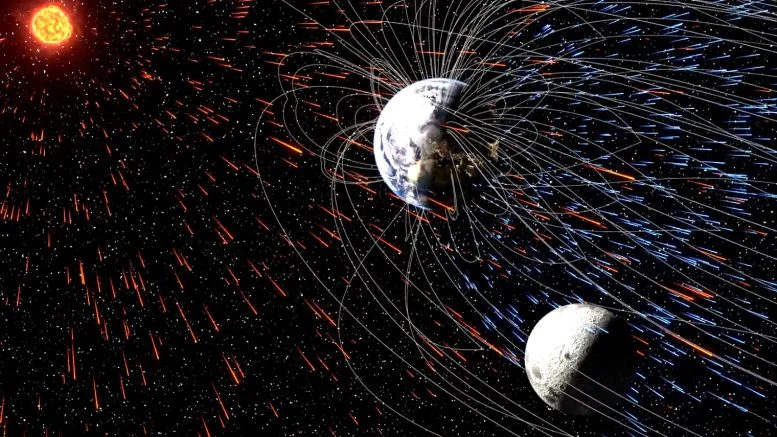
A new study from the University of Rochester, published in Nature Communications Earth and Environment, suggests that Earth’s magnetic field can help atmospheric particles escape into space rather than trapping them. Once lifted by the solar wind, these particles can follow paths shaped by the magnetic field. Because Earth’s magnetic field has existed for billions of years, this slow transfer may have been taking place for much of the moon’s history.
“By combining data from particles preserved in lunar soil with computational modeling of how solar wind interacts with Earth’s atmosphere, we can trace the history of Earth’s atmosphere and its magnetic field,” says Eric Blackman, a professor in the Department of Physics and Astronomy and a distinguished scientist at URochester’s Laboratory for Laser Energetics (LLE).
The research suggests that lunar soil may preserve a long-term chemical record of Earth’s atmosphere. It may also contain materials that could be useful for people who eventually live and work on the moon.
Evidence Hidden in Moon Soil
Samples collected during NASA’s Apollo missions in the 1970s have provided crucial evidence. Analysis of these samples shows that the moon’s surface layer, known as regolith, contains volatile substances such as water, carbon dioxide, helium, argon, and nitrogen. Some of these elements are known to come from the solar wind, the continuous flow of charged particles released by the sun. However, the amounts found in lunar soil, especially nitrogen, are too high to be explained by solar wind alone.
In 2005, a research group from the University of Tokyo proposed that some of these volatiles originated from Earth’s atmosphere. They suggested this transfer could only have occurred before Earth developed a magnetic field, assuming that a magnetic field would prevent atmospheric particles from escaping into space.
The Rochester researchers concluded that this assumption may not be correct.
Simulating Earth to Moon Particle Transfer
To test how atmospheric particles could reach the moon, the research team relied on advanced computer simulations. The group included Shubhonkar Paramanick, a graduate student in the Department of Physics and Astronomy and a Horton Fellow at the LLE; John Tarduno, the William R. Kenan, Jr. Professor in the Department of Earth and Environmental Sciences; and Jonathan Carroll-Nellenback, a computational scientist at the Center for Integrated Research Computing and an assistant professor in the Department of Physics and Astronomy.
The simulations examined two different situations. One represented an early version of Earth with no magnetic field and a stronger solar wind. The other reflected present-day Earth, with a strong magnetic field and a weaker solar wind. The results showed that particle transfer to the moon was far more efficient under modern conditions.
In the modern scenario, the solar wind can dislodge charged particles from Earth’s upper atmosphere. These particles then travel along magnetic field lines, some of which extend far enough into space to intersect the moon’s orbit. Over billions of years, this steady process has allowed small amounts of Earth’s atmosphere to accumulate on the lunar surface.
A Window Into Earth’s History and Future Exploration
Because this exchange has occurred over such long timescales, the moon may preserve a chemical archive of Earth’s atmospheric past. Studying lunar soil could help scientists better understand how Earth’s climate, oceans, and life evolved over deep time.
The ongoing transfer of particles also suggests the moon may contain more useful resources than once believed. Volatile elements such as water and nitrogen could support a long-term human presence, reducing reliance on supplies sent from Earth and making lunar exploration more practical.
“Our study may also have broader implications for understanding early atmospheric escape on planets like Mars, which lacks a global magnetic field today but had one similar to Earth in the past, along with a likely thicker atmosphere,” Paramanick says. “By examining planetary evolution alongside atmospheric escape across different epochs, we can gain insight into how these processes shape planetary habitability.”
Reference: “Terrestrial atmospheric ion implantation occurred in the nearside lunar regolith during the history of Earth’s dynamo” by Shubhonkar Paramanick, Eric G. Blackman, John A. Tarduno and Jonathan Carroll-Nellenback, 11 December 2025, Communications Earth & Environment.
DOI: 10.1038/s43247-025-02960-4
This work was funded in part by NASA and the National Science Foundation.
Leave a Reply