
By Pranjal Malewar Published: January 9, 2026
Collected at: https://www.techexplorist.com/cattlefever-ai-tool-reads-cows-face-fever/101801/
What if ranchers could check a cow’s health simply by looking at its face? That futuristic idea is becoming reality thanks to CattleFever, a new system developed at the University of Arkansas.
Made by the Artificial Intelligence and Computer Vision Lab (AICV), the tool uses AI and thermal cameras to check a cow’s body temperature. It’s an early step toward automatic systems that could change how farmers care for their animals.
The project was led by Trong Thang Pham, a doctoral student at the University of Arkansas, under the guidance of Ngan Le, associate professor of electrical engineering and computer science. Le’s lab specializes in medical imaging, computer vision, and robotics.
Together, they set out to solve a long‑standing problem: today, cattle temperatures are measured rectally, a stressful process for animals and labor‑intensive for ranchers. CattleFever offers a non‑invasive alternative that could improve animal welfare and help detect disease before symptoms spread.
To train the system, the researchers needed data. Existing datasets for animals like dogs, cats, horses, and sheep weren’t enough, and the only cattle dataset, CattleEyeView, contained overhead RGB photos for herd tracking.
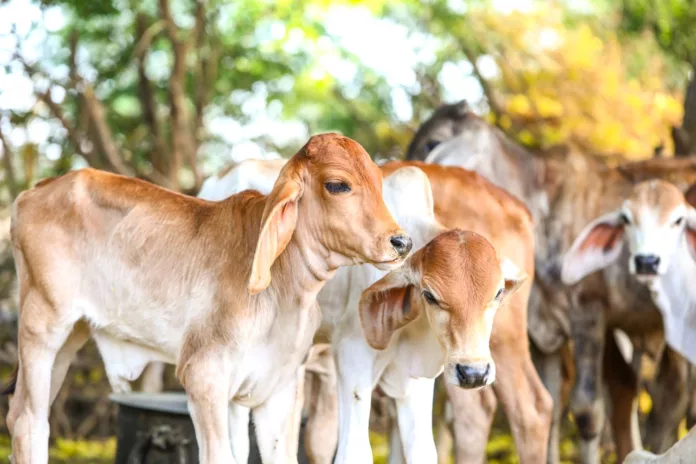
So the team built their own dataset at the Arkansas Agricultural Experiment Station’s Savoy Research Complex. Researchers filmed thousands of calves with short videos and thermal cameras, while also checking their temperatures with rectal thermometers to have accurate reference readings.

The researchers then annotated 13 facial landmarks, eyes, ears, muzzle, and mouth across hundreds of frames. This work produced CattleFace‑RGBT, a dataset that links visible features with thermal data. The landmark‑detection tool can now automatically identify a calf’s face and key features across both RGB and thermal images.
Could AI really estimate a cow’s temperature from its face?
Through ablation studies, the team discovered that readings from the eyes and nostrils most closely matched those from a thermometer. Using these landmarks, the system focused on thermal data from those regions.
The most accurate predictions came from random forest regression, a machine‑learning method that averages results from many decision trees. The outcome: CattleFever could estimate a cow’s temperature within 1 degree of a rectal thermometer reading.
For now, the system works best when cattle face the camera directly. The next challenge is teaching AI to recognize cows in natural settings, grazing, moving, or turning their heads.
“We probably need to take more photos of them in real‑world settings, such as running around, to capture their motion in the field,” Pham explained.
The team has publicly shared the CattleFace‑RGBT dataset, inviting other researchers to build on their work.
“If we find something new, we share that with the world. That’s the spirit,” Pham said.
CattleFever represents a leap toward precision livestock farming, where AI and sensors help ranchers care for animals more efficiently and humanely. By spotting fevers early, ranchers could prevent costly outbreaks and improve herd health, all by reading the subtle heat signatures in a cow’s face.
One day, simply looking at a cow’s face could do more than meet its eyes, it might reveal its health and help farmers keep their herds stronger and farming smarter.
Journal Reference:
- Trong Thang Pham, Ethan Coffman, Beth Kegley, Jeremy G. Powell, Jiangchao Zhao, Ngan Le. CattleFever: An automated cattle fever estimation system. Smart Agricultural Technology. DOI: 10.1016/j.atech.2025.101434
Leave a Reply